

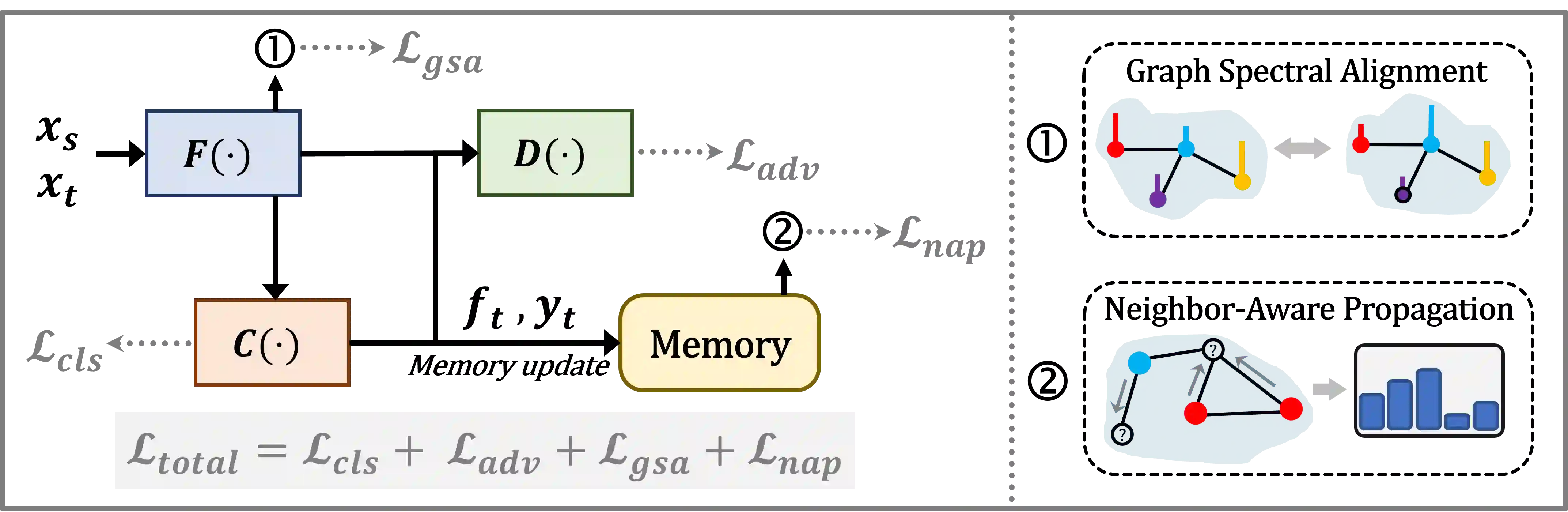
Unsupervised domain adaptation (UDA) is a pivotal form in machine learning to extend the in-domain model to the distinctive target domains where the data distributions differ. Most prior works focus on capturing the inter-domain transferability but largely overlook rich intra-domain structures, which empirically results in even worse discriminability. In this work, we introduce a novel graph SPectral Alignment (SPA) framework to tackle the tradeoff. The core of our method is briefly condensed as follows: (i)-by casting the DA problem to graph primitives, SPA composes a coarse graph alignment mechanism with a novel spectral regularizer towards aligning the domain graphs in eigenspaces; (ii)-we further develop a fine-grained message propagation module -- upon a novel neighbor-aware self-training mechanism -- in order for enhanced discriminability in the target domain. On standardized benchmarks, the extensive experiments of SPA demonstrate that its performance has surpassed the existing cutting-edge DA methods. Coupled with dense model analysis, we conclude that our approach indeed possesses superior efficacy, robustness, discriminability, and transferability. Code and data are available at: https://github.com/CrownX/SPA.
翻译:无监督领域自适应(UDA)是机器学习中将领域内模型扩展至数据分布不同的目标领域的关键形式。现有研究多聚焦于捕获域间可迁移性,却很大程度上忽视了丰富的域内结构,这从经验上导致了判别性能的下降。本文提出了一种新颖的图谱谱对齐(SPA)框架来应对这一权衡问题。该方法的核心理念可简要概括为:(i) 通过将领域自适应问题转化为图基元,SPA设计了一种粗粒度图对齐机制,并引入新颖的谱正则化器以实现特征空间中域图的谱对齐;(ii) 进一步开发了一种细粒度消息传播模块——基于新颖的邻域感知自训练机制——以增强目标域的判别能力。在标准化基准测试中,SPA的广泛实验证明其性能已超越现有前沿领域自适应方法。结合密集的模型分析,我们得出结论:该方法确实具有优越的有效性、鲁棒性、判别性和可迁移性。代码与数据见:https://github.com/CrownX/SPA。




相关内容





 微信扫码咨询专知VIP会员