

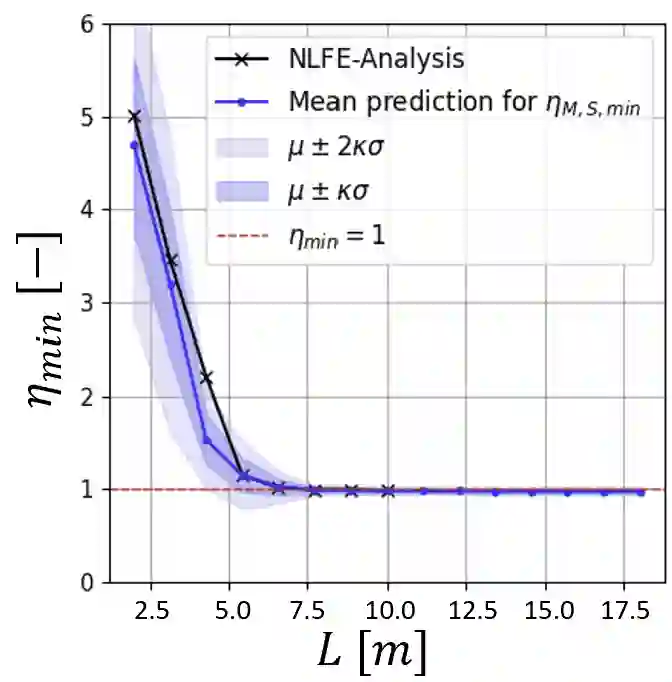
Aging infrastructure portfolios pose a critical resource allocation challenge: deciding which structures require intervention and which can safely remain in service. Structural assessments must balance the trade-off between cheaper, conservative analysis methods and accurate but costly simulations that do not scale portfolio-wide. We propose Bayesian neural network (BNN) surrogates for rapid structural pre-assessment of worldwide common bridge types, such as reinforced concrete frame bridges. Trained on a large-scale database of non-linear finite element analyses generated via a parametric pipeline and developed based on the Swiss Federal Railway's bridge portfolio, the models accurately and efficiently estimate high-fidelity structural analysis results by predicting code compliance factors with calibrated epistemic uncertainty. Our BNN surrogate enables fast, uncertainty-aware triage: flagging likely critical structures and providing guidance where refined analysis is pertinent. We demonstrate the framework's effectiveness in a real-world case study of a railway underpass, showing its potential to significantly reduce costs and emissions by avoiding unnecessary analyses and physical interventions across entire infrastructure portfolios.
翻译:老化基础设施组合提出了一个关键资源分配难题:如何确定哪些结构需要干预,哪些可安全维持运营。结构评估必须在成本较低但保守的分析方法与精确但昂贵且难以在组合层面规模化应用的仿真之间取得平衡。本文提出采用贝叶斯神经网络代理模型对全球常见桥梁类型(如钢筋混凝土框架桥)进行快速结构预评估。该模型基于瑞士联邦铁路桥梁组合开发的参数化流程生成的大规模非线性有限元分析数据库进行训练,能够通过预测规范符合系数并校准认知不确定性,从而准确高效地估计高保真结构分析结果。我们的贝叶斯神经网络代理模型支持快速且考虑不确定性的分级评估:标记潜在关键结构,并为需要精细化分析的场景提供指导。通过铁路下穿通道的实际案例研究,我们验证了该框架的有效性,表明其能够通过避免在整个基础设施组合中进行不必要的分析和物理干预,显著降低成本和碳排放。





相关内容

 微信扫码咨询专知VIP会员