

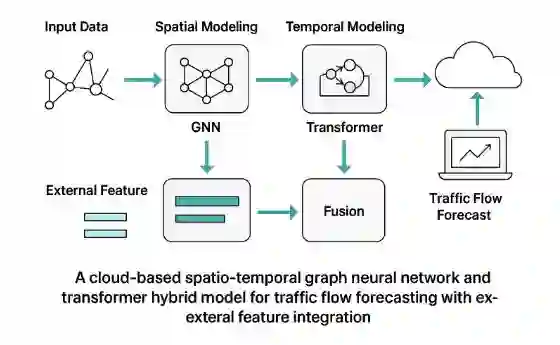
Accurate traffic flow forecasting is essential for the development of intelligent transportation systems (ITS), supporting tasks such as traffic signal optimization, congestion management, and route planning. Traditional models often fail to effectively capture complex spatial-temporal dependencies in large-scale road networks, especially under the influence of external factors such as weather, holidays, and traffic accidents. To address this challenge, this paper proposes a cloud-based hybrid model that integrates Spatio-Temporal Graph Neural Networks (ST-GNN) with a Transformer architecture for traffic flow prediction. The model leverages the strengths of GNNs in modeling spatial correlations across road networks and the Transformers' ability to capture long-term temporal dependencies. External contextual features are incorporated via feature fusion to enhance predictive accuracy. The proposed model is deployed on a cloud computing platform to achieve scalability and real-time adaptability. Experimental evaluation of the dataset shows that our model outperforms baseline methods (LSTM, TCN, GCN, pure Transformer) with an RMSE of only 17.92 and a MAE of only 10.53. These findings suggest that the hybrid GNN-Transformer approach provides an effective and scalable solution for cloud-based ITS applications, offering methodological advancements for traffic flow forecasting and practical implications for congestion mitigation.
翻译:准确的交通流预测对于智能交通系统(ITS)的发展至关重要,可支持交通信号优化、拥堵管理和路径规划等任务。传统模型往往难以有效捕捉大规模路网中复杂的时空依赖关系,尤其是在天气、节假日和交通事故等外部因素的影响下。为应对这一挑战,本文提出一种基于云计算的混合模型,将时空图神经网络(ST-GNN)与Transformer架构相结合,用于交通流预测。该模型利用GNN在建模路网空间相关性方面的优势,以及Transformer捕捉长期时间依赖关系的能力。通过特征融合引入外部上下文特征以提升预测精度。所提出的模型部署于云计算平台,以实现可扩展性和实时适应性。在数据集上的实验评估表明,该模型优于基线方法(LSTM、TCN、GCN、纯Transformer),其均方根误差(RMSE)仅为17.92,平均绝对误差(MAE)仅为10.53。这些结果表明,GNN-Transformer混合方法为基于云计算的ITS应用提供了有效且可扩展的解决方案,为交通流预测提供了方法论进展,并为缓解拥堵提供了实践启示。




相关内容




 微信扫码咨询专知VIP会员