

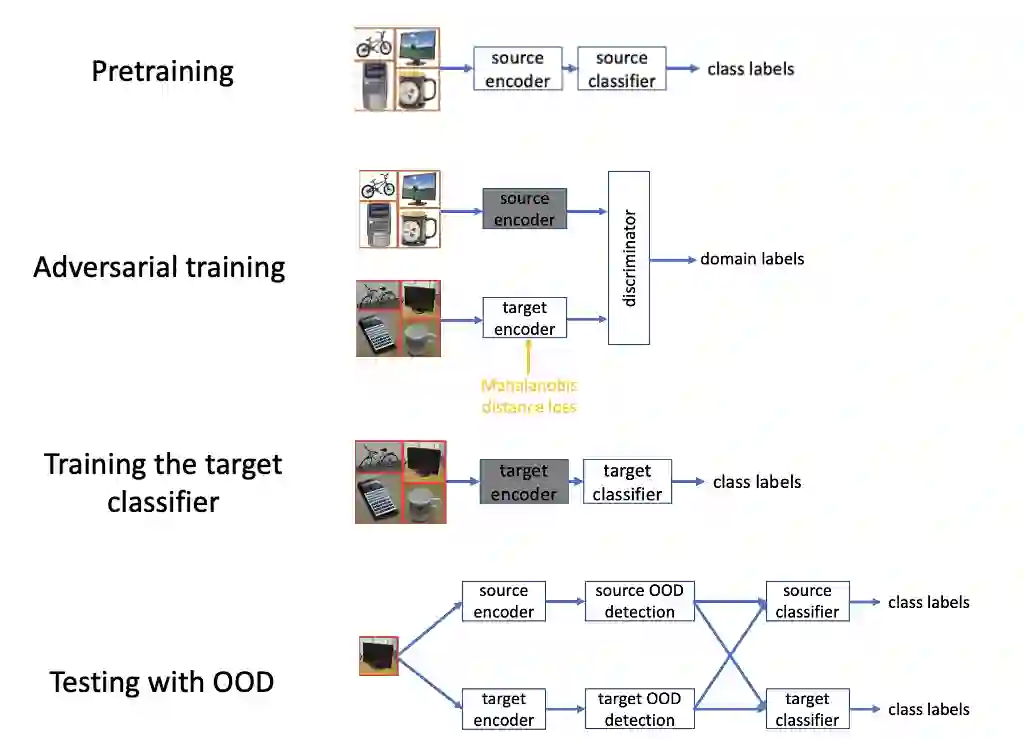
In smart computing, the labels of training samples for a specific task are not always abundant. However, the labels of samples in a relevant but different dataset are available. As a result, researchers have relied on unsupervised domain adaptation to leverage the labels in a dataset (the source domain) to perform better classification in a different, unlabeled dataset (target domain). Existing non-generative adversarial solutions for UDA aim at achieving domain confusion through adversarial training. The ideal scenario is that perfect domain confusion is achieved, but this is not guaranteed to be true. To further enforce domain confusion on top of the adversarial training, we propose a novel UDA algorithm, \textit{E-ADDA}, which uses both a novel variation of the Mahalanobis distance loss and an out-of-distribution detection subroutine. The Mahalanobis distance loss minimizes the distribution-wise distance between the encoded target samples and the distribution of the source domain, thus enforcing additional domain confusion on top of adversarial training. Then, the OOD subroutine further eliminates samples on which the domain confusion is unsuccessful. We have performed extensive and comprehensive evaluations of E-ADDA in the acoustic and computer vision modalities. In the acoustic modality, E-ADDA outperforms several state-of-the-art UDA algorithms by up to 29.8%, measured in the f1 score. In the computer vision modality, the evaluation results suggest that we achieve new state-of-the-art performance on popular UDA benchmarks such as Office-31 and Office-Home, outperforming the second best-performing algorithms by up to 17.9%.
翻译:在智能计算中,特定任务的训练样本标签并不总是充足的。然而,相关但不同数据集中的样本标签却可获取。因此,研究人员依赖无监督域自适应来利用某一数据集(源域)中的标签,对另一个无标签但不同的数据集(目标域)实现更优的分类性能。现有用于无监督域自适应的非生成式对抗方法旨在通过对抗训练实现域混淆。理想情况下应达到完全域混淆,但这无法保证。为进一步强化对抗训练基础上的域混淆,我们提出了一种新型无监督域自适应算法E-ADDA,该算法同时采用新型的马氏距离损失变体和分布外检测子程序。马氏距离损失通过最小化编码后的目标样本分布与源域分布之间的度量距离,在对抗训练之上施加额外的域混淆约束。随后,OOD子程序进一步剔除域混淆失败的样本。我们在声学和计算机视觉模态上对E-ADDA进行了广泛而全面的评估。在声学模态中,E-ADDA的f1分数相比多个最先进的无监督域自适应算法最高提升29.8%。在计算机视觉模态中,评估结果表明我们在Office-31和Office-Home等流行无监督域自适应基准上取得了新的最佳性能,相比排名第二的算法最高提升17.9%。




相关内容


 微信扫码咨询专知VIP会员