

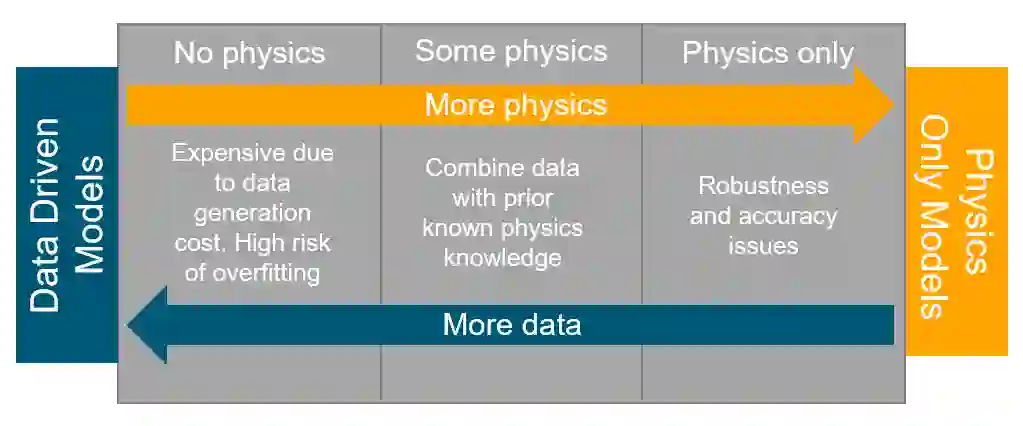
Successfully training Physics Informed Neural Networks (PINNs) for highly nonlinear PDEs on complex 3D domains remains a challenging task. In this paper, PINNs are employed to solve the 3D incompressible Navier-Stokes (NS) equations at moderate to high Reynolds numbers for complex geometries. The presented method utilizes very sparsely distributed solution data in the domain. A detailed investigation on the effect of the amount of supplied data and the PDE-based regularizers is presented. Additionally, a hybrid data-PINNs approach is used to generate a surrogate model of a realistic flow-thermal electronics design problem. This surrogate model provides near real-time sampling and was found to outperform standard data-driven neural networks when tested on unseen query points. The findings of the paper show how PINNs can be effective when used in conjunction with sparse data for solving 3D nonlinear PDEs or for surrogate modeling of design spaces governed by them.
翻译:成功训练物理信息神经网络以求解复杂三维域上的高度非线性偏微分方程仍是一项具有挑战性的任务。本文采用物理信息神经网络求解复杂几何构型中中等至高雷诺数下的三维不可压缩纳维-斯托克斯方程。所提方法利用域内极其稀疏分布的求解数据。本文详细研究了数据量和基于偏微分方程的正则化项的影响。此外,采用数据-物理信息神经网络混合方法为实际流热电子设计问题生成代理模型。该代理模型能够实现近实时采样,并在测试未知查询点时,其性能优于标准数据驱动神经网络。本文研究结果表明,物理信息神经网络与稀疏数据结合使用时,可有效求解三维非线性偏微分方程或对其主导的设计空间进行代理建模。




相关内容





 微信扫码咨询专知VIP会员