

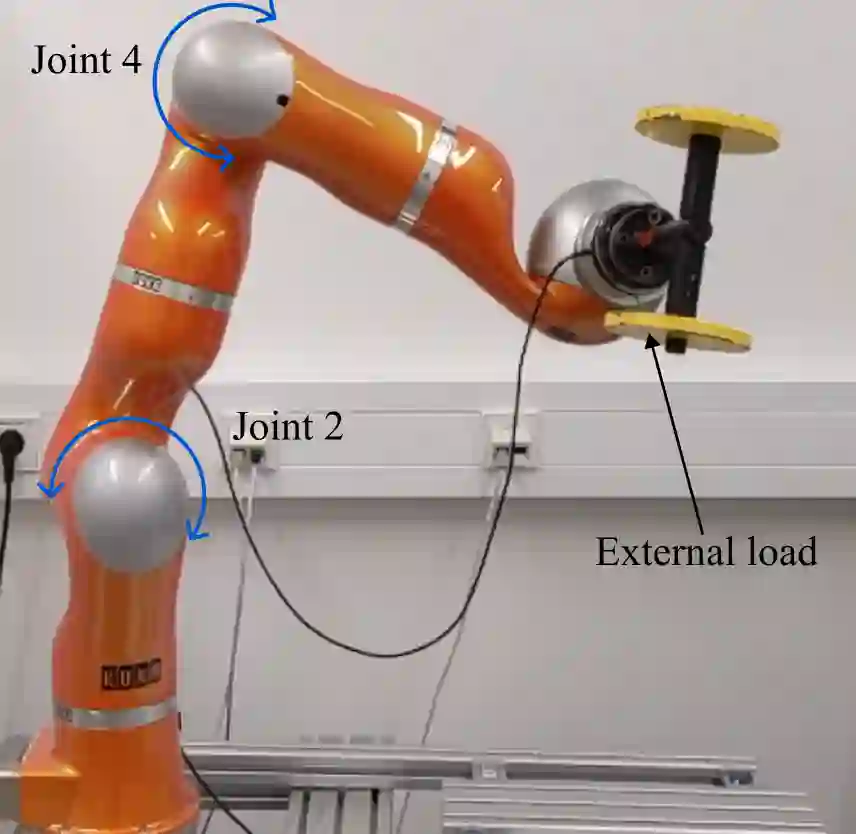
In the Fourth Industrial Revolution, wherein artificial intelligence and the automation of machines occupy a central role, the deployment of robots is indispensable. However, the manufacturing process using robots, especially in collaboration with humans, is highly intricate. In particular, modeling the friction torque in robotic joints is a longstanding problem due to the lack of a good mathematical description. This motivates the usage of data-driven methods in recent works. However, model-based and data-driven models often exhibit limitations in their ability to generalize beyond the specific dynamics they were trained on, as we demonstrate in this paper. To address this challenge, we introduce a novel approach based on residual learning, which aims to adapt an existing friction model to new dynamics using as little data as possible. We validate our approach by training a base neural network on a symmetric friction data set to learn an accurate relation between the velocity and the friction torque. Subsequently, to adapt to more complex asymmetric settings, we train a second network on a small dataset, focusing on predicting the residual of the initial network's output. By combining the output of both networks in a suitable manner, our proposed estimator outperforms the conventional model-based approach and the base neural network significantly. Furthermore, we evaluate our method on trajectories involving external loads and still observe a substantial improvement, approximately 60-70\%, over the conventional approach. Our method does not rely on data with external load during training, eliminating the need for external torque sensors. This demonstrates the generalization capability of our approach, even with a small amount of data-only 43 seconds of a robot movement-enabling adaptation to diverse scenarios based on prior knowledge about friction in different settings.
翻译:在第四次工业革命中,人工智能与机器自动化占据核心地位,机器人的部署不可或缺。然而,使用机器人进行制造的过程(特别是人机协作场景)极为复杂。其中,由于缺乏良好的数学描述,机器人关节摩擦扭矩的建模是一个长期难题。这促使近年来的研究采用数据驱动方法。但正如本文所示,基于模型的方法和数据驱动模型在泛化至训练动力学范围之外的场景时往往存在局限性。为解决这一挑战,我们提出了一种基于残差学习的新方法,旨在利用尽可能少的数据使现有摩擦模型适应新动力学特性。我们通过在一个对称摩擦数据集上训练基础神经网络,学习速度与摩擦扭矩之间的精确关系来验证该方法。随后,为适应更复杂的非对称场景,我们在小规模数据集上训练第二个网络,专注于预测初始网络输出的残差。通过适当组合两个网络的输出,我们提出的估计器性能显著优于传统基于模型的方法和基础神经网络。此外,我们在包含外部载荷的轨迹上评估该方法,仍观察到相较于传统方法约60-70%的显著改进。我们的方法无需在训练中使用外部载荷数据,从而避免了对外部扭矩传感器的需求。这证明了该方法仅需43秒机器人运动数据(少量数据)即可基于不同场景下的摩擦先验知识实现泛化适应能力。




相关内容





 微信扫码咨询专知VIP会员