

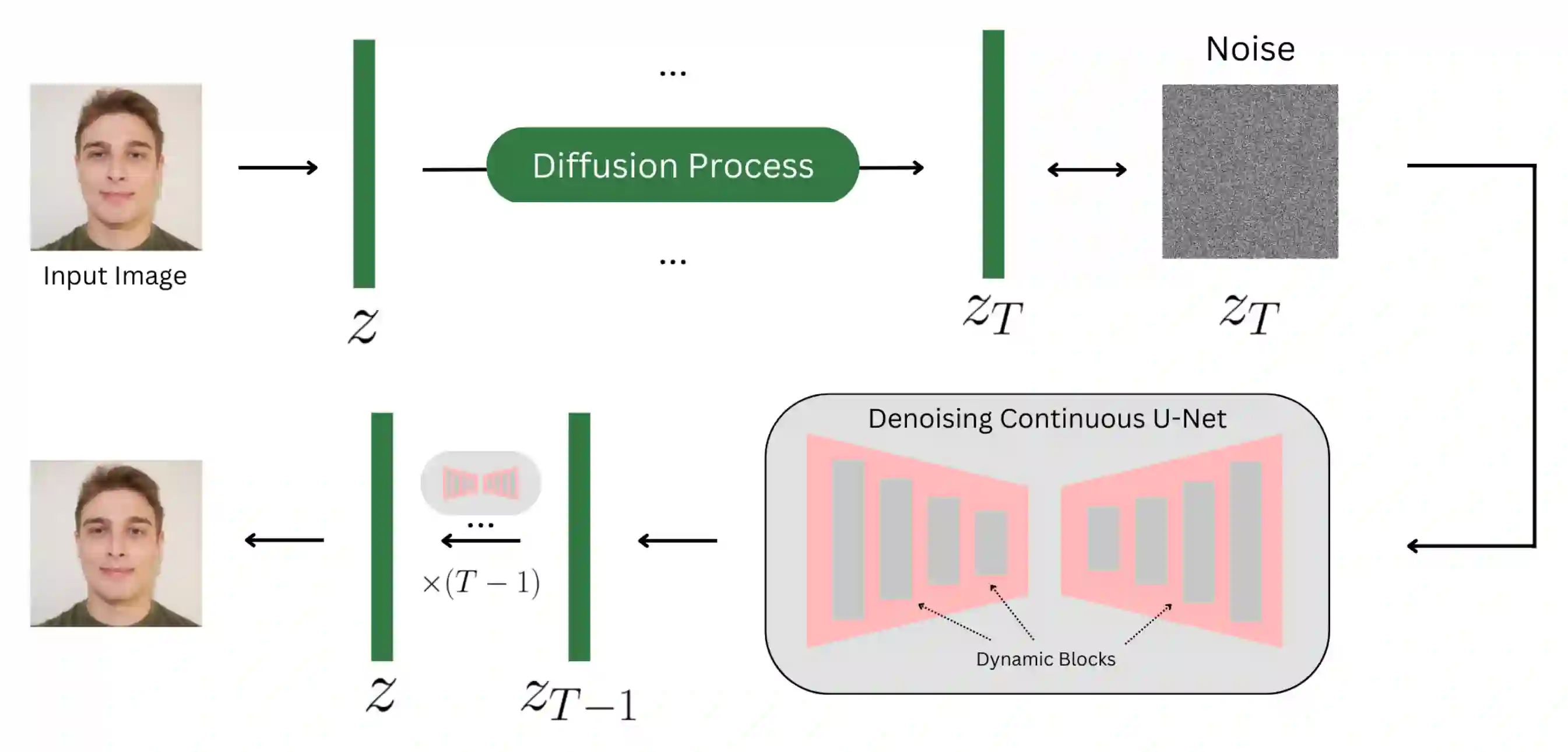
Diffusion Probabilistic Models stand as a critical tool in generative modelling, enabling the generation of complex data distributions. This family of generative models yields record-breaking performance in tasks such as image synthesis, video generation, and molecule design. Despite their capabilities, their efficiency, especially in the reverse process, remains a challenge due to slow convergence rates and high computational costs. In this paper, we introduce an approach that leverages continuous dynamical systems to design a novel denoising network for diffusion models that is more parameter-efficient, exhibits faster convergence, and demonstrates increased noise robustness. Experimenting with Denoising Diffusion Probabilistic Models (DDPMs), our framework operates with approximately a quarter of the parameters, and $\sim$ 30\% of the Floating Point Operations (FLOPs) compared to standard U-Nets in DDPMs. Furthermore, our model is notably faster in inference than the baseline when measured in fair and equal conditions. We also provide a mathematical intuition as to why our proposed reverse process is faster as well as a mathematical discussion of the empirical tradeoffs in the denoising downstream task. Finally, we argue that our method is compatible with existing performance enhancement techniques, enabling further improvements in efficiency, quality, and speed.
翻译:扩散概率模型作为生成建模中的关键工具,能够生成复杂的数据分布。这类生成模型在图像合成、视频生成和分子设计等任务中取得了创纪录的性能表现。尽管能力出众,但由于收敛速度慢和计算成本高,其效率问题——特别是逆向过程——仍是挑战。本文提出了一种利用连续动力系统设计新型去噪网络的方法,该网络具有更高的参数效率、更快的收敛速度以及更强的噪声鲁棒性。在去噪扩散概率模型(DDPM)实验中,我们的框架仅使用标准U-Net约四分之一的参数和约30%的浮点运算量(FLOPs)。此外,在公平对等条件下,我们的模型推理速度显著快于基线模型。我们还从数学角度阐释了所提出的逆向过程加速原因,并讨论了去噪下游任务中经验性折衷的数学原理。最后,我们论证了该方法与现有性能增强技术的兼容性,可进一步提升效率、质量和速度。







相关内容





 微信扫码咨询专知VIP会员