

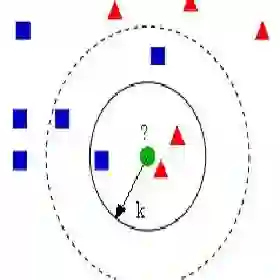
The K Nearest Neighbors (KNN) classifier is widely used in many fields such as fingerprint-based localization or medicine. It determines the class membership of unlabelled sample based on the class memberships of the K labelled samples, the so-called nearest neighbors, that are closest to the unlabelled sample. The choice of K has been the topic of various studies and proposed KNN-variants. Yet no variant has been proven to outperform all other variants. In this paper a new KNN-variant is proposed which ensures that the K nearest neighbors are indeed close to the unlabelled sample and finds K along the way. The proposed algorithm is tested and compared to the standard KNN in theoretical scenarios and for indoor localization based on ion-mobility spectrometry fingerprints. It achieves a higher classification accuracy than the KNN in the tests, while requiring having the same computational demand.
翻译:K最近邻(KNN)分类器广泛应用于指纹定位或医学等众多领域。它根据K个标记样本(即与未标记样本最接近的所谓最近邻)的类别归属来确定未标记样本的类别。K值的选择一直是各种研究和KNN变体提出的主题,然而尚无一种变体能被证明优于所有其他变体。本文提出了一种新的KNN变体,该变体确保K个最近邻确实接近未标记样本,并在此过程中自动确定K值。所提出的算法在理论场景及基于离子迁移谱指纹的室内定位中进行了测试,并与标准KNN进行了比较。在测试中,该算法在保持相同计算需求的同时,实现了比KNN更高的分类精度。




相关内容



 微信扫码咨询专知VIP会员