

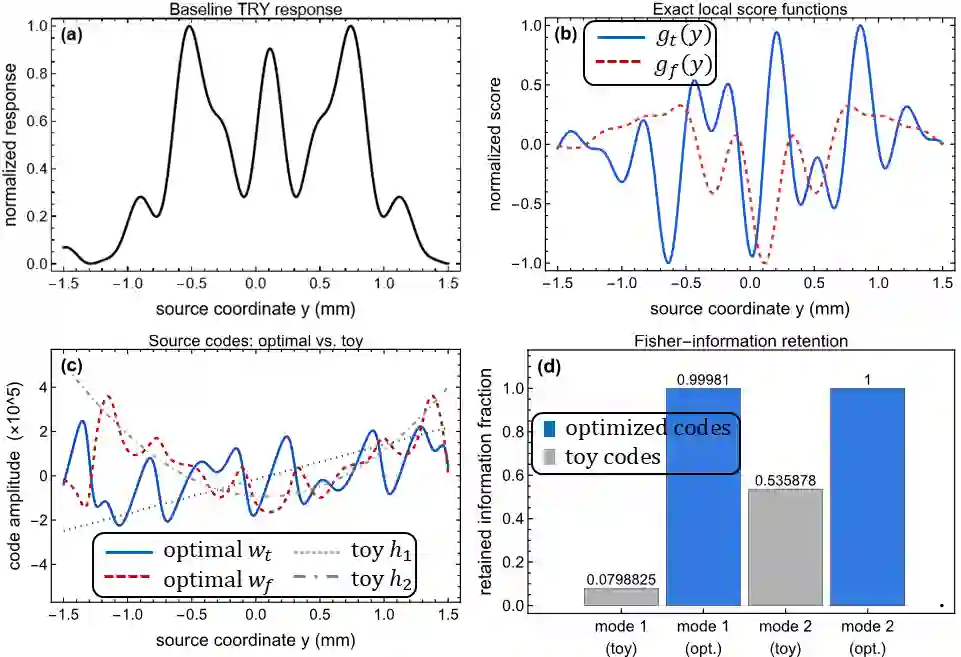
We propose a physically explicit sensing application of a time-reversed Young (TRY) interferometer: simultaneous monitoring of beam tilt and focus drift with a fixed detector. The task is relevant to compact optical relays, free-space links, fiber-coupling stages, and micro-optical alignment modules, where continuous tracking of pointing and focus is needed but downstream wavefront cameras or multiport analyzers are undesirable. Using a finite-width double-slit Fresnel model, we derive the exact local TRY response functions for tilt-like and defocus-like phase perturbations and compute the corresponding optimal upstream source codes numerically. The physical optimal codes are fringe-locked and differ qualitatively from the simple odd/even modes suggested by Gaussian toy models. Two source-coded scalar channels recover essentially all local Fisher information in the full source-resolved TRY record for the physical model considered here. Compared with downstream direct intensity sensing, TRY provides first-order access to the mixed tilt--defocus task with fixed detection; compared with ideal downstream matched-mode sorting, its advantage is architectural rather than fundamental.
翻译:我们提出了一种时间反转杨氏干涉仪的一种物理含义清晰的传感应用:通过固定探测器同时监测光束倾斜和焦点漂移。该任务对于紧凑型光学中继、自由空间链路、光纤耦合级以及微光学对准模块具有重要意义,在这些场景中需要持续跟踪指向和焦点,但下游波前相机或多端口分析仪并不理想。通过使用有限宽度的双缝菲涅耳模型,我们推导了针对倾斜类和离焦类相位扰动的精确局部时间反转杨氏响应函数,并数值计算了相应的最优上游源编码。物理上的最优编码是条纹锁定的,并且与高斯玩具模型所建议的简单奇偶模态在性质上不同。对于所考虑的物理模型,两个源编码标量通道几乎恢复了完整源分辨时间反转杨氏记录中的所有局部Fisher信息。与下游直接强度传感相比,时间反转杨氏干涉仪为混合倾斜-离焦任务提供了固定检测下的一阶访问能力;与理想的下游匹配模式分选相比,其优势在于架构层面而非基本原理层面。




相关内容

 微信扫码咨询专知VIP会员