

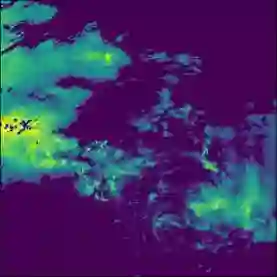
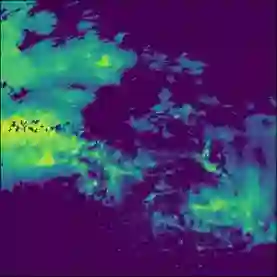
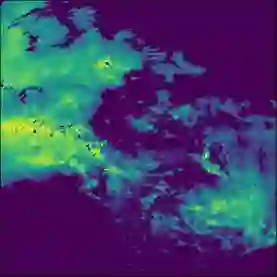
Spatiotemporal prediction aims to generate future sequences by paradigms learned from historical contexts. It is essential in numerous domains, such as traffic flow prediction and weather forecasting. Recently, research in this field has been predominantly driven by deep neural networks based on autoencoder architectures. However, existing methods commonly adopt autoencoder architectures with identical receptive field sizes. To address this issue, we propose an Asymmetric Receptive Field Autoencoder (ARFA) model, which introduces corresponding sizes of receptive field modules tailored to the distinct functionalities of the encoder and decoder. In the encoder, we present a large kernel module for global spatiotemporal feature extraction. In the decoder, we develop a small kernel module for local spatiotemporal information reconstruction. Experimental results demonstrate that ARFA consistently achieves state-of-the-art performance on popular datasets. Additionally, we construct the RainBench, a large-scale radar echo dataset for precipitation prediction, to address the scarcity of meteorological data in the domain.
翻译:时空预测旨在通过从历史环境中学习到的范式生成未来序列。它在交通流预测、天气预报等多个领域至关重要。近年来,该领域的研究主要由基于自编码器架构的深度神经网络驱动。然而,现有方法通常采用具有相同感受野大小的自编码器结构。为解决这一问题,我们提出了一种非对称感受野自编码器(ARFA)模型,该模型针对编码器和解码器的不同功能,引入了相应尺度的感受野模块。在编码器中,我们提出了一种大核模块用于全局时空特征提取;在解码器中,我们设计了一种小核模块用于局部时空信息重建。实验结果表明,ARFA在主流数据集上始终达到最先进性能。此外,我们构建了RainBench——一个用于降水预测的大规模雷达回波数据集,以缓解该领域气象数据稀缺的问题。




相关内容





 微信扫码咨询专知VIP会员