

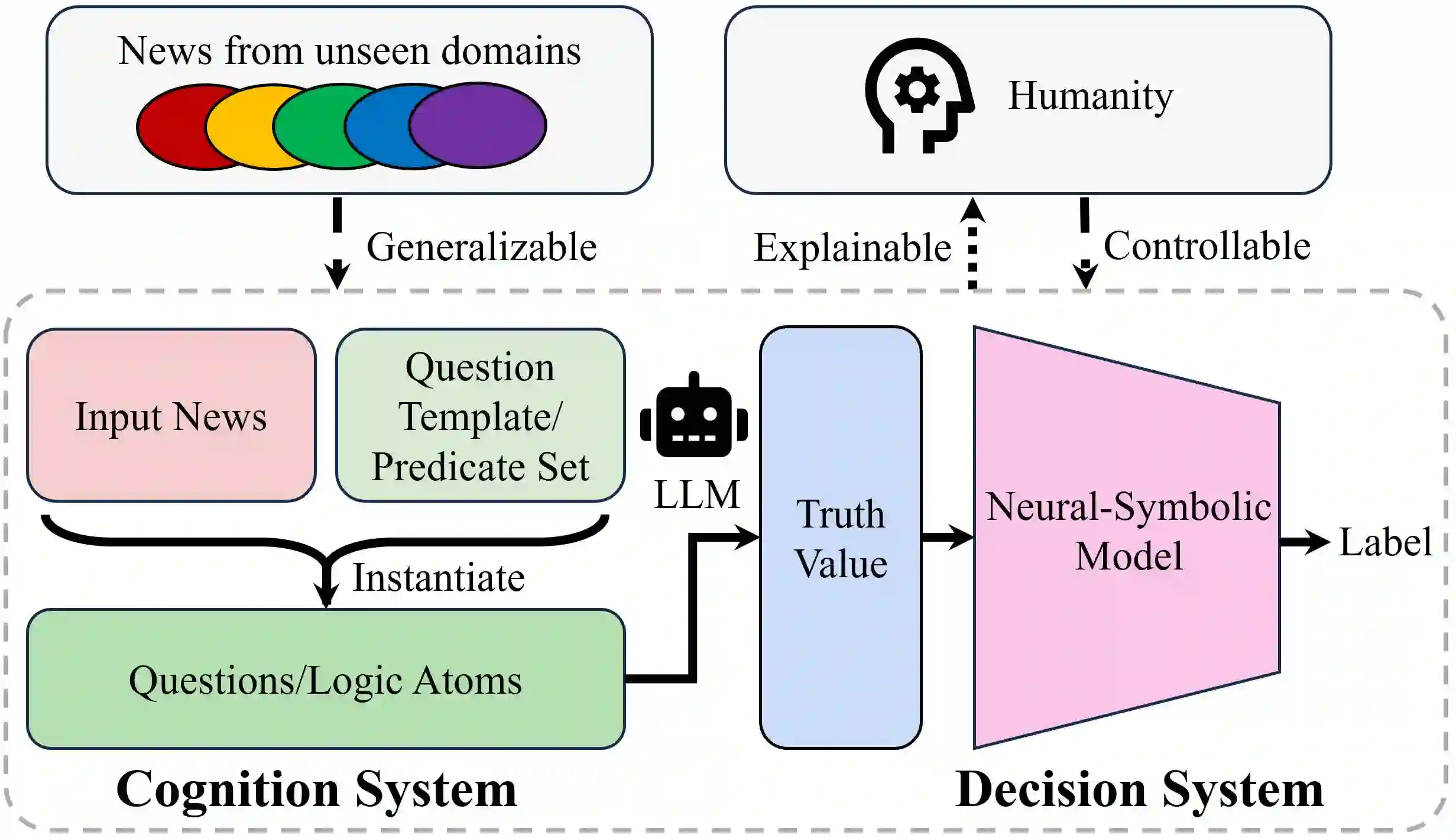
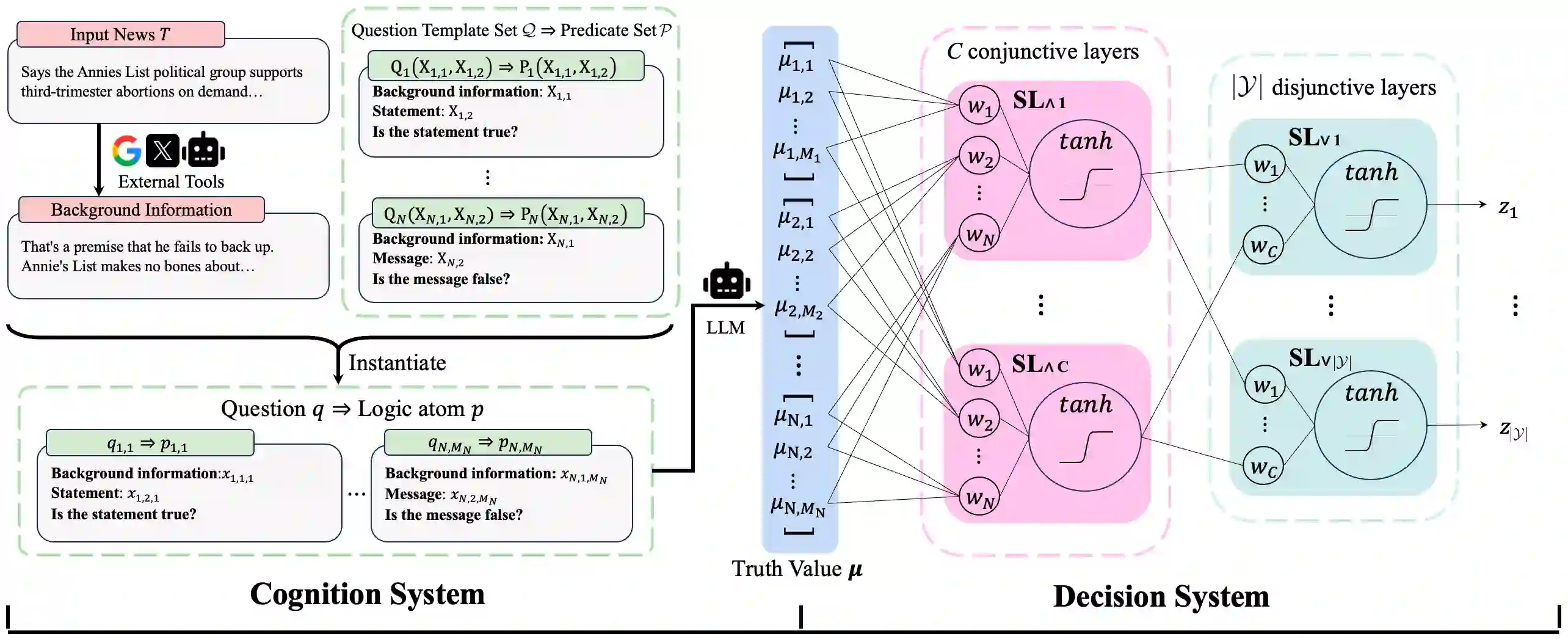
The proliferation of fake news has emerged as a severe societal problem, raising significant interest from industry and academia. While existing deep-learning based methods have made progress in detecting fake news accurately, their reliability may be compromised caused by the non-transparent reasoning processes, poor generalization abilities and inherent risks of integration with large language models (LLMs). To address this challenge, we propose {\methodname}, a novel framework for trustworthy fake news detection that prioritizes explainability, generalizability and controllability of models. This is achieved via a dual-system framework that integrates cognition and decision systems, adhering to the principles above. The cognition system harnesses human expertise to generate logical predicates, which guide LLMs in generating human-readable logic atoms. Meanwhile, the decision system deduces generalizable logic rules to aggregate these atoms, enabling the identification of the truthfulness of the input news across diverse domains and enhancing transparency in the decision-making process. Finally, we present comprehensive evaluation results on four datasets, demonstrating the feasibility and trustworthiness of our proposed framework. Our implementation is available at \url{https://github.com/less-and-less-bugs/Trust_TELLER}.
翻译:假新闻的泛滥已成为严重的社会问题,引起了工业界和学术界的广泛关注。尽管现有的基于深度学习方法在准确检测假新闻方面取得了进展,但其可靠性可能因推理过程不透明、泛化能力差以及与大型语言模型(LLMs)集成的固有风险而受到损害。为解决这一挑战,我们提出{\methodname},一种面向可信赖假新闻检测的新型框架,其优先考虑模型的可解释性、泛化性和可控性。这是通过遵循上述原则、融合认知与决策系统的双系统框架实现的。认知系统利用人类专业知识生成逻辑谓词,引导LLMs生成人类可读的逻辑原子;而决策系统则推导出可泛化的逻辑规则来聚合这些原子,从而能在不同领域识别输入新闻的真实性,并增强决策过程的透明度。最后,我们在四个数据集上展示了全面的评估结果,证明了所提框架的可行性与可信赖性。我们的实现代码见\url{https://github.com/less-and-less-bugs/Trust_TELLER}。




相关内容




 微信扫码咨询专知VIP会员