

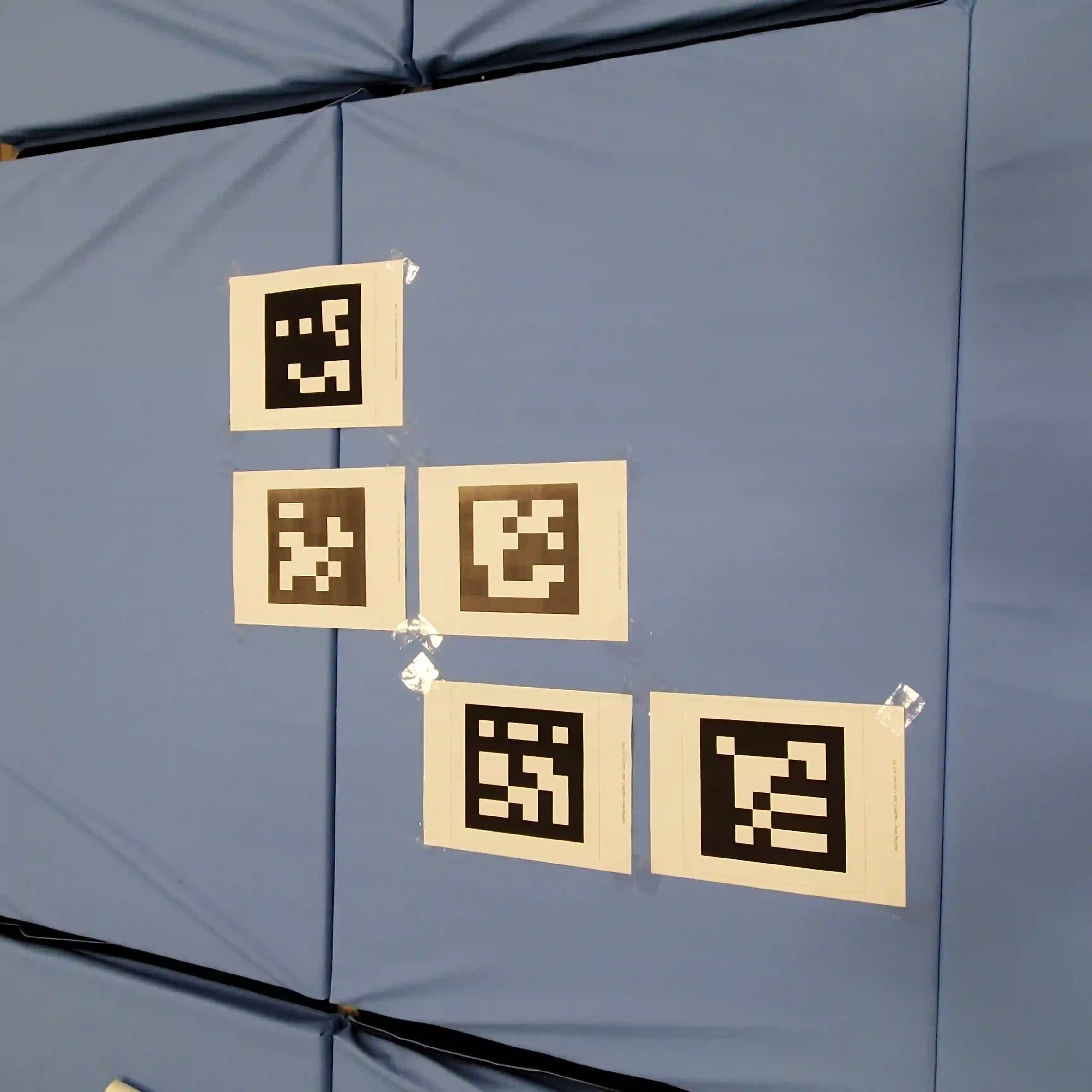
This paper presents a comparative study of three modes for mobile robot localization based on visual SLAM using fiducial markers (i.e., square-shaped artificial landmarks with a black-and-white grid pattern): SLAM, SLAM with a prior map, and localization with a prior map. The reason for comparing the SLAM-based approaches leveraging fiducial markers is because previous work has shown their superior performance over feature-only methods, with less computational burden compared to methods that use both feature and marker detection without compromising the localization performance. The evaluation is conducted using indoor image sequences captured with a hand-held camera containing multiple fiducial markers in the environment. The performance metrics include absolute trajectory error and runtime for the optimization process per frame. In particular, for the last two modes (SLAM and localization with a prior map), we evaluate their performances by perturbing the quality of prior map to study the extent to which each mode is tolerant to such perturbations. Hardware experiments show consistent trajectory error levels across the three modes, with the localization mode exhibiting the shortest runtime among them. Yet, with map perturbations, SLAM with a prior map maintains performance, while localization mode degrades in both aspects.
翻译:本文对基于视觉SLAM并使用基准标记(即具有黑白网格图案的方形人工地标)的三种移动机器人定位模式进行了比较研究:SLAM、使用先验地图的SLAM以及使用先验地图的定位。之所以比较基于SLAM并利用基准标记的方法,是因为先前研究表明,与纯特征方法相比,这类方法在定位性能不受影响的情况下,计算负担更轻;同时相比同时使用特征和标记检测的方法,其计算量也更小。评估采用手持摄像机在包含多个基准标记的环境中采集的室内图像序列进行。性能指标包括绝对轨迹误差和每帧优化过程的运行时间。特别地,对于后两种模式(使用先验地图的SLAM和定位),我们通过扰动先验地图的质量来评估其性能,以研究每种模式对这类扰动的容忍程度。硬件实验表明,三种模式的轨迹误差水平基本一致,其中定位模式的运行时间最短。然而,在地图扰动情况下,使用先验地图的SLAM仍能保持性能,而定位模式在两方面均出现性能下降。




相关内容




 微信扫码咨询专知VIP会员