

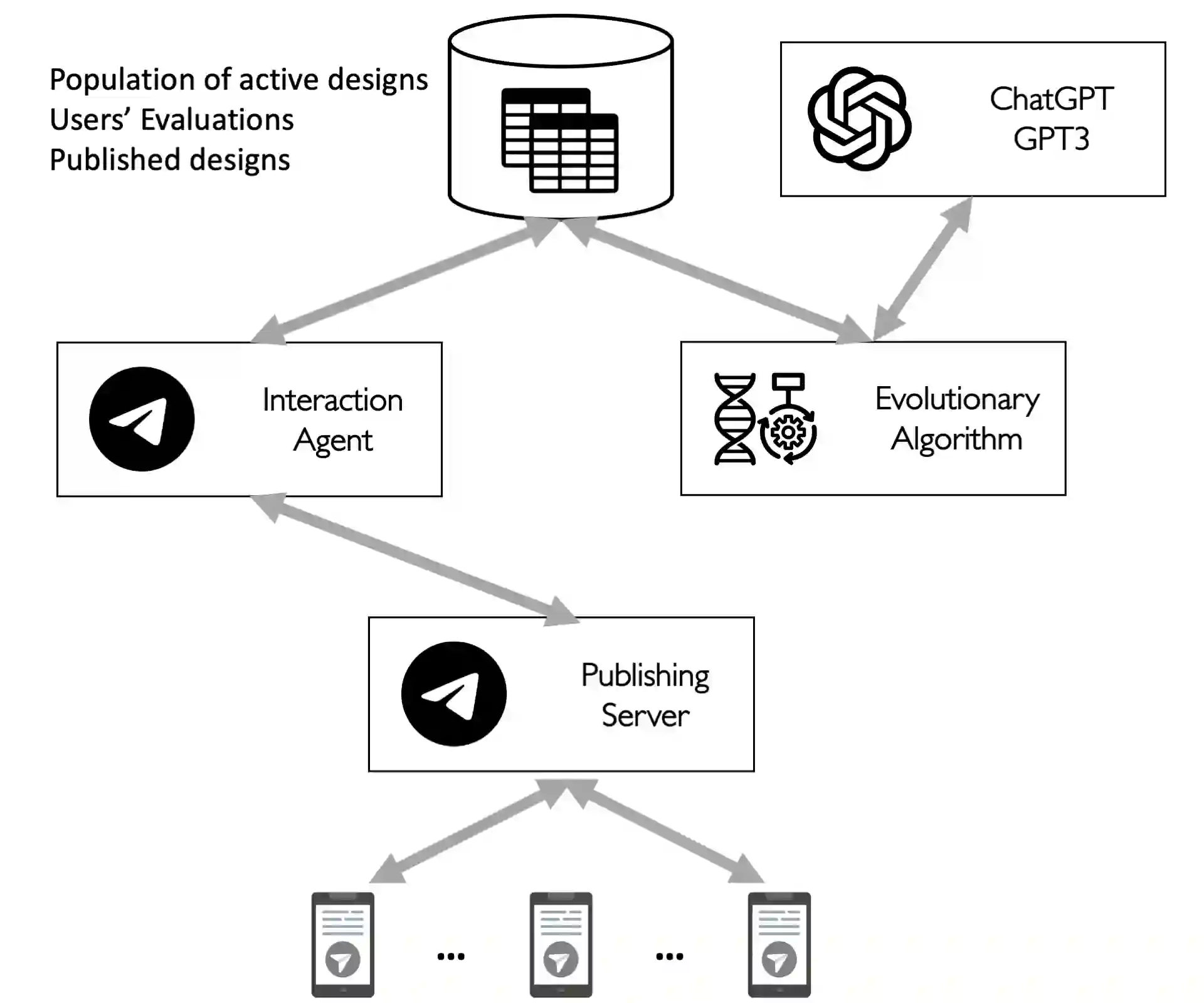
Large language models (LLMs) have taken the scientific world by storm, changing the landscape of natural language processing and human-computer interaction. These powerful tools can answer complex questions and, surprisingly, perform challenging creative tasks (e.g., generate code and applications to solve problems, write stories, pieces of music, etc.). In this paper, we present a collaborative game design framework that combines interactive evolution and large language models to simulate the typical human design process. We use the former to exploit users' feedback for selecting the most promising ideas and large language models for a very complex creative task - the recombination and variation of ideas. In our framework, the process starts with a brief and a set of candidate designs, either generated using a language model or proposed by the users. Next, users collaborate on the design process by providing feedback to an interactive genetic algorithm that selects, recombines, and mutates the most promising designs. We evaluated our framework on three game design tasks with human designers who collaborated remotely.
翻译:大型语言模型(LLMs)已席卷科学界,彻底改变了自然语言处理和人机交互的格局。这些强大工具不仅能回答复杂问题,还能出人意料地完成具有挑战性的创意任务(例如,生成代码和应用程序以解决问题、编写故事、创作音乐等)。本文提出了一种结合交互式进化与大型语言模型的协作游戏设计框架,用以模拟典型的人类设计过程。我们利用前者挖掘用户反馈以筛选最具潜力的创意,并借助大型语言模型处理极为复杂的创意任务——创意的重组与变异。在该框架中,设计始于一份简短说明及一组候选方案(这些方案可由语言模型生成或由用户提出)。随后,用户通过向交互式遗传算法提供反馈来协作完成设计过程,该算法对最具前景的设计进行选择、重组和变异。我们通过三个游戏设计任务,对远程协作的人类设计师群体进行了框架评估。




相关内容


 微信扫码咨询专知VIP会员