

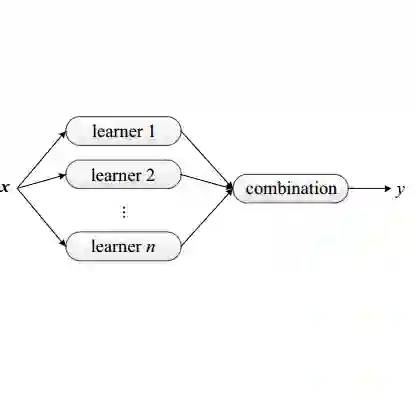
Nowadays, denoising diffusion probabilistic models have been adapted for many image segmentation tasks. However, existing end-to-end models have already demonstrated remarkable capabilities. Rather than using denoising diffusion probabilistic models alone, integrating the abilities of both denoising diffusion probabilistic models and existing end-to-end models can better improve the performance of image segmentation. Based on this, we implicitly introduce residual term into the diffusion process and propose ResEnsemble-DDPM, which seamlessly integrates the diffusion model and the end-to-end model through ensemble learning. The output distributions of these two models are strictly symmetric with respect to the ground truth distribution, allowing us to integrate the two models by reducing the residual term. Experimental results demonstrate that our ResEnsemble-DDPM can further improve the capabilities of existing models. Furthermore, its ensemble learning strategy can be generalized to other downstream tasks in image generation and get strong competitiveness.
翻译:当前,去噪扩散概率模型已被广泛应用于诸多图像分割任务。然而,现有端到端模型已展现出卓越性能。单纯使用去噪扩散概率模型并非最优选择,将去噪扩散概率模型与现有端到端模型的能力相结合,能更有效提升图像分割性能。基于此,我们隐式地在扩散过程中引入残差项,并提出ResEnsemble-DDPM,通过集成学习无缝融合扩散模型与端到端模型。这两个模型的输出分布相对于真实分布严格对称,使我们能够通过缩减残差项实现模型集成。实验结果表明,本文提出的ResEnsemble-DDPM可进一步提升现有模型的能力。此外,其集成学习策略可泛化至图像生成领域的其他下游任务,展现出强劲的竞争力。




相关内容




 微信扫码咨询专知VIP会员