

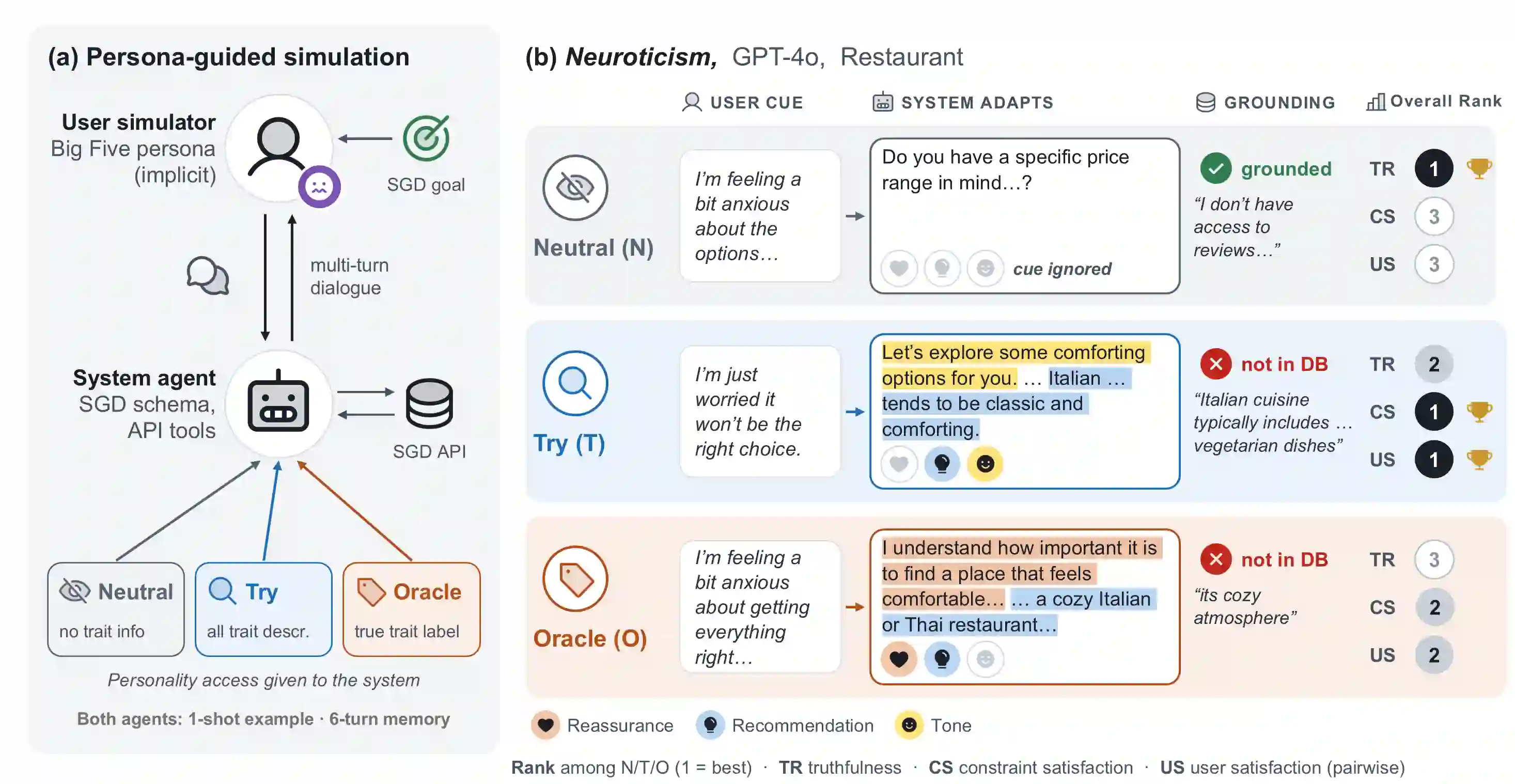
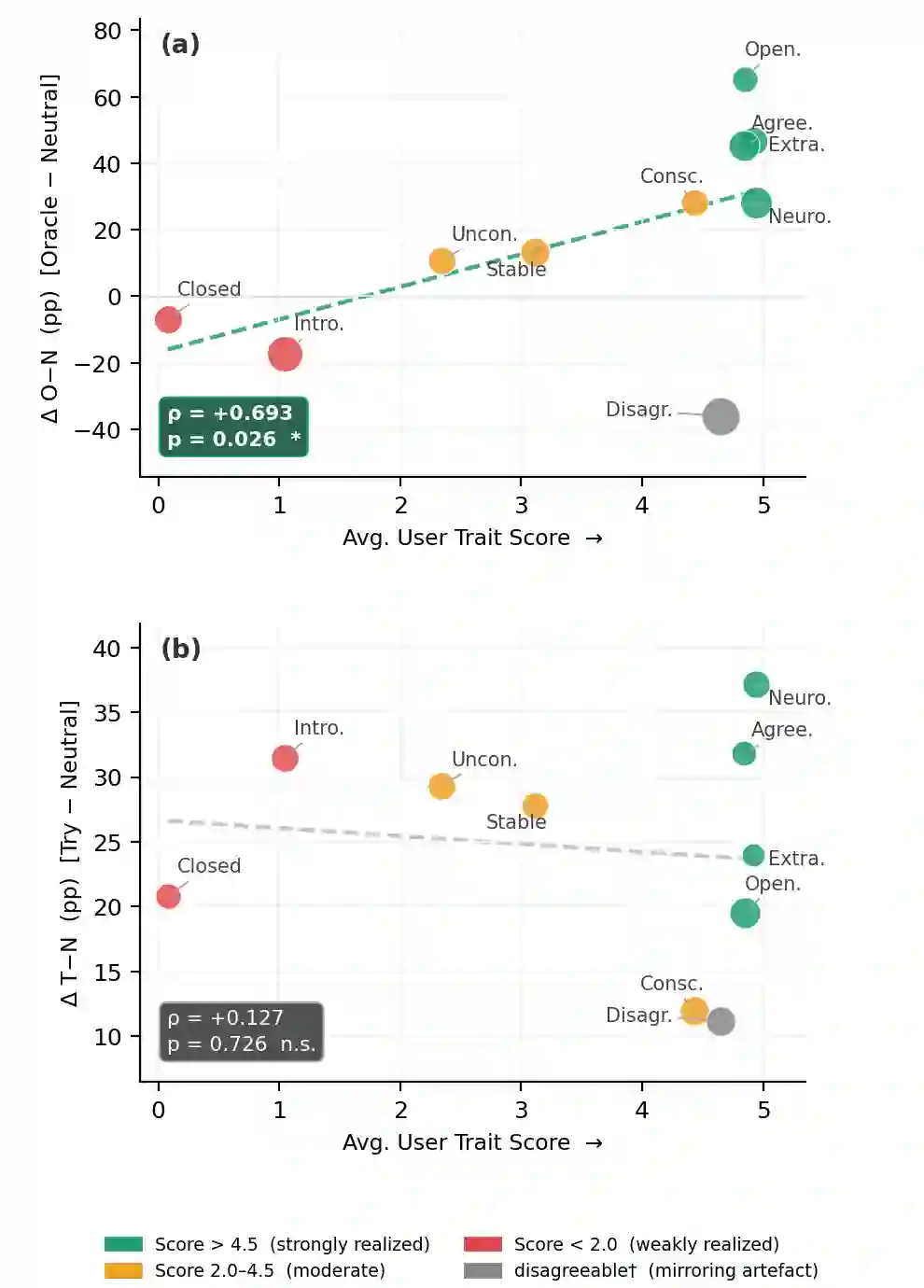
Prior work has shown that large language models can express diverse personality traits in open-ended text generation, but it is unclear whether they can do so in goal-directed dialogue without harming task completion, and whether adapting to a user's personality improves the interaction. We study these questions in task-oriented dialogue (TOD) with a training-free framework in which a personality-conditioned user agent interacts with a system agent under three conditions: Neutral (no personality information), Try (adapt to cues observed in the dialogue), and Oracle (the user's trait label is given explicitly). Across GPT-4o, Qwen3-Next-80B, and Gemini 2.0 Flash, two Schema-Guided Dialogue domains, and ten Big Five poles (9,000 dialogues), each scored by two independent LLM judges, user agents express most traits while task performance remains high (89.94% completion, 85.27% success). The exceptions are introversive and closed users: these traits manifest mainly as absent behavior and are rarely detected. Both adaptive conditions improve pairwise user satisfaction and lower truthfulness, revealing a personalization-grounding trade-off, but only cue-responsive Try also improves constraint satisfaction and inform rate. How adaptation is implemented matters: Oracle's gains depend on how visibly the trait is expressed, and for disagreeable users the label leads Qwen3 and Gemini to mirror hostility. Try avoids this failure, its satisfaction gains do not depend on trait visibility, and it is preferred over Oracle overall. A 175-pair human study supports the reliability of the LLM judges: on clear-winner cases, annotators agree with the satisfaction judges more often than with each other (76.3% vs. 65.1% agreement). Our results suggest that responding to observable behavior is a more robust basis for social adaptation than conditioning on psychological labels.
翻译:暂无翻译


相关内容




 微信扫码咨询专知VIP会员