

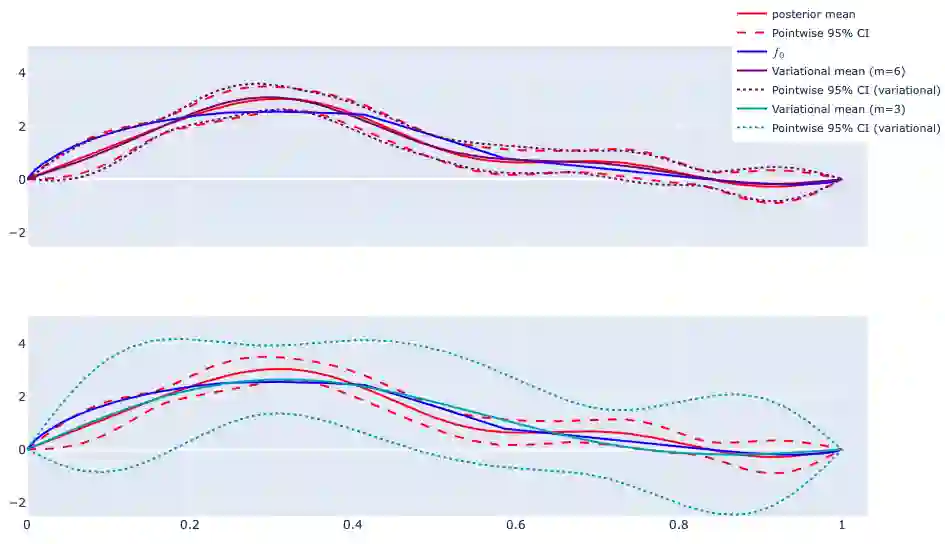
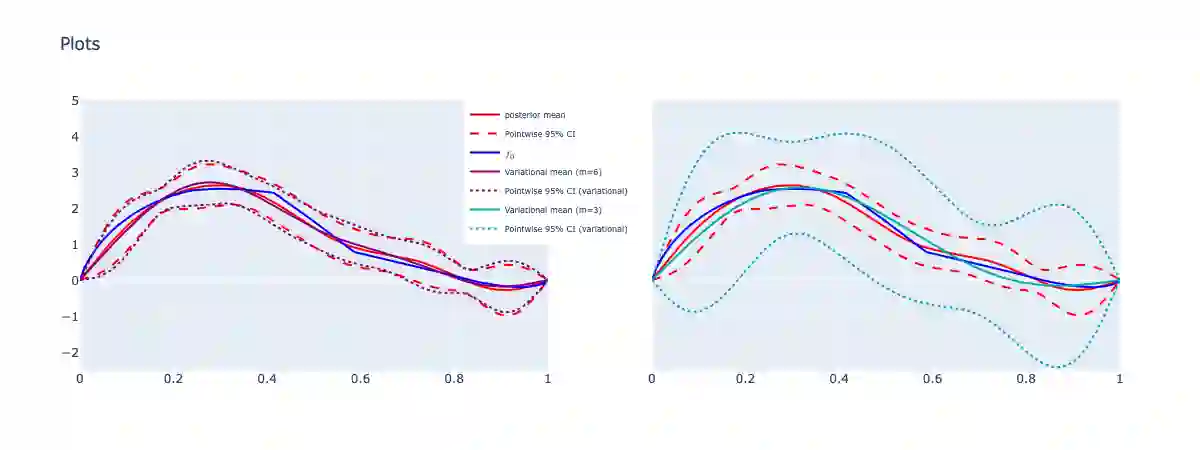
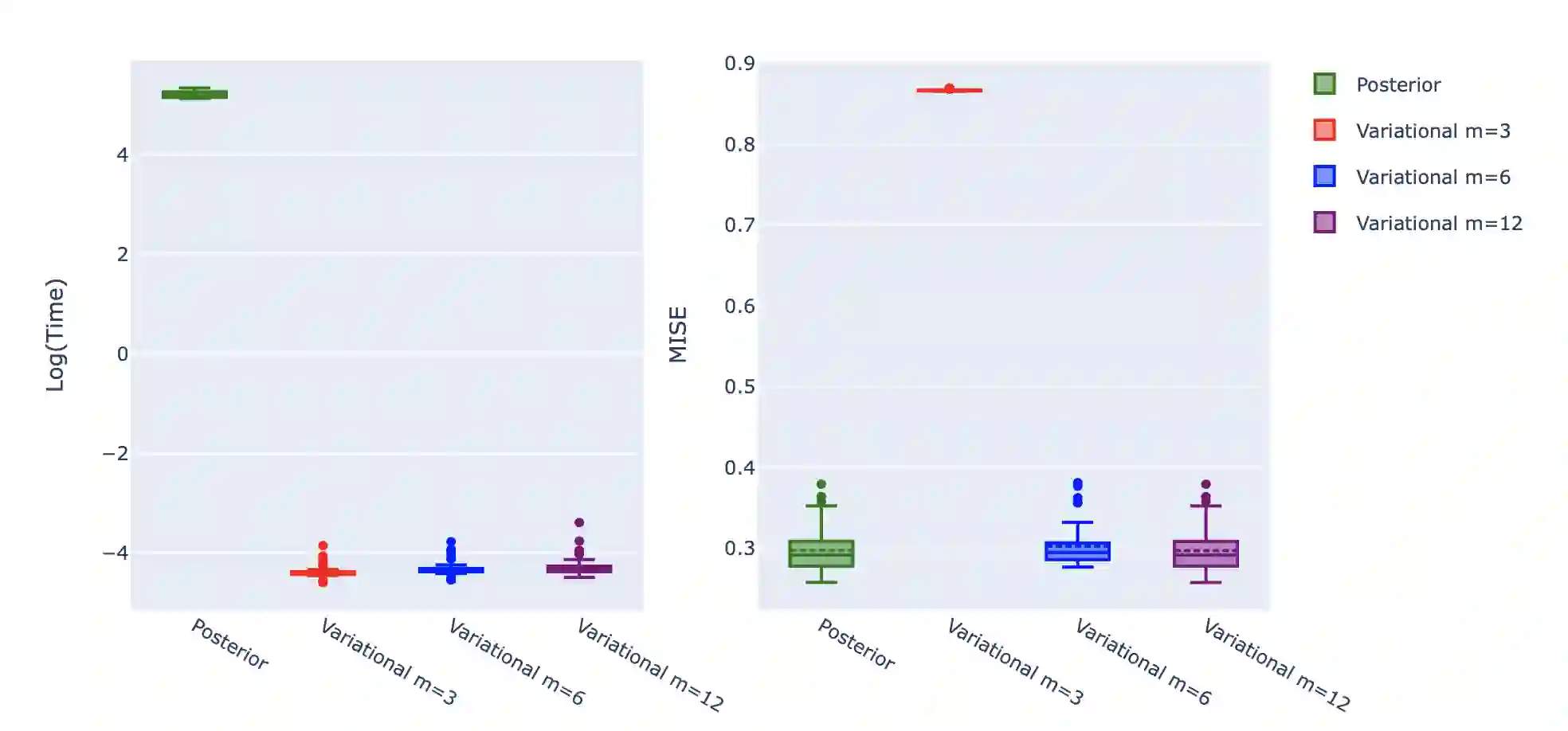
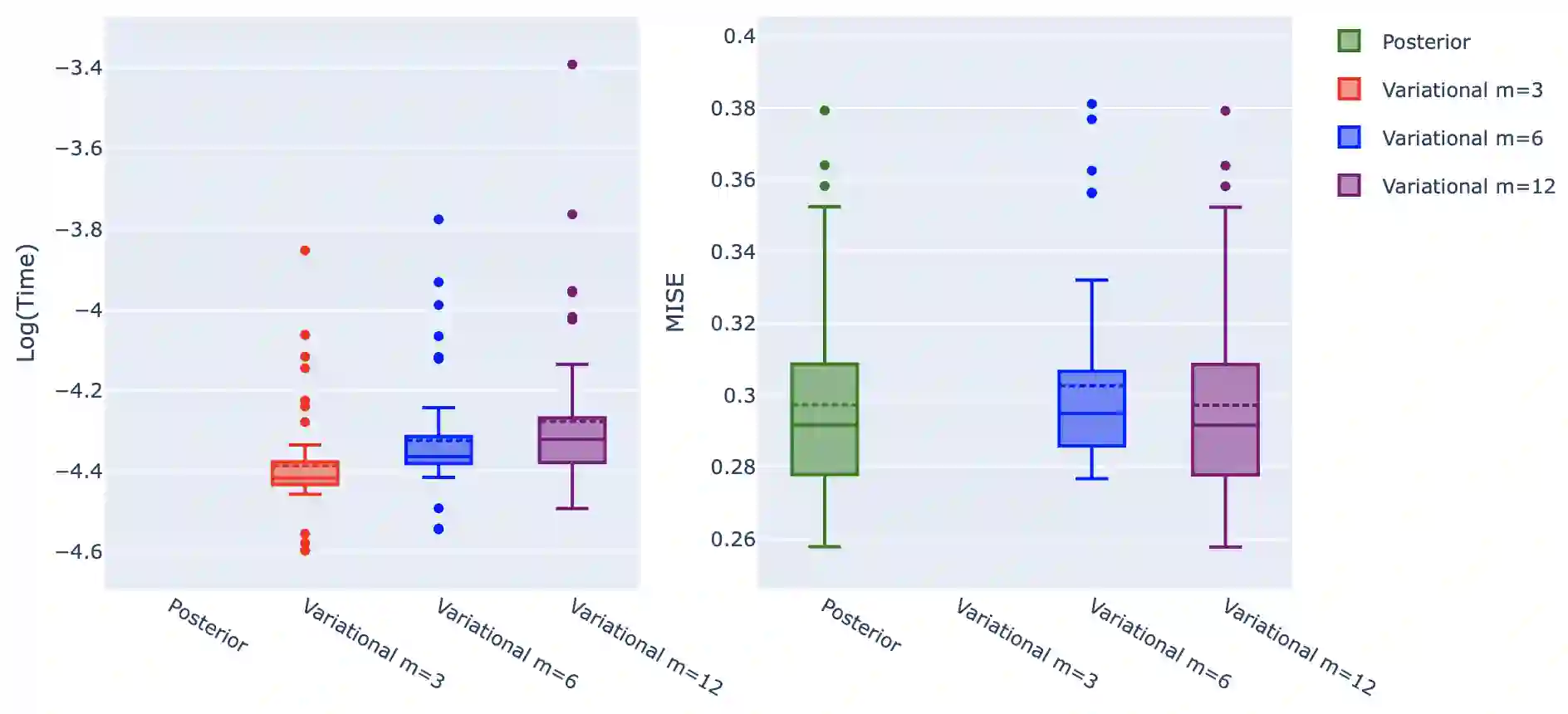
By now Bayesian methods are routinely used in practice for solving inverse problems. In inverse problems the parameter or signal of interest is observed only indirectly, as an image of a given map, and the observations are typically further corrupted with noise. Bayes offers a natural way to regularize these problems via the prior distribution and provides a probabilistic solution, quantifying the remaining uncertainty in the problem. However, the computational costs of standard, sampling based Bayesian approaches can be overly large in such complex models. Therefore, in practice variational Bayes is becoming increasingly popular. Nevertheless, the theoretical understanding of these methods is still relatively limited, especially in context of inverse problems. In our analysis we investigate variational Bayesian methods for Gaussian process priors to solve linear inverse problems. We consider both mildly and severely ill-posed inverse problems and work with the popular inducing variables variational Bayes approach proposed by Titsias in 2009. We derive posterior contraction rates for the variational posterior in general settings and show that the minimax estimation rate can be attained by correctly tunned procedures. As specific examples we consider a collection of inverse problems including the heat equation, Volterra operator and Radon transform and inducing variable methods based on population and empirical spectral features.
翻译:如今,贝叶斯方法在实践中已被常规用于求解逆问题。在逆问题中,感兴趣的参数或信号仅通过给定映射的图像间接观测,且观测数据通常被噪声进一步污染。贝叶斯方法通过先验分布自然地提供了一种正则化途径,并给出概率解,从而量化问题中剩余的不确定性。然而,在此类复杂模型中,基于采样的标准贝叶斯方法计算成本过高。因此,变分贝叶斯方法在实践中日益流行。尽管如此,这些方法的理论理解仍相对有限,尤其是在逆问题的背景下。在我们的分析中,我们研究了基于高斯过程先验的变分贝叶斯方法以求解线性逆问题。我们同时考虑了适度和严重不适定逆问题,并采用 Titsias(2009)提出的流行的诱导变量变分贝叶斯方法。我们在一般设定下推导了变分后验的后验收缩率,并表明通过正确调整的流程可以达到极小极大估计速率。作为具体示例,我们考虑了包括热方程、Volterra 算子和 Radon 变换在内的一系列逆问题,以及基于总体和经验谱特征的诱导变量方法。




相关内容




 微信扫码咨询专知VIP会员