

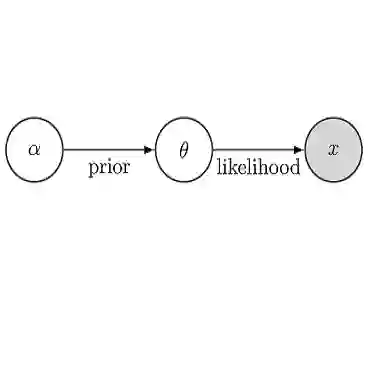
The swift progression of machine learning (ML) has not gone unnoticed in the realm of statistical mechanics. ML techniques have attracted attention by the classical density-functional theory (DFT) community, as they enable discovery of free-energy functionals to determine the equilibrium-density profile of a many-particle system. Within DFT, the external potential accounts for the interaction of the many-particle system with an external field, thus, affecting the density distribution. In this context, we introduce a statistical-learning framework to infer the external potential exerted on a many-particle system. We combine a Bayesian inference approach with the classical DFT apparatus to reconstruct the external potential, yielding a probabilistic description of the external potential functional form with inherent uncertainty quantification. Our framework is exemplified with a grand-canonical one-dimensional particle ensemble with excluded volume interactions in a confined geometry. The required training dataset is generated using a Monte Carlo (MC) simulation where the external potential is applied to the grand-canonical ensemble. The resulting particle coordinates from the MC simulation are fed into the learning framework to uncover the external potential. This eventually allows us to compute the equilibrium density profile of the system by using the tools of DFT. Our approach benchmarks the inferred density against the exact one calculated through the DFT formulation with the true external potential. The proposed Bayesian procedure accurately infers the external potential and the density profile. We also highlight the external-potential uncertainty quantification conditioned on the amount of available simulated data. The seemingly simple case study introduced in this work might serve as a prototype for studying a wide variety of applications, including adsorption and capillarity.
翻译:机器学习(ML)的飞速发展在统计力学领域备受关注。机器学习技术因其能够发现自由能泛函以确定多粒子系统的平衡密度分布,而引起了经典密度泛函理论(DFT)界的关注。在密度泛函理论框架中,外势描述了多粒子系统与外场的相互作用,从而影响密度分布。在此背景下,我们提出了一种统计学习框架,用于推断作用于多粒子系统的外势。我们将贝叶斯推断方法与经典密度泛函理论工具相结合,以重构外势,从而得到外势函数形式的概率化描述,并具备固有的不确定性量化。该框架通过一个具有排除体积相互作用的一维巨正则系综粒子系(处于受限几何结构)进行示例说明。所需的训练数据集通过蒙特卡洛(MC)模拟生成,其中外势被施加于该巨正则系综。蒙特卡洛模拟得到的粒子坐标被输入学习框架以揭示外势。最终,利用密度泛函理论工具可计算系统的平衡密度分布。我们的方法将推断得到的密度与通过真实外势的密度泛函理论公式精确计算的密度进行基准比较。所提出的贝叶斯方法能够准确推断外势及密度分布,同时我们还强调了基于可用模拟数据量条件下的外势不确定性量化。本文引入的看似简单的案例研究,可望作为研究包括吸附和毛细现象在内的广泛应用的范例。




相关内容



 微信扫码咨询专知VIP会员