

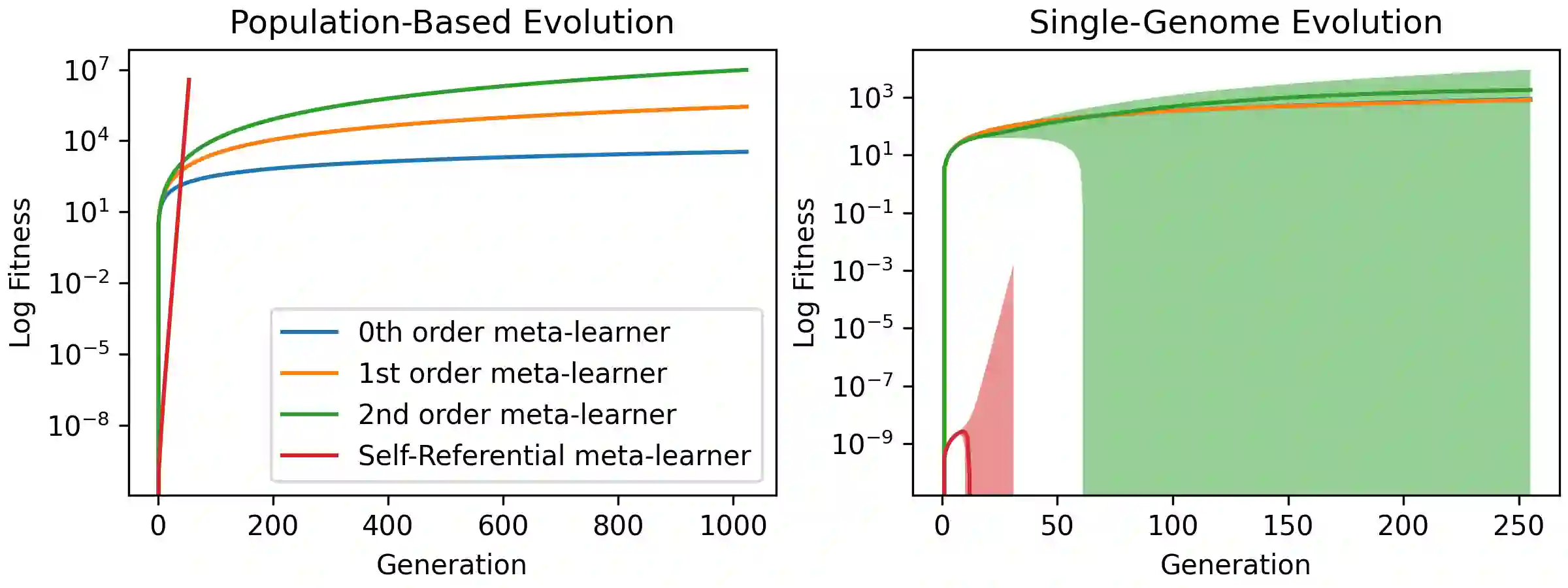
Meta-learning, the notion of learning to learn, enables learning systems to quickly and flexibly solve new tasks. This usually involves defining a set of outer-loop meta-parameters that are then used to update a set of inner-loop parameters. Most meta-learning approaches use complicated and computationally expensive bi-level optimisation schemes to update these meta-parameters. Ideally, systems should perform multiple orders of meta-learning, i.e. to learn to learn to learn and so on, to accelerate their own learning. Unfortunately, standard meta-learning techniques are often inappropriate for these higher-order meta-parameters because the meta-optimisation procedure becomes too complicated or unstable. Inspired by the higher-order meta-learning we observe in real-world evolution, we show that using simple population-based evolution implicitly optimises for arbitrarily-high order meta-parameters. First, we theoretically prove and empirically show that population-based evolution implicitly optimises meta-parameters of arbitrarily-high order in a simple setting. We then introduce a minimal self-referential parameterisation, which in principle enables arbitrary-order meta-learning. Finally, we show that higher-order meta-learning improves performance on time series forecasting tasks.
翻译:元学习,即“学会学习”的概念,使学习系统能够快速灵活地解决新任务。这通常需要定义一组外环元参数,用于更新一组内环参数。大多数元学习方法采用复杂且计算成本高昂的双层优化方案来更新这些元参数。理想情况下,系统应能执行多阶元学习(即学会如何学会学习,并以此类推),以加速自身的学习过程。然而,标准元学习技术往往不适用于这些高阶元参数,因为元优化过程会变得过于复杂或不稳定。受真实世界进化中观察到的高阶元学习现象启发,我们证明:使用简单的种群进化方法可隐式优化任意高阶的元参数。首先,我们在理论上证明并通过实验表明,在简单设定下,种群进化能够隐式优化任意高阶的元参数。接着,我们引入一种最小化的自指参数化方法,从原理上实现任意阶元学习。最后,我们证明高阶元学习能提升时序预测任务的性能。




相关内容



 微信扫码咨询专知VIP会员