

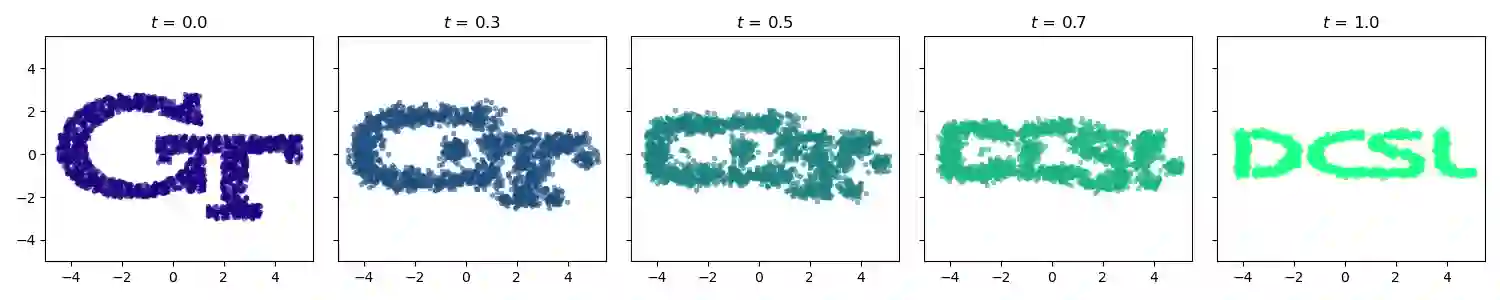
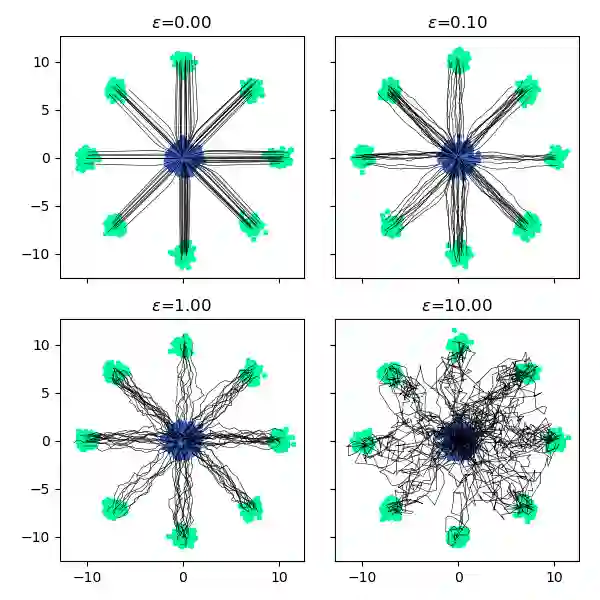
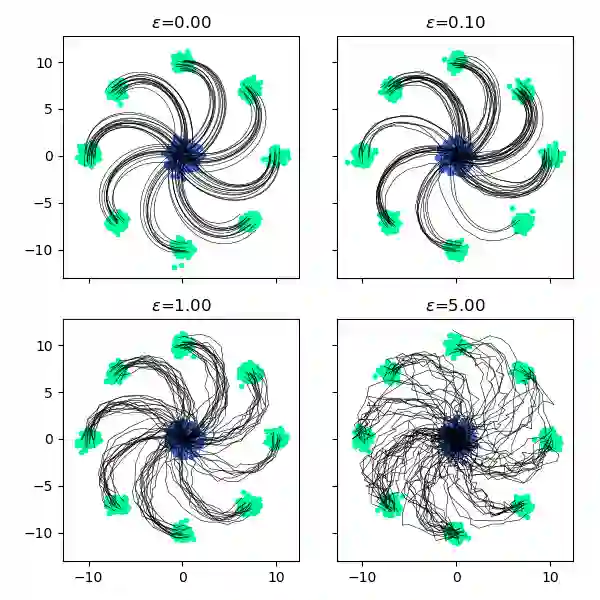
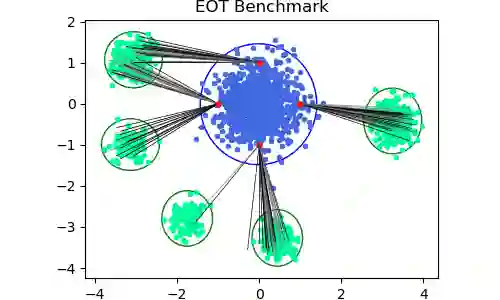
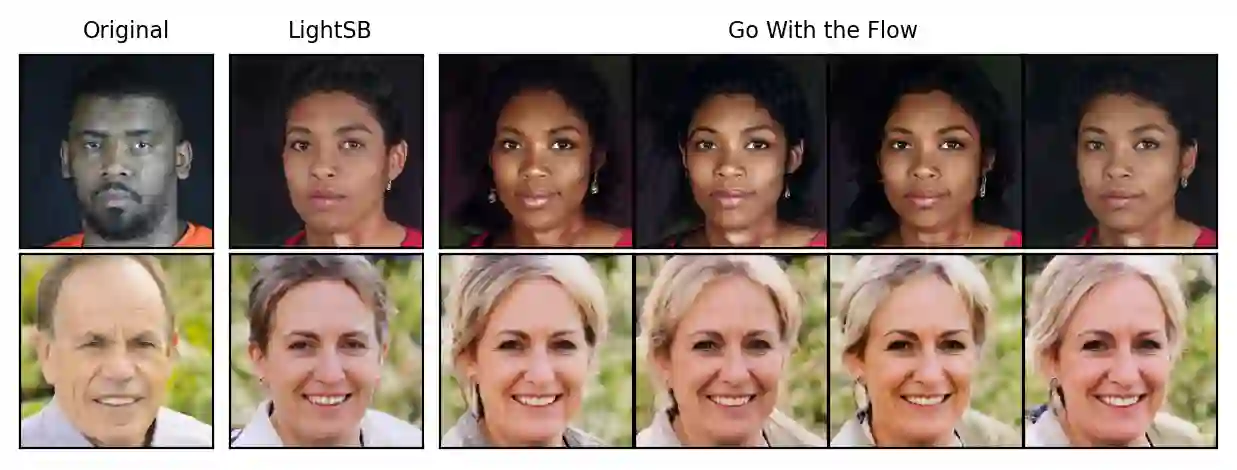
Schr\"{o}dinger Bridges (SB) are diffusion processes that steer, in finite time, a given initial distribution to another final one while minimizing a suitable cost functional. Although various methods for computing SBs have recently been proposed in the literature, most of these approaches require computationally expensive training schemes, even for solving low-dimensional problems. In this work, we propose an analytic parametrization of a set of feasible policies for steering the distribution of a dynamical system from one Gaussian Mixture Model (GMM) to another. Instead of relying on standard non-convex optimization techniques, the optimal policy within the set can be approximated as the solution of a low-dimensional linear program whose dimension scales linearly with the number of components in each mixture. Furthermore, our method generalizes naturally to more general classes of dynamical systems such as controllable Linear Time-Varying systems that cannot currently be solved using traditional neural SB approaches. We showcase the potential of this approach in low-to-moderate dimensional problems such as image-to-image translation in the latent space of an autoencoder, and various other examples. We also benchmark our approach on an Entropic Optimal Transport (EOT) problem and show that it outperforms state-of-the-art methods in cases where the boundary distributions are mixture models while requiring virtually no training.
翻译:薛定谔桥(SB)是一类扩散过程,其目标是在有限时间内将给定初始分布引导至另一终态分布,同时最小化适当的成本泛函。尽管近期文献中已提出多种计算SB的方法,但大多数方案需要计算成本高昂的训练机制,即使对于求解低维问题亦是如此。在本工作中,我们提出了一种可行策略集合的解析参数化方法,用于将动态系统的分布从一个高斯混合模型(GMM)引导至另一个GMM。相较于依赖标准的非凸优化技术,该集合内的最优策略可通过求解低维线性规划来近似,其维度随各混合模型中分量数量线性增长。此外,我们的方法可自然推广至更广泛的动态系统类别,例如当前传统神经SB方法无法求解的可控线性时变系统。我们展示了该方法在低至中维问题中的潜力,包括自编码器隐空间中的图像到图像转换及其他多种示例。我们还在熵最优传输(EOT)问题上对本方法进行了基准测试,结果表明当边界分布为混合模型时,该方法在几乎无需训练的情况下优于现有最优方法。




相关内容




 微信扫码咨询专知VIP会员