

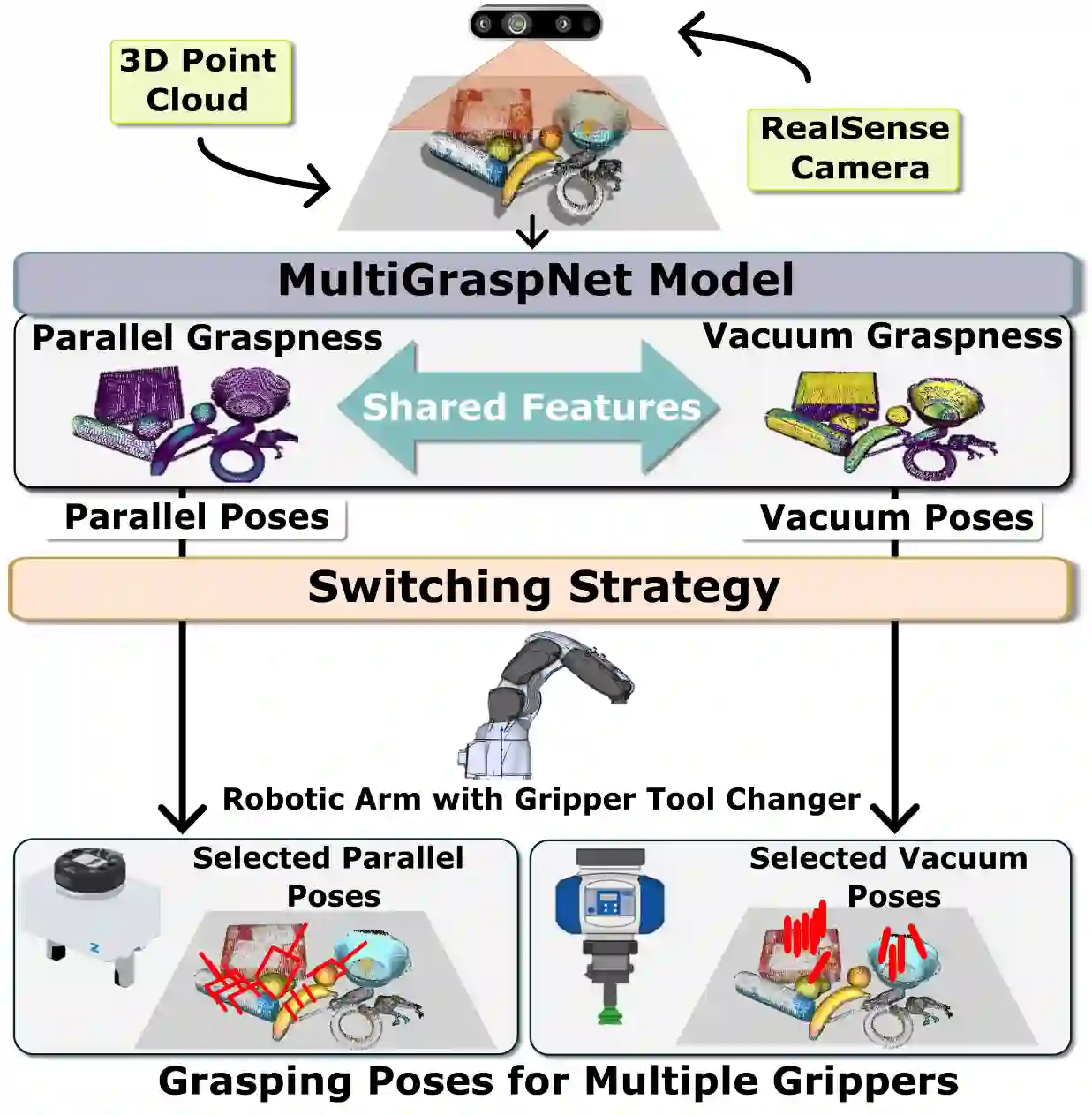
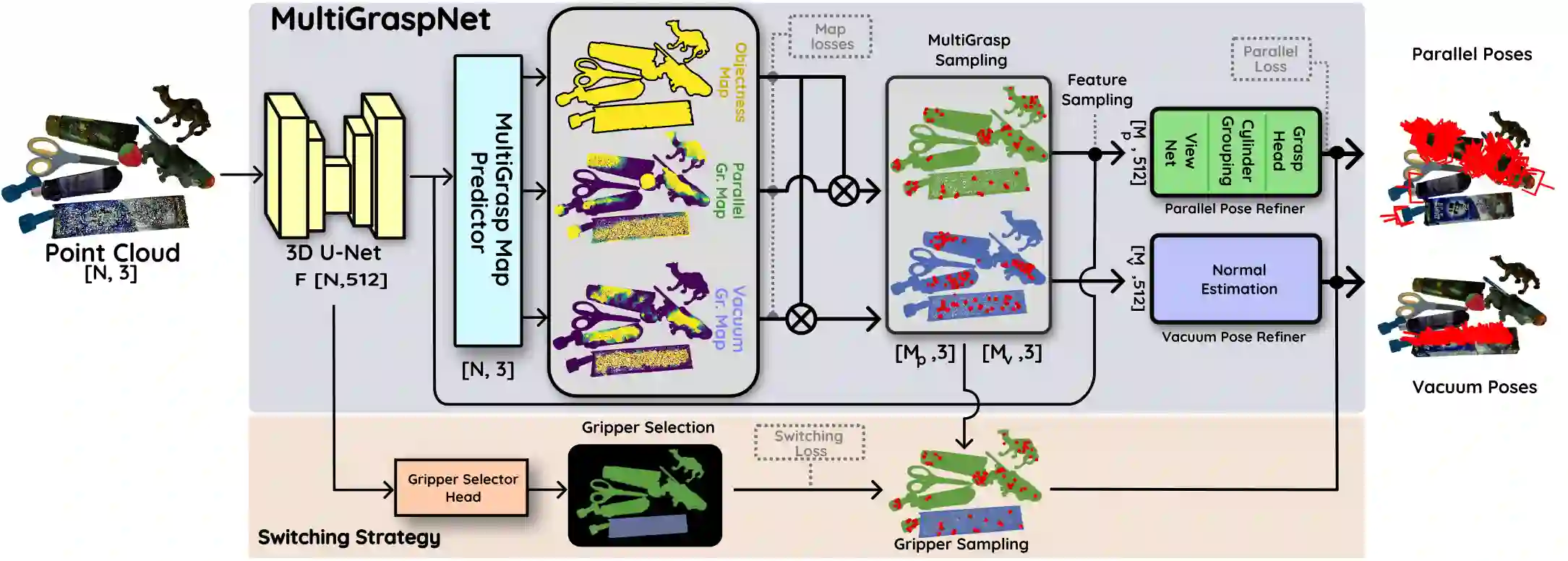
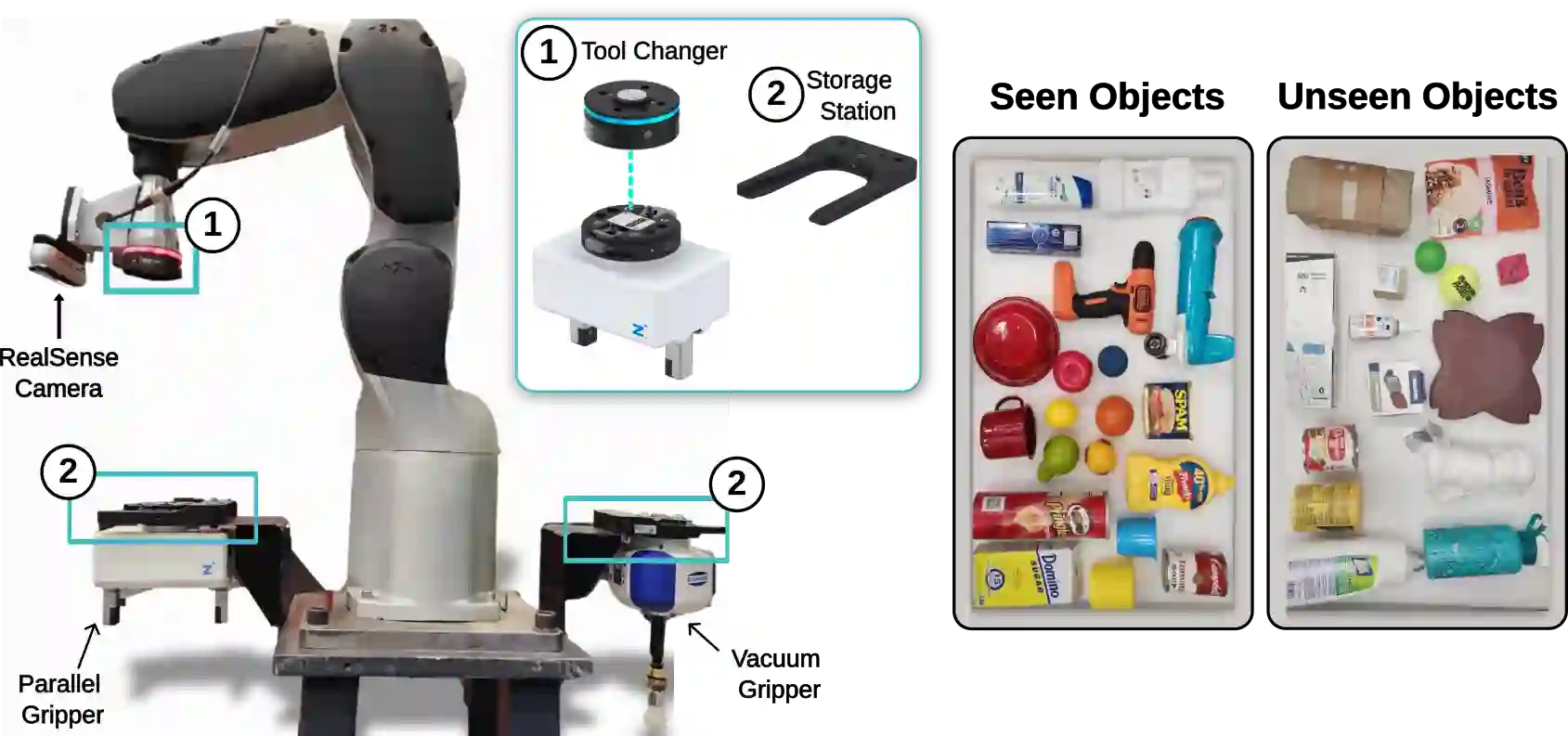
Vision-based models for robotic grasping automate critical, repetitive, and draining industrial tasks. Existing approaches are typically limited in two ways: they either target a single gripper and are potentially applied on costly dual-arm setups, or rely on custom hybrid grippers that require ad-hoc learning procedures with logic that cannot be transferred across tasks, restricting their general applicability. In this work, we present MultiGraspNet, a novel multitask 3D deep learning method that predicts feasible poses simultaneously for parallel and vacuum grippers within a unified framework, enabling a single robot to handle multiple end effectors. The model is trained on the richly annotated GraspNet-1Billion and SuctionNet-1Billion datasets, which have been aligned for the purpose, and generates graspability masks quantifying the suitability of each scene point for successful grasps. By sharing early-stage features while maintaining gripper-specific refiners, MultiGraspNet effectively leverages complementary information across grasping modalities. This design preserves a compact architectural footprint of only 15.75M parameters and enables fast inference on a single GPU, enhancing adaptability and efficiency in cluttered scenes. We characterize MultiGraspnet's performance with an extensive experimental analysis, demonstrating its competitiveness with single-task models on relevant benchmarks while reducing computational cost. Moreover, real-world experiments on a single-arm multi-gripper robotic setup show that our approach outperforms normalization-based multi-gripper approaches. Project page: https://vandal-lab.github.io/multigraspnet-project
翻译:暂无翻译





相关内容




 微信扫码咨询专知VIP会员