

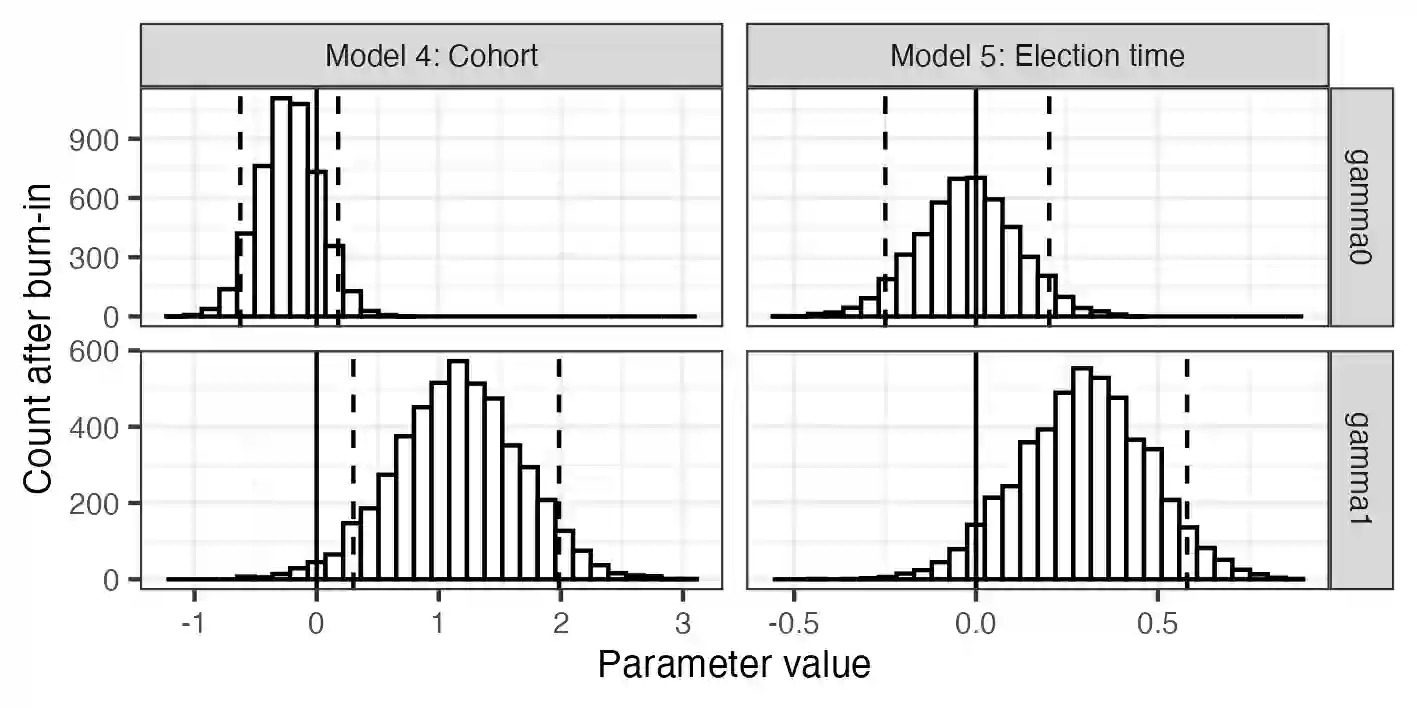
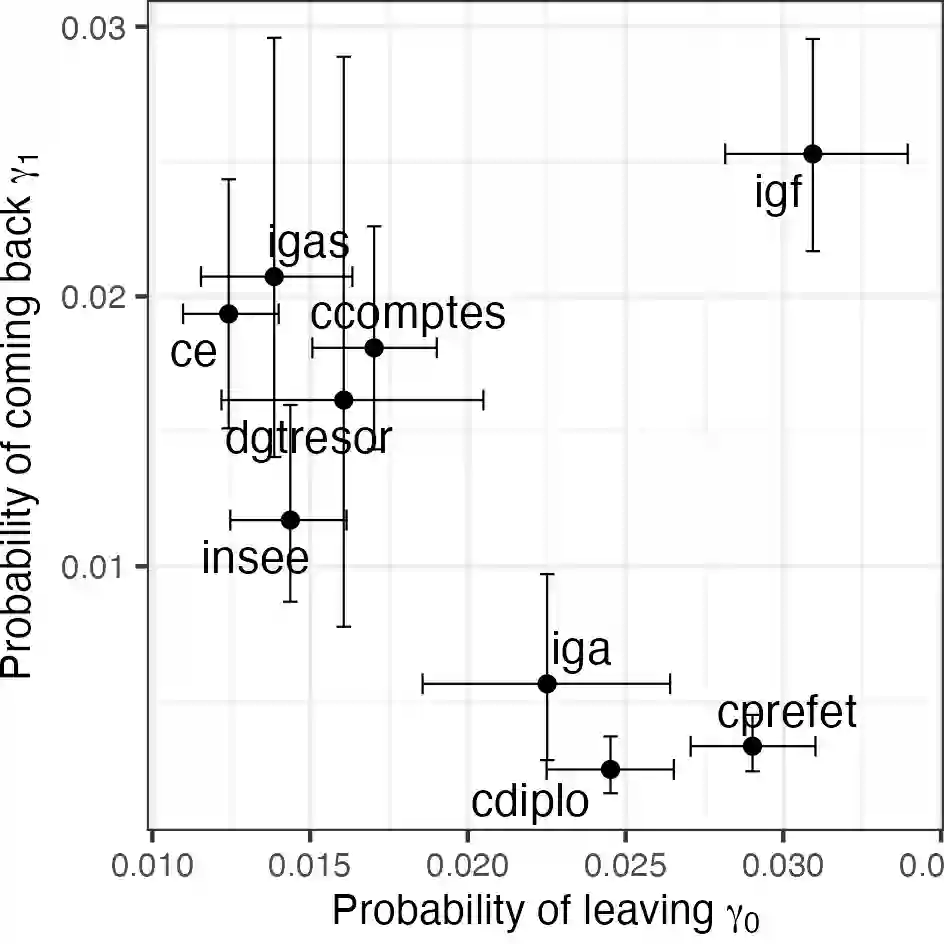
Many social scientists study the career trajectories of populations of interest, such as economic and administrative elites. However, data to document such processes are rarely completely available, which motivates the adoption of inference tools that can account for large numbers of missing values. Taking the example of public-private paths of elite civil servants in France, we introduce binary Markov switching models to perform Bayesian data augmentation. Our procedure relies on two data sources: (1) detailed observations of a small number of individual trajectories, and (2) less informative ``traces'' left by all individuals, which we model for imputation of missing data. An advantage of this model class is that it maintains the properties of hidden Markov models and enables a tailored sampler to target the posterior, while allowing for varying parameters across individuals and time. We provide two applied studies which demonstrate this can be used to properly test substantive hypotheses, and expand the social scientific literature in various ways. We notably show that the rate at which ENA graduates exit the French public sector has not increased since 1990, but that the rate at which they come back has increased.
翻译:许多社会科学家研究特定人群的职业轨迹,例如经济与管理精英。然而,记录此类过程的数据很少完全可得,这促使我们采用能够处理大量缺失值的推断工具。以法国精英公务员的公共-私营部门转换路径为例,我们引入二元马尔可夫切换模型进行贝叶斯数据增强。我们的方法依赖两种数据源:(1)少量个体轨迹的详细观测数据;(2)所有个体留下的信息量较少的“轨迹”,我们通过建模这些轨迹来填补缺失数据。此类模型的优势在于保持了隐马尔可夫模型的性质,可通过定制采样器求解后验分布,同时允许个体间与时变参数的存在。我们通过两项应用研究证明,该方法能有效检验实质性假设,并从多角度拓展社会科学研究。我们特别指出:自1990年以来,法国国立行政学院毕业生离开公共部门的比例并未上升,但其回流比例有所增加。







相关内容




 微信扫码咨询专知VIP会员