

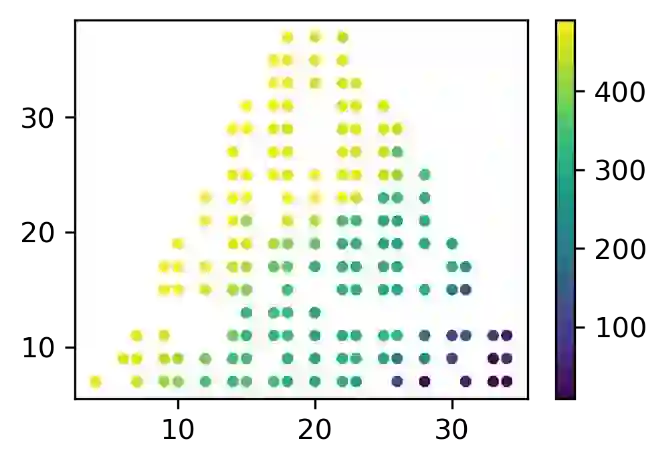
Advanced materials are needed to further next-generation technologies such as quantum computing, carbon capture, and low-cost medical imaging. However, advanced materials discovery is confounded by two fundamental challenges: the challenge of a high-dimensional, complex materials search space and the challenge of combining knowledge, i.e., data fusion across instruments and labs. To overcome the first challenge, researchers employ knowledge of the underlying material synthesis-structure-property relationship, as a material's structure is often predictive of its functional property and vice versa. For example, optimal materials often occur along composition-phase boundaries or within specific phase regions. Additionally, knowledge of the synthesis-structure-property relationship is fundamental to understanding underlying physical mechanisms. However, quantifying the synthesis-structure-property relationship requires overcoming the second challenge. Researchers must merge knowledge gathered across instruments, measurement modalities, and even laboratories. We present the Synthesis-structure-property relAtionship coreGionalized lEarner (SAGE) algorithm. A fully Bayesian algorithm that uses multimodal coregionalization to merge knowledge across data sources to learn synthesis-structure-property relationships.
翻译:先进材料是推动量子计算、碳捕获和低成本医学成像等下一代技术发展所必需的。然而,先进材料的发现面临两个根本性挑战:高维复杂材料搜索空间的挑战,以及跨仪器和实验室的知识融合(即数据融合)的挑战。为克服第一个挑战,研究人员利用材料合成-结构-性能之间的潜在关系知识,因为材料的结构往往能预测其功能特性,反之亦然。例如,最优材料常出现在成分相边界或特定相区。此外,合成-结构-性能关系的认知是理解潜在物理机制的基础。然而,量化合成-结构-性能关系需要克服第二个挑战——研究人员必须整合跨仪器、测量模态乃至实验室获取的知识。我们提出合成-结构-性能关系共区域化学习器(SAGE)算法,这是一种全贝叶斯算法,通过多模态共区域化融合跨数据源的知识来学习合成-结构-性能关系。








相关内容




 微信扫码咨询专知VIP会员