

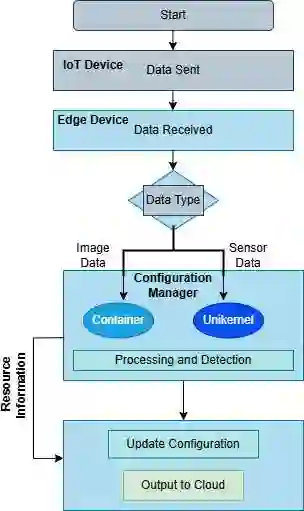
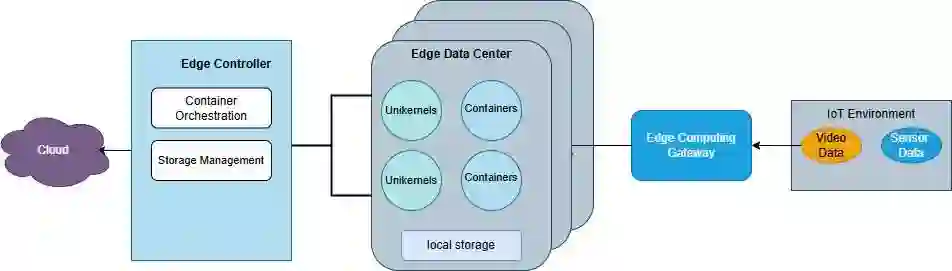
Edge computing is emerging as a key enabler of low-latency, high-efficiency processing for the Internet of Things (IoT) and other real-time applications. To support these demands, containerization has gained traction in edge computing due to its lightweight virtualization and efficient resource management. However, there is currently no established framework to leverage both containers and unikernels on edge devices for optimized IoT deployments. This paper proposes a hybrid edge system design that leverages container and unikernel technologies to optimize resource utilization based on application complexity. Containers are employed for resource-intensive applications, e.g., computer vision, providing faster processing, flexibility, and ease of deployment. In contrast, unikernels are used for lightweight applications, offering enhanced resource performance with minimal overhead. Our system design also incorporates container orchestration to efficiently manage multiple instances across the edge efficiently, ensuring scalability and reliability. We demonstrate our hybrid approach's performance and efficiency advantages through real-world computer vision and data science applications on ARM-powered edge device. Our results demonstrate that this hybrid approach improves resource utilization and reduces latency compared to traditional virtualized solutions. This work provides insights into optimizing edge infrastructures, enabling more efficient and specialized deployment strategies for diverse application workloads.
翻译:边缘计算正逐渐成为物联网(IoT)及其他实时应用实现低延迟、高效率处理的关键赋能技术。为满足这些需求,容器化技术凭借其轻量级虚拟化和高效的资源管理能力,在边缘计算领域日益受到关注。然而,目前尚缺乏成熟的框架来在边缘设备上协同利用容器与Unikernel,以优化物联网部署。本文提出一种混合边缘系统设计,该设计结合容器与Unikernel技术,根据应用复杂度优化资源利用率。容器被用于资源密集型应用(例如计算机视觉),以提供更快的处理速度、灵活性及便捷的部署;而Unikernel则用于轻量级应用,以极低的开销实现更高的资源性能。我们的系统设计还集成了容器编排功能,以高效管理边缘侧多个实例,确保可扩展性与可靠性。通过在基于ARM架构的边缘设备上进行实际计算机视觉与数据科学应用的测试,我们验证了该混合方法在性能与效率上的优势。实验结果表明,相较于传统的虚拟化方案,此混合方法能够提升资源利用率并降低延迟。本研究为优化边缘基础设施提供了见解,有助于为多样化的应用负载实现更高效、更专业的部署策略。





相关内容





 微信扫码咨询专知VIP会员