

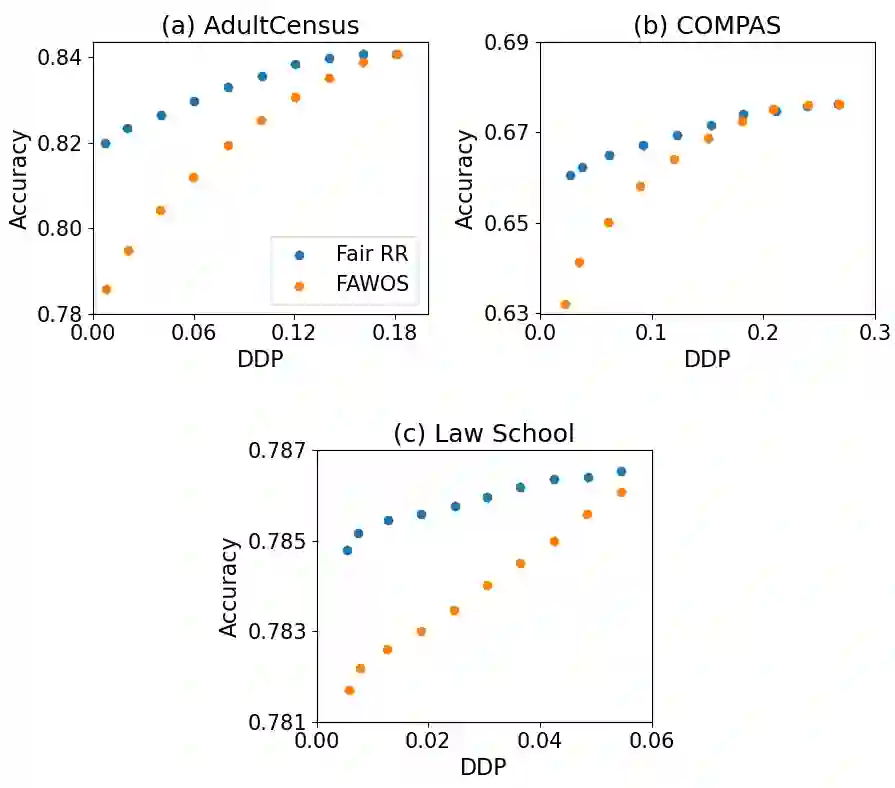
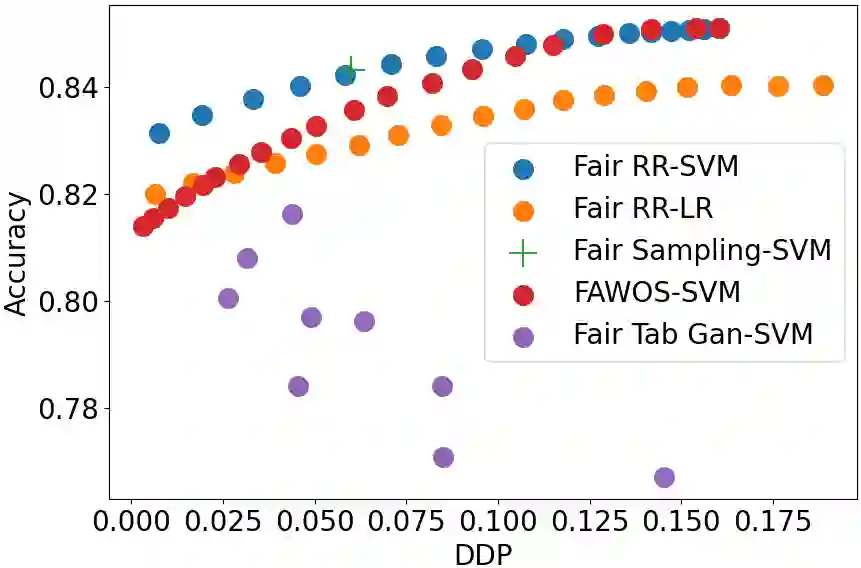
The increasing usage of machine learning models in consequential decision-making processes has spurred research into the fairness of these systems. While significant work has been done to study group fairness in the in-processing and post-processing setting, there has been little that theoretically connects these results to the pre-processing domain. This paper proposes that achieving group fairness in downstream models can be formulated as finding the optimal design matrix in which to modify a response variable in a Randomized Response framework. We show that measures of group fairness can be directly controlled for with optimal model utility, proposing a pre-processing algorithm called FairRR that yields excellent downstream model utility and fairness.
翻译:机器学习模型在关键决策过程中的广泛应用,促使学界对这类系统的公平性展开研究。尽管在过程处理和后处理场景中已有大量关于群体公平性的工作,但鲜有研究从理论层面将这些成果与预处理领域联系起来。本文提出,下游模型中的群体公平性目标可转化为在随机化响应框架下寻找最优设计矩阵以修正响应变量的问题。我们证明,通过最优模型效用可直接调控群体公平性度量,并据此提出名为FairRR的预处理算法,该算法可使下游模型在保持卓越效用的同时实现公平性。




相关内容





 微信扫码咨询专知VIP会员