

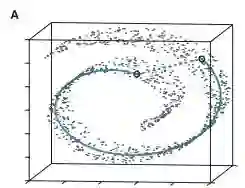
Despite persistent efforts in revealing the temporal patterns in scientific careers, little attention has been paid to the spatial patterns of scientific activities in the knowledge space. Here, we consider scientists' publication sequence as walks on the quantifiable epistemic landscape constructed by the manifold learning algorithm based on the semantic proximity among papers learned by the document-embedding method or the relational proximity learned by the graph-embedding method, aiming to reveal the individual research topic dynamics and association between research radius with academic performance. Intuitively, the visualization shows the localized and bounded nature of mobile trajectories. We further find that distributions of scientists' transition radius and transition pace are both left-skewed compared with the results of controlled experiments. Then, we observe the mixed exploration and exploitation pattern and the corresponding strategic trade-off in the research transition, where scientists both deepen their previous research with frequency bias and explore new research with knowledge proximity bias. We further develop a bounded exploration-exploitation model to reproduce the patterns. Moreover, the association between scientists' research radius and academic performance shows that extensive exploration will not lead to a sustained increase in academic output but a decrease in impact. In addition, we also note that disruptive findings are more derived from an extensive transition, whereas there is a saturation in this association. Our findings are instrumental for designing the course of an academic career and enlightening the investment of scientific practicing resources.
翻译:尽管在揭示科学生涯时间模式方面已有持续努力,但学界对科学活动在知识空间中的空间模式关注甚少。本文通过将科学家的论文发表序列视为在量化认知地图上的行走轨迹展开研究:该认知地图基于流形学习算法构建,利用文档嵌入方法学习的论文语义邻近性或图嵌入方法学习的关系邻近性生成,旨在揭示个体研究主题动态及研究半径与学术绩效之间的关联。直观可视化表明,移动轨迹具有局域化与有限性特征。进一步发现,与对照实验相比,科学家研究半径与移动速率的分布均呈现左偏态。随后观察到研究迁移中探索与利用的混合模式及相应的策略权衡:科学家既通过频率偏好深化已有研究,又通过知识邻近性偏好探索新领域。我们进而建立有限探索-利用模型复现上述模式。此外,科学家研究半径与学术绩效的关联表明,广泛探索不会持续提升学术产出量,反而会降低影响力。同时值得注意的是,颠覆性发现更多源于广泛迁移,但该关联存在饱和效应。本研究对学术生涯路径规划及科研资源投入策略具有重要启示意义。




相关内容

- Today (iOS and OS X): widgets for the Today view of Notification Center
- Share (iOS and OS X): post content to web services or share content with others
- Actions (iOS and OS X): app extensions to view or manipulate inside another app
- Photo Editing (iOS): edit a photo or video in Apple's Photos app with extensions from a third-party apps
- Finder Sync (OS X): remote file storage in the Finder with support for Finder content annotation
- Storage Provider (iOS): an interface between files inside an app and other apps on a user's device
- Custom Keyboard (iOS): system-wide alternative keyboards
Source: iOS 8 Extensions: Apple’s Plan for a Powerful App Ecosystem



 微信扫码咨询专知VIP会员