

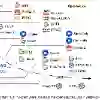
Foundation models (e.g. ChatGPT, StableDiffusion) pervasively influence society, warranting immediate social attention. While the models themselves garner much attention, to accurately characterize their impact, we must consider the broader sociotechnical ecosystem. We propose Ecosystem Graphs as a documentation framework to transparently centralize knowledge of this ecosystem. Ecosystem Graphs is composed of assets (datasets, models, applications) linked together by dependencies that indicate technical (e.g. how Bing relies on GPT-4) and social (e.g. how Microsoft relies on OpenAI) relationships. To supplement the graph structure, each asset is further enriched with fine-grained metadata (e.g. the license or training emissions). We document the ecosystem extensively at https://crfm.stanford.edu/ecosystem-graphs/. As of March 16, 2023, we annotate 262 assets (64 datasets, 128 models, 70 applications) from 63 organizations linked by 356 dependencies. We show Ecosystem Graphs functions as a powerful abstraction and interface for achieving the minimum transparency required to address myriad use cases. Therefore, we envision Ecosystem Graphs will be a community-maintained resource that provides value to stakeholders spanning AI researchers, industry professionals, social scientists, auditors and policymakers.
翻译:基础模型(如ChatGPT、StableDiffusion)对社会产生广泛影响,亟需社会关注。尽管模型本身备受瞩目,但要准确刻画其影响,我们必须考虑更广泛的社会技术生态系统。我们提出"生态系统图"(Ecosystem Graphs)作为文献框架,以透明化方式集中记录该生态系统的知识。生态系统图由资产(数据集、模型、应用)组成,通过关联关系相互连接,这些关联既包含技术关系(如Bing依赖GPT-4的方式)也包含社会关系(如Microsoft依赖OpenAI的方式)。为补充图结构,每个资产还被进一步赋予细粒度元数据(如许可证或训练排放量)。我们在网址https://crfm.stanford.edu/ecosystem-graphs/对该生态系统进行了详尽记录。截至2023年3月16日,我们已标注来自63个组织的262个资产(64个数据集、128个模型、70个应用),由356个关联关系相连接。我们证明生态系统图可作为强大的抽象接口,实现满足多种用例所需的最低限度透明度。因此,我们设想生态系统图将成为社区维护的资源,为包括AI研究者、产业专业人士、社会科学家、审计师和政策制定者在内的利益相关者提供价值。




相关内容




 微信扫码咨询专知VIP会员