

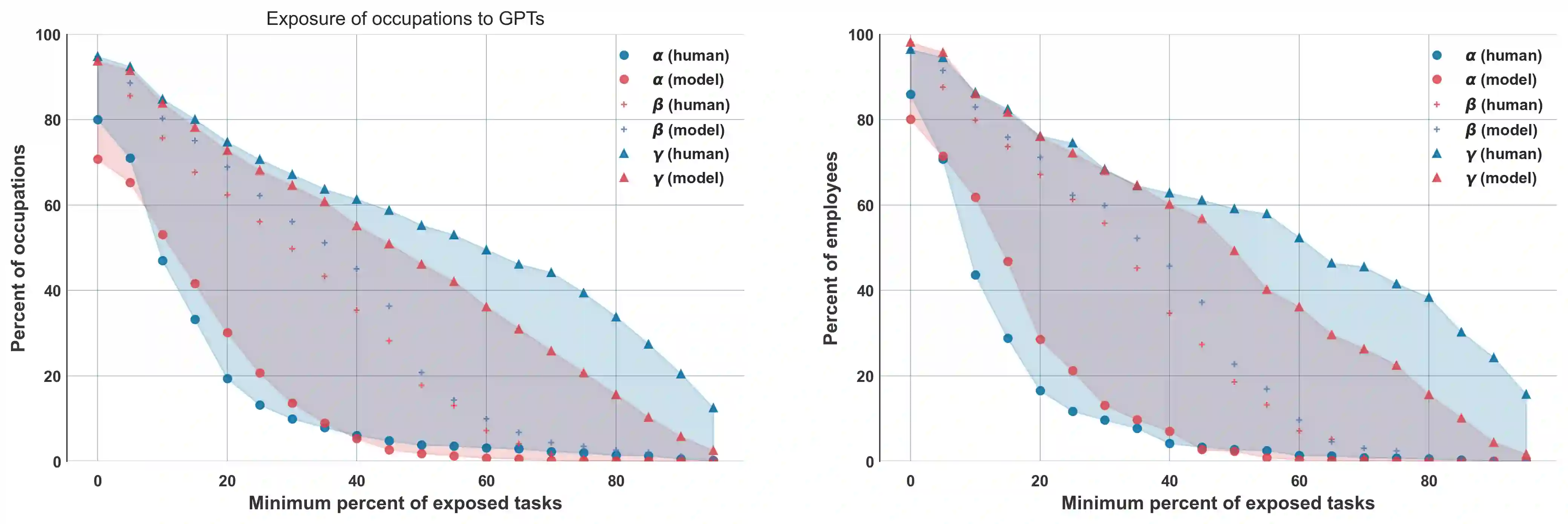
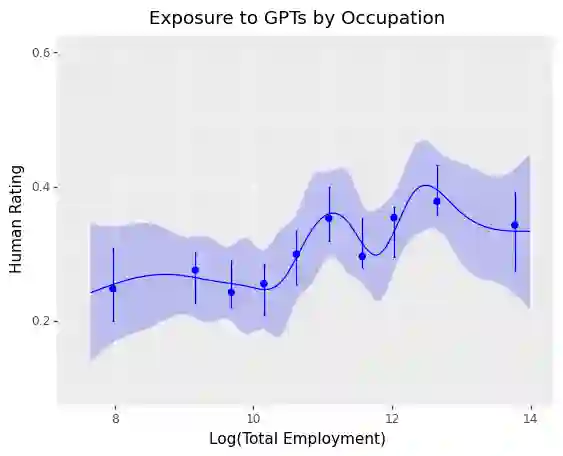
We investigate the potential implications of large language models (LLMs), such as Generative Pre-trained Transformers (GPTs), on the U.S. labor market, focusing on the increased capabilities arising from LLM-powered software compared to LLMs on their own. Using a new rubric, we assess occupations based on their alignment with LLM capabilities, integrating both human expertise and GPT-4 classifications. Our findings reveal that around 80% of the U.S. workforce could have at least 10% of their work tasks affected by the introduction of LLMs, while approximately 19% of workers may see at least 50% of their tasks impacted. We do not make predictions about the development or adoption timeline of such LLMs. The projected effects span all wage levels, with higher-income jobs potentially facing greater exposure to LLM capabilities and LLM-powered software. Significantly, these impacts are not restricted to industries with higher recent productivity growth. Our analysis suggests that, with access to an LLM, about 15% of all worker tasks in the US could be completed significantly faster at the same level of quality. When incorporating software and tooling built on top of LLMs, this share increases to between 47 and 56% of all tasks. This finding implies that LLM-powered software will have a substantial effect on scaling the economic impacts of the underlying models. We conclude that LLMs such as GPTs exhibit traits of general-purpose technologies, indicating that they could have considerable economic, social, and policy implications.
翻译:我们研究了大型语言模型(如生成式预训练Transformer,GPT)对美国劳动力市场的潜在影响,重点分析了相较于单一LLM,基于LLM的软件所提升的能力。通过采用一种新的评估框架,结合人类专家评估与GPT-4分类,我们评估了各类职业与LLM能力的匹配程度。研究结果表明,约80%的美国劳动力可能至少有10%的工作任务受到LLM引入的影响,而约19%的从业者可能面临至少50%的任务受影响。我们并未对这类LLM的发展或应用时间线做出预测。预估的影响覆盖所有薪资水平,其中高收入岗位可能面临LLM能力及LLM驱动软件更显著的冲击。值得注意的是,这些影响并不局限于近期生产率增长较快的行业。我们的分析显示,在接入LLM的情况下,美国约15%的工人任务可在保持同等质量水平下显著加速完成。当整合基于LLM构建的软件与工具时,这一比例提升至全部任务的47%至56%。这一发现表明,基于LLM的软件将对放大底层模型的经济影响产生实质性作用。我们得出结论:GPT等LLM展现出通用技术特征,预示着其可能对经济、社会及政策领域产生深远影响。




相关内容





 微信扫码咨询专知VIP会员