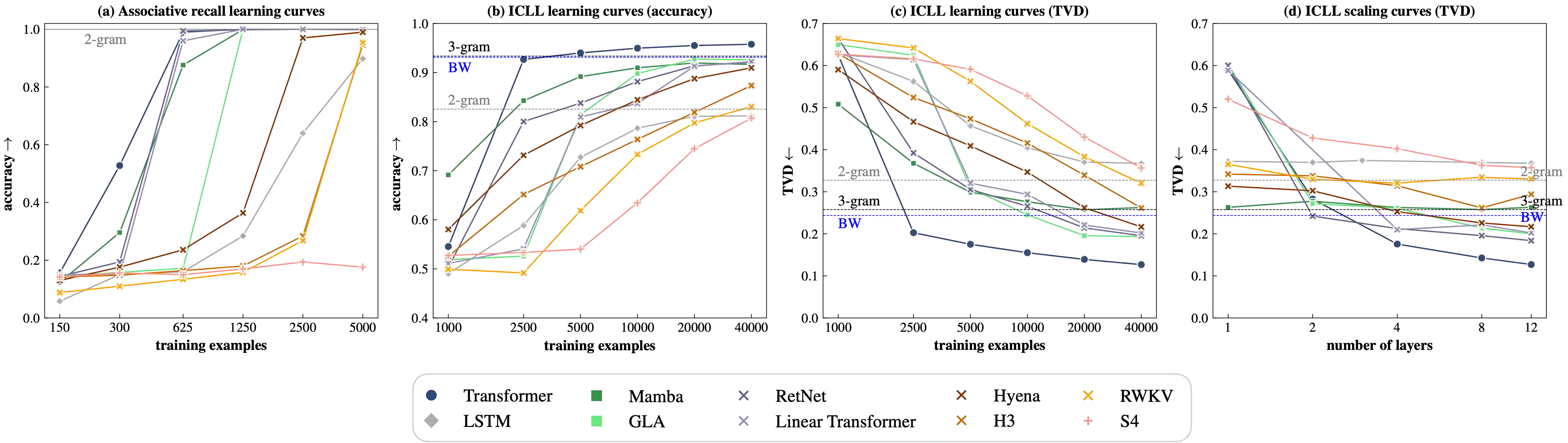
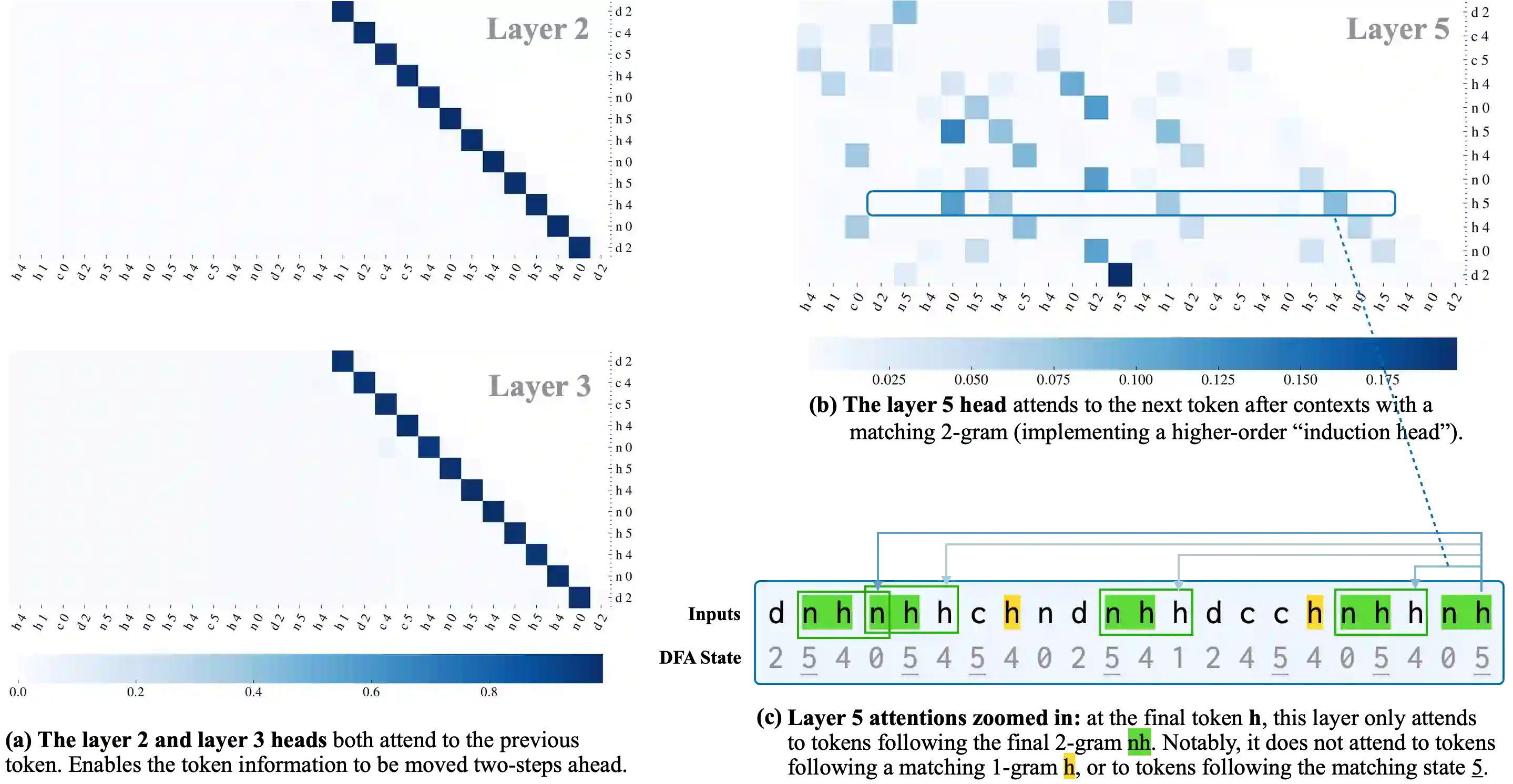
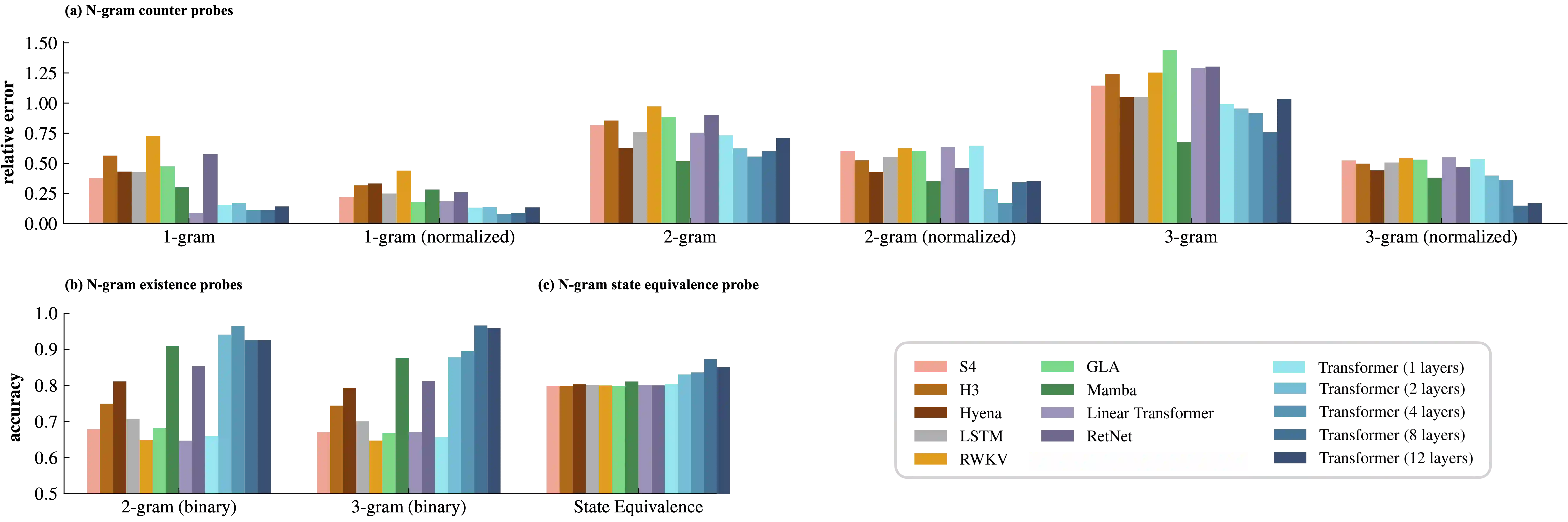
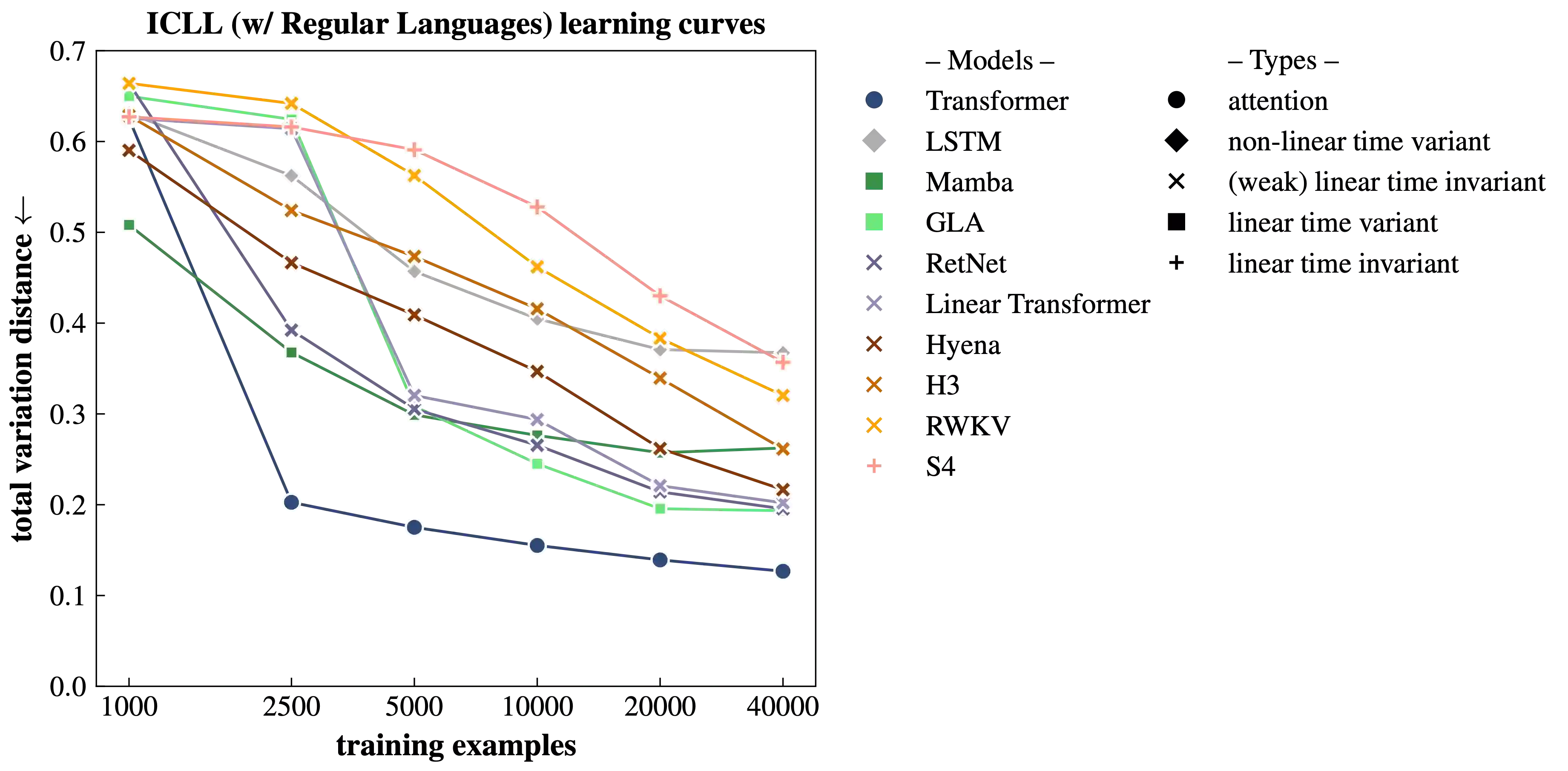
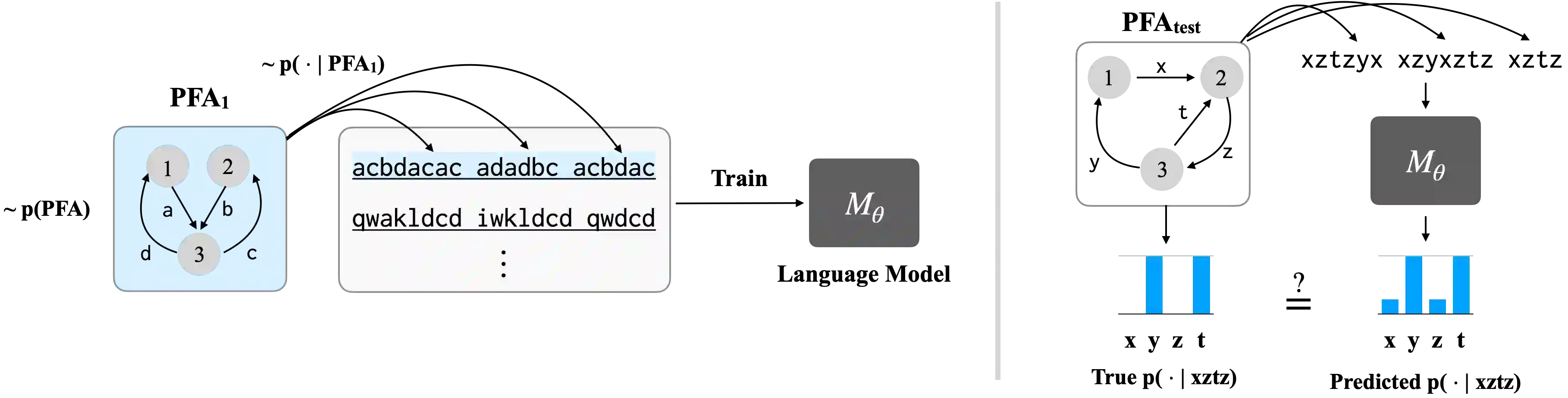
Large-scale neural language models exhibit a remarkable capacity for in-context learning (ICL): they can infer novel functions from datasets provided as input. Most of our current understanding of when and how ICL arises comes from LMs trained on extremely simple learning problems like linear regression and associative recall. There remains a significant gap between these model problems and the "real" ICL exhibited by LMs trained on large text corpora, which involves not just retrieval and function approximation but free-form generation of language and other structured outputs. In this paper, we study ICL through the lens of a new family of model problems we term in context language learning (ICLL). In ICLL, LMs are presented with a set of strings from a formal language, and must generate additional strings from the same language. We focus on in-context learning of regular languages generated by random finite automata. We evaluate a diverse set of neural sequence models (including several RNNs, Transformers, and state-space model variants) on regular ICLL tasks, aiming to answer three questions: (1) Which model classes are empirically capable of ICLL? (2) What algorithmic solutions do successful models implement to perform ICLL? (3) What architectural changes can improve ICLL in less performant models? We first show that Transformers significantly outperform neural sequence models with recurrent or convolutional representations on ICLL tasks. Next, we provide evidence that their ability to do so relies on specialized "n-gram heads" (higher-order variants of induction heads) that compute input-conditional next-token distributions. Finally, we show that hard-wiring these heads into recurrent and convolutional models improves performance not just on ICLL, but natural language modeling -- improving the perplexity of 340M-parameter models by up to 1.14 points (6.7%) on the SlimPajama dataset.


翻译:大规模神经语言模型展现出惊人的上下文学习(ICL)能力:它们能够从输入数据集中推断出新函数。当前我们对于ICL何时以及如何产生的大部分理解,均源自在线性回归和关联回忆等极其简单的学习任务上训练的语言模型。这些模型问题与在大规模文本语料库上训练的语言模型所展现的"真实"ICL之间存在显著差距——后者不仅涉及检索和函数逼近,还涉及自由生成语言及其他结构化输出。本文通过一个我们称之为上下文语言学习(ICLL)的新模型问题系列来研究ICL。在ICLL中,语言模型被呈现一组来自形式语言的字符串,并需生成同一语言的更多字符串。我们聚焦于随机有限自动机生成的正则语言的上下文学习。在正则ICLL任务上,我们评估了多种神经序列模型(包括多种RNN、Transformer及状态空间模型变体),旨在回答三个问题:(1)哪些模型类别在经验上具备ICLL能力?(2)成功模型为实现ICLL采用了何种算法解决方案?(3)哪些架构改进能提升性能较弱模型的ICLL能力?我们首先证明Transformer在ICLL任务上显著优于具有循环或卷积表示的神经序列模型。其次,我们提供证据表明其实现该能力依赖于专门化的"n-gram头"(归纳头的更高阶变体),这些模块计算基于输入条件的下一个词元分布。最后,我们证明将这些头硬编码到循环和卷积模型中,不仅能提升ICLL性能,还能改进自然语言建模——在SlimPajama数据集上使3.4亿参数模型的困惑度最多降低1.14个点(6.7%)。
0
下载
关闭预览

相关内容

ACM/IEEE第23届模型驱动工程语言和系统国际会议,是模型驱动软件和系统工程的首要会议系列,由ACM-SIGSOFT和IEEE-TCSE支持组织。自1998年以来,模型涵盖了建模的各个方面,从语言和方法到工具和应用程序。模特的参加者来自不同的背景,包括研究人员、学者、工程师和工业专业人士。MODELS 2019是一个论坛,参与者可以围绕建模和模型驱动的软件和系统交流前沿研究成果和创新实践经验。今年的版本将为建模社区提供进一步推进建模基础的机会,并在网络物理系统、嵌入式系统、社会技术系统、云计算、大数据、机器学习、安全、开源等新兴领域提出建模的创新应用以及可持续性。 官网链接:http://www.modelsconference.org/
FlowQA: Grasping Flow in History for Conversational Machine Comprehension
专知会员服务
34+阅读 · 2019年10月18日
Stabilizing Transformers for Reinforcement Learning
专知会员服务
60+阅读 · 2019年10月17日
《DeepGCNs: Making GCNs Go as Deep as CNNs》
专知会员服务
32+阅读 · 2019年10月17日
Keras François Chollet 《Deep Learning with Python 》, 386页pdf
专知会员服务
164+阅读 · 2019年10月12日
Transferring Knowledge across Learning Processes
CreateAMind
29+阅读 · 2019年5月18日
强化学习的Unsupervised Meta-Learning
CreateAMind
18+阅读 · 2019年1月7日
Unsupervised Learning via Meta-Learning
CreateAMind
44+阅读 · 2019年1月3日
meta learning 17年:MAML SNAIL
CreateAMind
11+阅读 · 2019年1月2日
A Technical Overview of AI & ML in 2018 & Trends for 2019
待字闺中
18+阅读 · 2018年12月24日
Single-Shot Object Detection with Enriched Semantics
统计学习与视觉计算组
14+阅读 · 2018年8月29日
STRCF for Visual Object Tracking
统计学习与视觉计算组
15+阅读 · 2018年5月29日
Focal Loss for Dense Object Detection
统计学习与视觉计算组
12+阅读 · 2018年3月15日
IJCAI | Cascade Dynamics Modeling with Attention-based RNN
KingsGarden
13+阅读 · 2017年7月16日
From Softmax to Sparsemax-ICML16(1)
KingsGarden
74+阅读 · 2016年11月26日
国家自然科学基金
1+阅读 · 2017年12月31日
国家自然科学基金
13+阅读 · 2017年12月31日
国家自然科学基金
2+阅读 · 2015年12月31日
国家自然科学基金
0+阅读 · 2015年12月31日
国家自然科学基金
0+阅读 · 2015年12月31日
国家自然科学基金
0+阅读 · 2015年12月31日
国家自然科学基金
2+阅读 · 2015年12月31日
国家自然科学基金
0+阅读 · 2014年12月31日
国家自然科学基金
0+阅读 · 2014年12月31日
国家自然科学基金
6+阅读 · 2014年12月31日
Car-Following Models: A Multidisciplinary Review
Arxiv
0+阅读 · 2024年3月5日
Arxiv
0+阅读 · 2024年3月4日
Arxiv
70+阅读 · 2022年6月30日
Knowledge Representation Learning: A Quantitative Review
VIP会员
最新内容
认知战:定义与能力发展
专知会员服务
2+阅读 · 今天9:25
乌军利用美国“黄蜂”无人机摧毁俄军后勤
专知会员服务
5+阅读 · 6月7日
《支持作战级人机协同智能的交互式OODA流程》
专知会员服务
14+阅读 · 6月7日
ICML 2026 | SARDI:扩散语言模型的自增强检索
专知会员服务
8+阅读 · 6月6日
相关资讯
Transferring Knowledge across Learning Processes
CreateAMind
29+阅读 · 2019年5月18日
强化学习的Unsupervised Meta-Learning
CreateAMind
18+阅读 · 2019年1月7日
Unsupervised Learning via Meta-Learning
CreateAMind
44+阅读 · 2019年1月3日
meta learning 17年:MAML SNAIL
CreateAMind
11+阅读 · 2019年1月2日
A Technical Overview of AI & ML in 2018 & Trends for 2019
待字闺中
18+阅读 · 2018年12月24日
Single-Shot Object Detection with Enriched Semantics
统计学习与视觉计算组
14+阅读 · 2018年8月29日
STRCF for Visual Object Tracking
统计学习与视觉计算组
15+阅读 · 2018年5月29日
Focal Loss for Dense Object Detection
统计学习与视觉计算组
12+阅读 · 2018年3月15日
IJCAI | Cascade Dynamics Modeling with Attention-based RNN
KingsGarden
13+阅读 · 2017年7月16日
From Softmax to Sparsemax-ICML16(1)
KingsGarden
74+阅读 · 2016年11月26日
相关基金
国家自然科学基金
1+阅读 · 2017年12月31日
国家自然科学基金
13+阅读 · 2017年12月31日
国家自然科学基金
2+阅读 · 2015年12月31日
国家自然科学基金
0+阅读 · 2015年12月31日
国家自然科学基金
0+阅读 · 2015年12月31日
国家自然科学基金
0+阅读 · 2015年12月31日
国家自然科学基金
2+阅读 · 2015年12月31日
国家自然科学基金
0+阅读 · 2014年12月31日
国家自然科学基金
0+阅读 · 2014年12月31日
国家自然科学基金
6+阅读 · 2014年12月31日
Top
微信扫码咨询专知VIP会员