

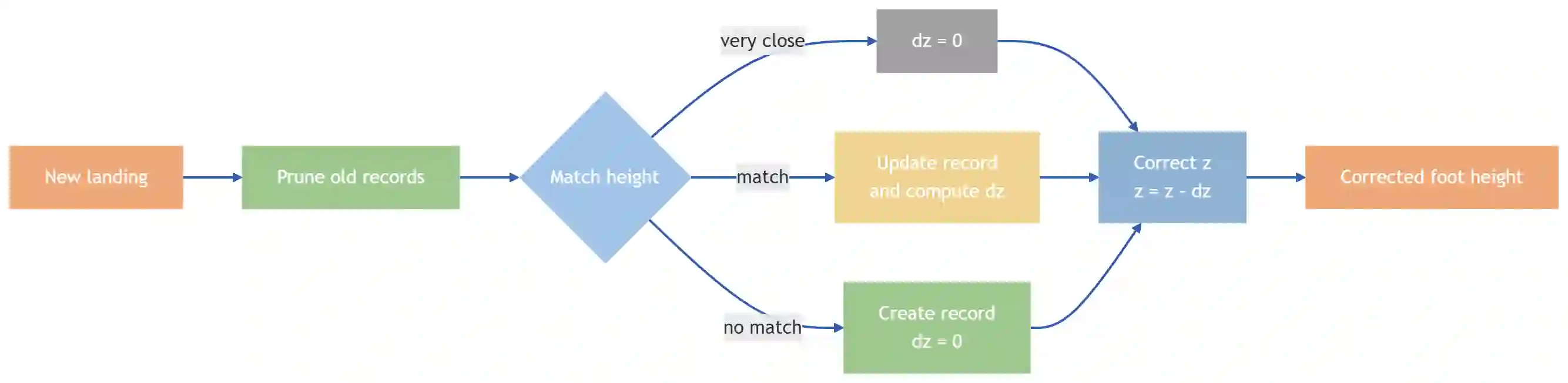
Reliable odometry for legged robots without cameras or LiDAR remains challenging due to IMU drift and noisy joint velocity sensing. This paper presents a purely proprioceptive state estimator that uses only IMU and motor measurements to jointly estimate body pose and velocity, with a unified formulation applicable to biped, quadruped, and wheel-legged robots. The key idea is to treat each contacting leg as a kinematic anchor: joint-torque--based foot wrench estimation selects reliable contacts, and the corresponding footfall positions provide intermittent world-frame constraints that suppress long-term drift. To prevent elevation drift during extended traversal, we introduce a lightweight height clustering and time-decay correction that snaps newly recorded footfall heights to previously observed support planes. To improve foot velocity observations under encoder quantization, we apply an inverse-kinematics cubature Kalman filter that directly filters foot-end velocities from joint angles and velocities. The implementation further mitigates yaw drift through multi-contact geometric consistency and degrades gracefully to a kinematics-derived heading reference when IMU yaw constraints are unavailable or unreliable. We evaluate the method on four quadruped platforms (three Astrall robots and a Unitree Go2 EDU) using closed-loop trajectories. On Astrall point-foot robot~A, a $\sim$200\,m horizontal loop and a $\sim$15\,m vertical loop return with 0.1638\,m and 0.219\,m error, respectively; on wheel-legged robot~B, the corresponding errors are 0.2264\,m and 0.199\,m. On wheel-legged robot~C, a $\sim$700\,m horizontal loop yields 7.68\,m error and a $\sim$20\,m vertical loop yields 0.540\,m error. Unitree Go2 EDU closes a $\sim$120\,m horizontal loop with 2.2138\,m error and a $\sim$8\,m vertical loop with less than 0.1\,m vertical error. github.com/ShineMinxing/Ros2Go2Estimator.git
翻译:在无相机或激光雷达的情况下,为足式机器人提供可靠的里程计仍具挑战性,这主要源于IMU漂移和关节速度传感噪声。本文提出一种纯粹的本体感知状态估计器,仅使用IMU和电机测量值来联合估计机体位姿与速度,其统一框架适用于双足、四足及轮腿式机器人。核心思想是将每条接触腿视为一个运动学锚点:基于关节力矩的足端力估计用于筛选可靠接触,相应的足落点位置则提供间歇性的世界坐标系约束,从而抑制长期漂移。为防止在长距离行进中出现高度漂移,我们引入一种轻量级的高度聚类与时间衰减校正方法,将新记录的足落点高度对齐到先前观测到的支撑平面。为改善编码器量化下的足端速度观测,我们应用一种逆运动学容积卡尔曼滤波器,直接从关节角度和速度中滤波估计足端速度。该实现进一步通过多接触几何一致性缓解偏航角漂移,并在IMU偏航约束不可用或不可靠时,优雅地退化为基于运动学的航向参考。我们在四个四足机器人平台(三个Astrall机器人和一个Unitree Go2 EDU)上使用闭环轨迹评估了该方法。在Astrall点足机器人A上,约200米水平环路和约15米垂直环路的误差分别为0.1638米和0.219米;在轮腿式机器人B上,相应误差为0.2264米和0.199米。在轮腿式机器人C上,约700米水平环路产生7.68米误差,约20米垂直环路产生0.540米误差。Unitree Go2 EDU在约120米水平环路中产生2.2138米误差,在约8米垂直环路中垂直误差小于0.1米。github.com/ShineMinxing/Ros2Go2Estimator.git




相关内容



 微信扫码咨询专知VIP会员