

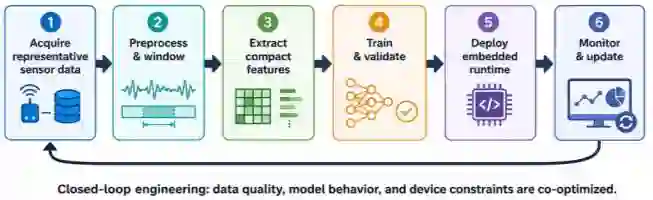
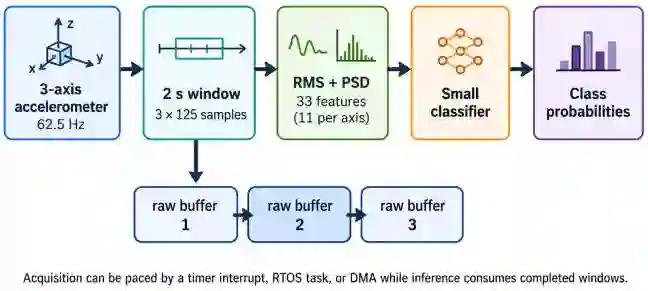
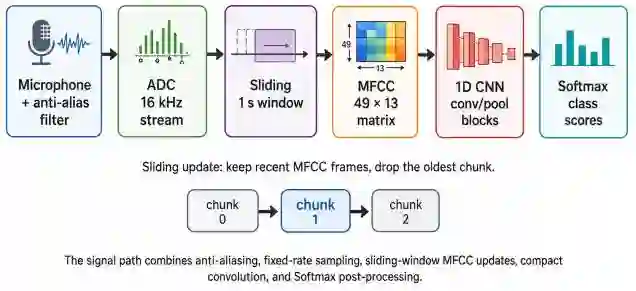
Embedded machine learning moves inference from cloud services to resource-constrained devices that must acquire data, preprocess signals, run a model, and act within tight limits on memory, energy, and latency. This paper presents a systems-oriented synthesis of an embedded machine-learning workflow for microcontroller-class platforms. The emphasis is placed on engineering decisions that are often hidden in generic machine-learning introductions: sampling and buffering, feature extraction as dimensionality reduction, validation under class imbalance, model/runtime co-design, and streaming deployment. Two representative signal families are used throughout the paper. The first is inertial motion recognition, where a two-second, three-axis accelerometer window is transformed from raw samples into root-mean-square and spectral features before classification. The second is keyword spotting, where audio is sampled, anti-aliased, transformed into mel-frequency cepstral coefficients, and processed by a compact one-dimensional convolutional network. The paper concludes with practical design rules for robust on-device inference, including data curation, quantization, thresholding, scheduling, and field monitoring.
翻译:嵌入式机器学习将推理从云服务转移到资源受限的设备上,这些设备必须在严格的内存、能耗和延迟限制下完成数据采集、信号预处理、模型运行及响应动作。本文针对微控制器级平台,提出了一种面向系统的嵌入式机器学习工作流程综合。重点聚焦于通用机器学习教程中常被掩盖的工程决策:采样与缓冲、基于特征提取的降维、类别不平衡下的验证、模型/运行时协同设计,以及流式部署。全文以两类代表性信号为贯穿案例:第一类是惯性运动识别,将两秒时长的三轴加速度计窗口从原始样本转换为均方根和频谱特征后再进行分类;第二类是关键词检测,对音频进行采样、抗混叠滤波、梅尔频率倒谱系数转换,并由紧凑型一维卷积网络处理。文章最后总结了实现稳健设备端推理的实用设计规则,包括数据整理、量化、阈值设定、调度与现场监测。




相关内容




 微信扫码咨询专知VIP会员