

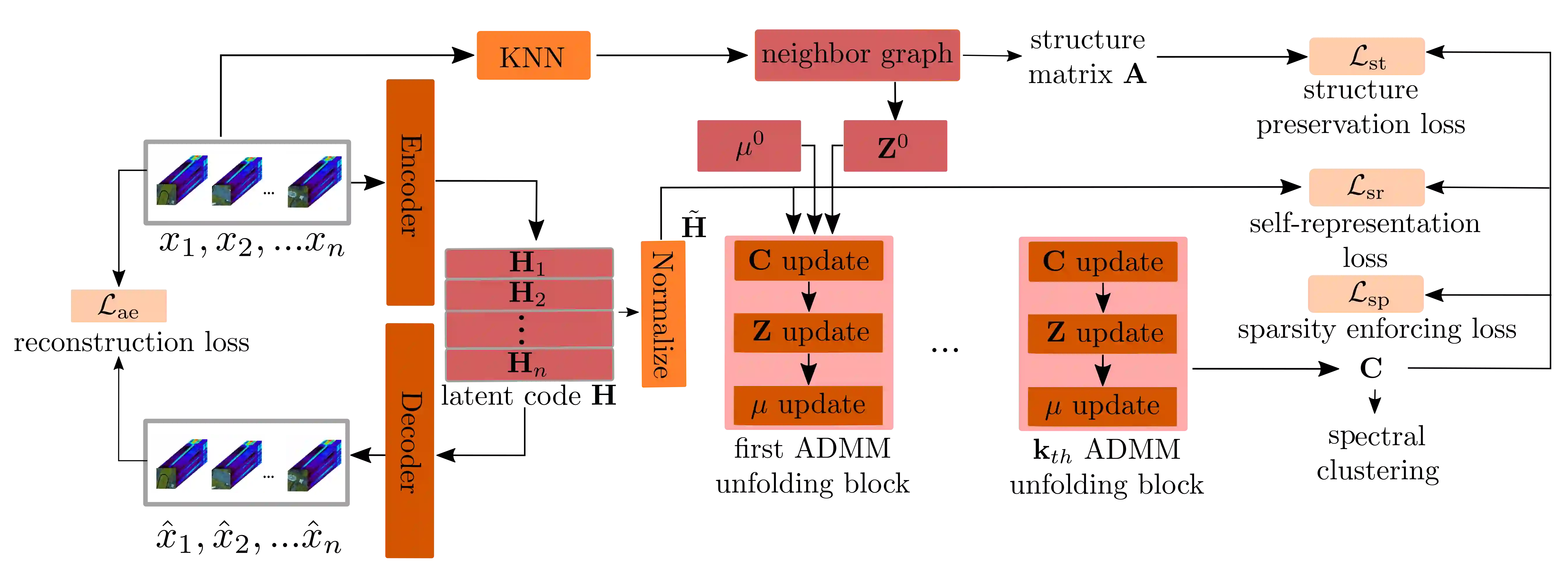
Deep subspace clustering methods are now prominent in clustering, typically using fully connected networks and a self-representation loss function. However, these methods often struggle with overfitting and lack interpretability. In this paper, we explore an alternative clustering approach based on deep unfolding. By unfolding iterative optimization methods into neural networks, this approach offers enhanced interpretability and reliability compared to data-driven deep learning methods, and greater adaptability and generalization than model-based approaches. Hence, unfolding has become widely used in inverse imaging problems, such as image restoration, reconstruction, and super-resolution, but has not been sufficiently explored yet in the context of clustering. In this work, we introduce an innovative clustering architecture for hyperspectral images (HSI) by unfolding an iterative solver based on the Alternating Direction Method of Multipliers (ADMM) for sparse subspace clustering. To our knowledge, this is the first attempt to apply unfolding ADMM for computing the self-representation matrix in subspace clustering. Moreover, our approach captures well the structural characteristics of HSI data by employing the K nearest neighbors algorithm as part of a structure preservation module. Experimental evaluation of three established HSI datasets shows clearly the potential of the unfolding approach in HSI clustering and even demonstrates superior performance compared to state-of-the-art techniques.
翻译:深度子空间聚类方法目前在聚类领域占据主导地位,通常采用全连接网络和自表示损失函数。然而,这些方法常常面临过拟合问题且缺乏可解释性。本文探讨了一种基于深度展开的替代性聚类方法。通过将迭代优化方法展开为神经网络,该方法相比数据驱动的深度学习方法具有更强的可解释性和可靠性,相比基于模型的方法则具有更好的适应性和泛化能力。因此,展开方法已在图像复原、重建和超分辨率等逆成像问题中得到广泛应用,但在聚类领域的探索尚不充分。本研究通过展开基于交替方向乘子法(ADMM)的稀疏子空间聚类迭代求解器,提出了一种创新的高光谱图像(HSI)聚类架构。据我们所知,这是首次尝试应用展开ADMM来计算子空间聚类中的自表示矩阵。此外,我们的方法通过采用K近邻算法作为结构保持模块的一部分,很好地捕捉了HSI数据的结构特征。在三个经典HSI数据集上的实验评估清楚地表明了展开方法在HSI聚类中的潜力,甚至展示了优于现有先进技术的性能。





相关内容




 微信扫码咨询专知VIP会员