

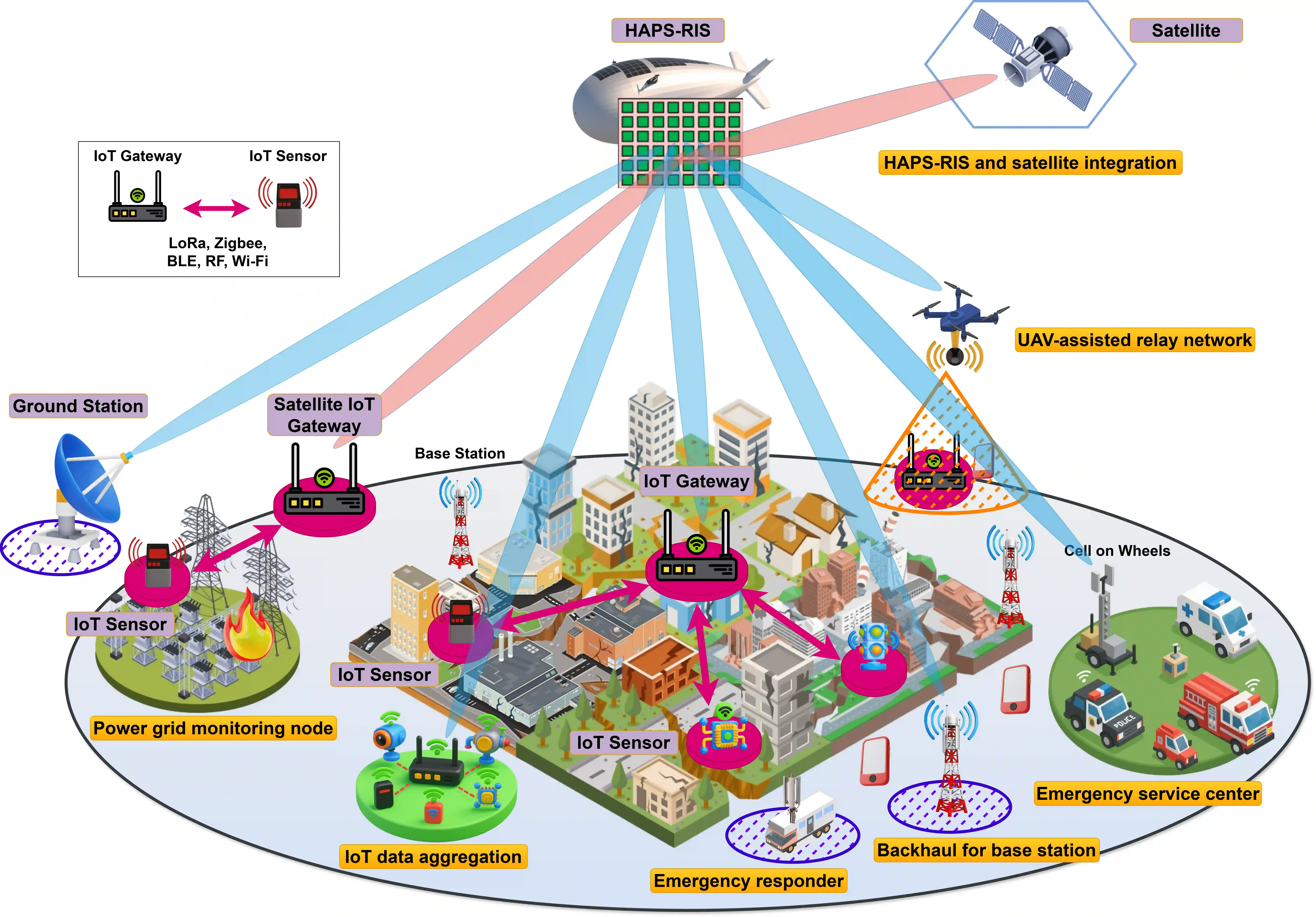
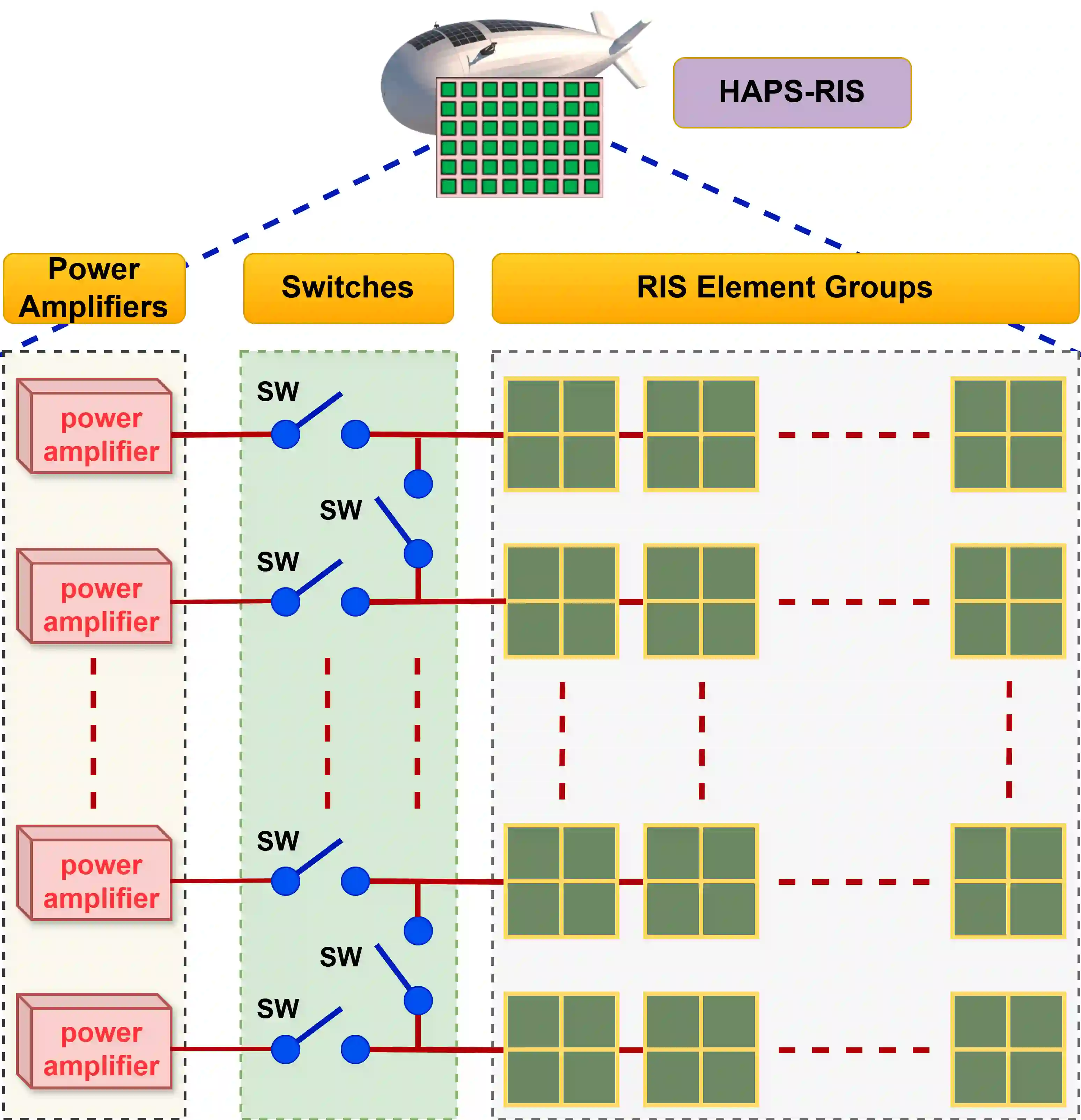
Reliable and resilient communication is essential for disaster recovery and emergency response, yet terrestrial infrastructure often fails during large-scale natural disasters. This paper proposes a High-Altitude Platform Station (HAPS) and Reconfigurable Intelligent Surfaces (RIS)-assisted Internet of Things (IoT) communication system to restore connectivity in disaster-affected areas. Distributed IoT sensors collect critical environmental data and forward it to nearby gateways via short-range links, while the HAPS-RIS system provides backhaul to these gateways. To overcome the severe double path loss of passive RIS at high altitudes, we propose a dynamically adjustable sub-connected active RIS architecture that can reconfigure the number of elements connected to each power amplifier through switching mechanisms. Simulation results demonstrate substantial gains in downlink and uplink data rates, as well as system energy efficiency, compared with conventional passive RIS schemes. Moreover, a 1 dB increase in ground-station transmit power yields approximately 20-30 Mbps improvement in gateway data rates. These findings confirm that HAPS-RIS technology offers an effective and energy-efficient approach for resilient IoT backhaul in 6G non-terrestrial networks, particularly in line-of-sight (LoS)-dominant HAPS-ground backhaul scenarios.
翻译:可靠且具有韧性的通信对于灾后恢复和应急响应至关重要,然而地面基础设施在大规模自然灾害期间常常失效。本文提出了一种高空平台站与可重构智能表面辅助的物联网通信系统,用于恢复受灾区域的网络连接。分布式物联网传感器收集关键环境数据,并通过短距离链路转发至附近的网关,而HAPS-RIS系统则为这些网关提供回程链路。为了克服高空中无源RIS严重的双程路径损耗,我们提出了一种动态可调的子连接有源RIS架构,该架构可通过开关机制重新配置连接到每个功率放大器的单元数量。仿真结果表明,与传统的无源RIS方案相比,该架构在下行和上行数据速率以及系统能效方面均取得了显著提升。此外,地面站发射功率每增加1 dB,网关数据速率可提升约20-30 Mbps。这些发现证实,HAPS-RIS技术为6G非地面网络中具有韧性的物联网回程提供了一种高效且节能的解决方案,尤其是在视距链路占主导的HAPS-地面回程场景中。




相关内容


 微信扫码咨询专知VIP会员