

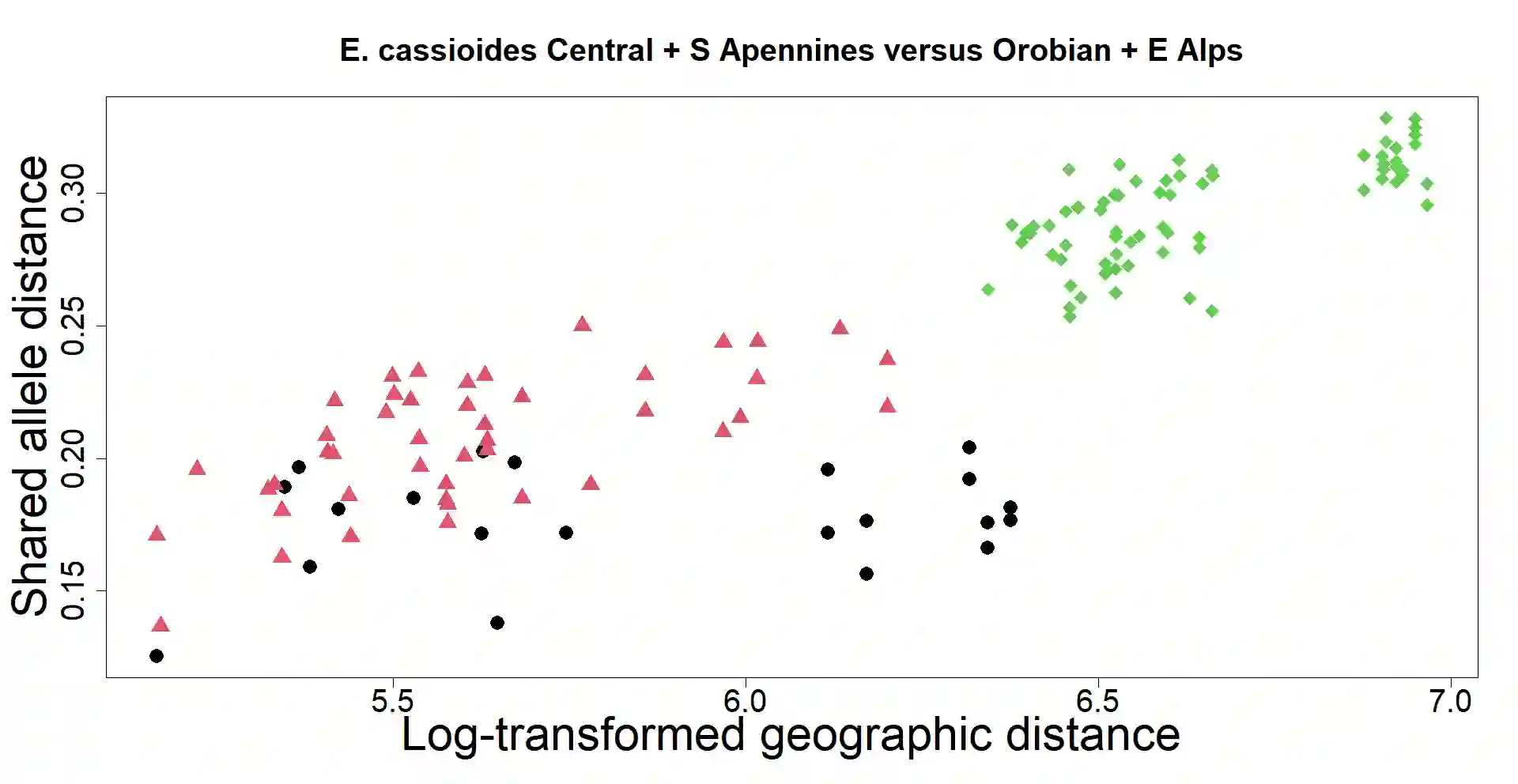
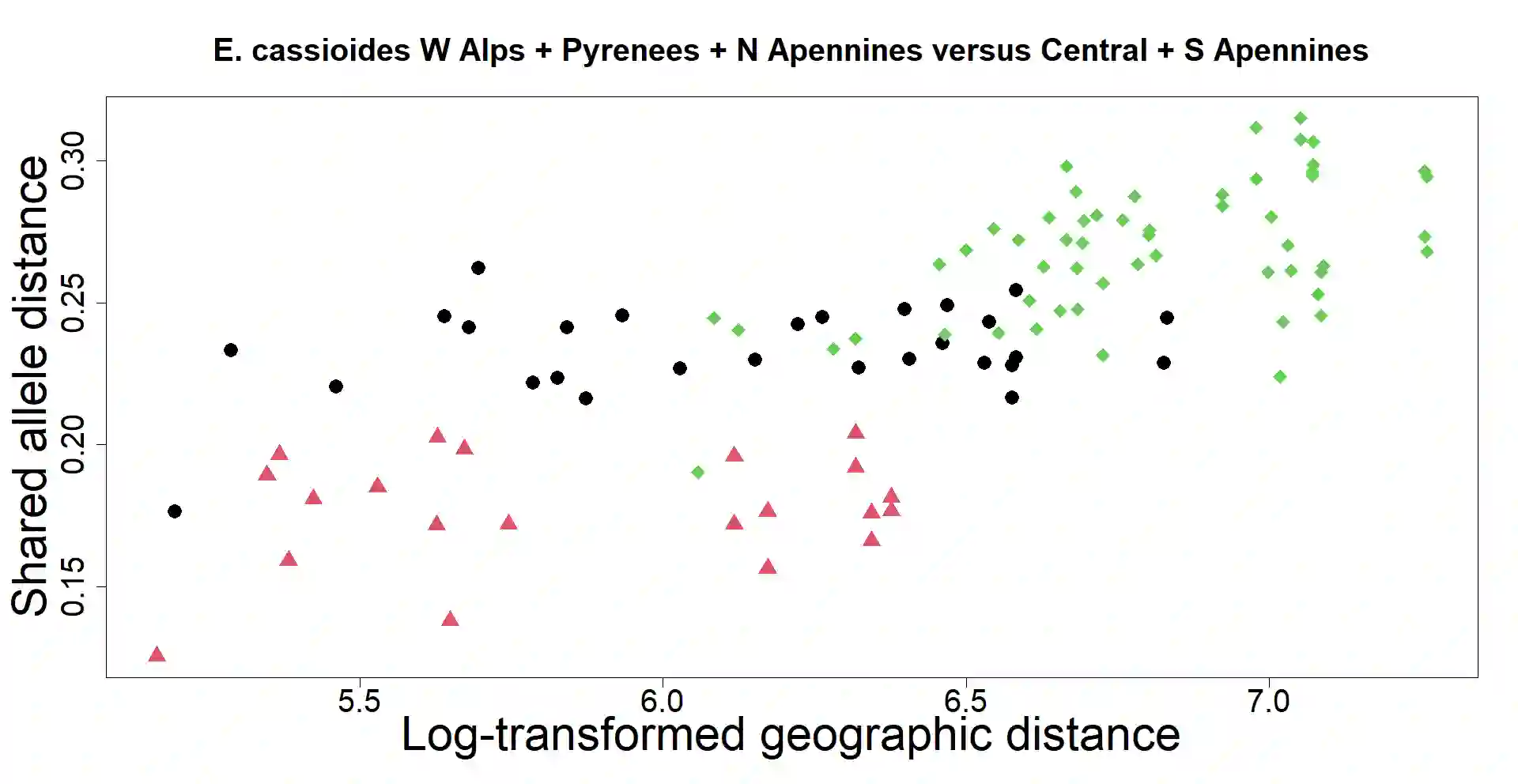
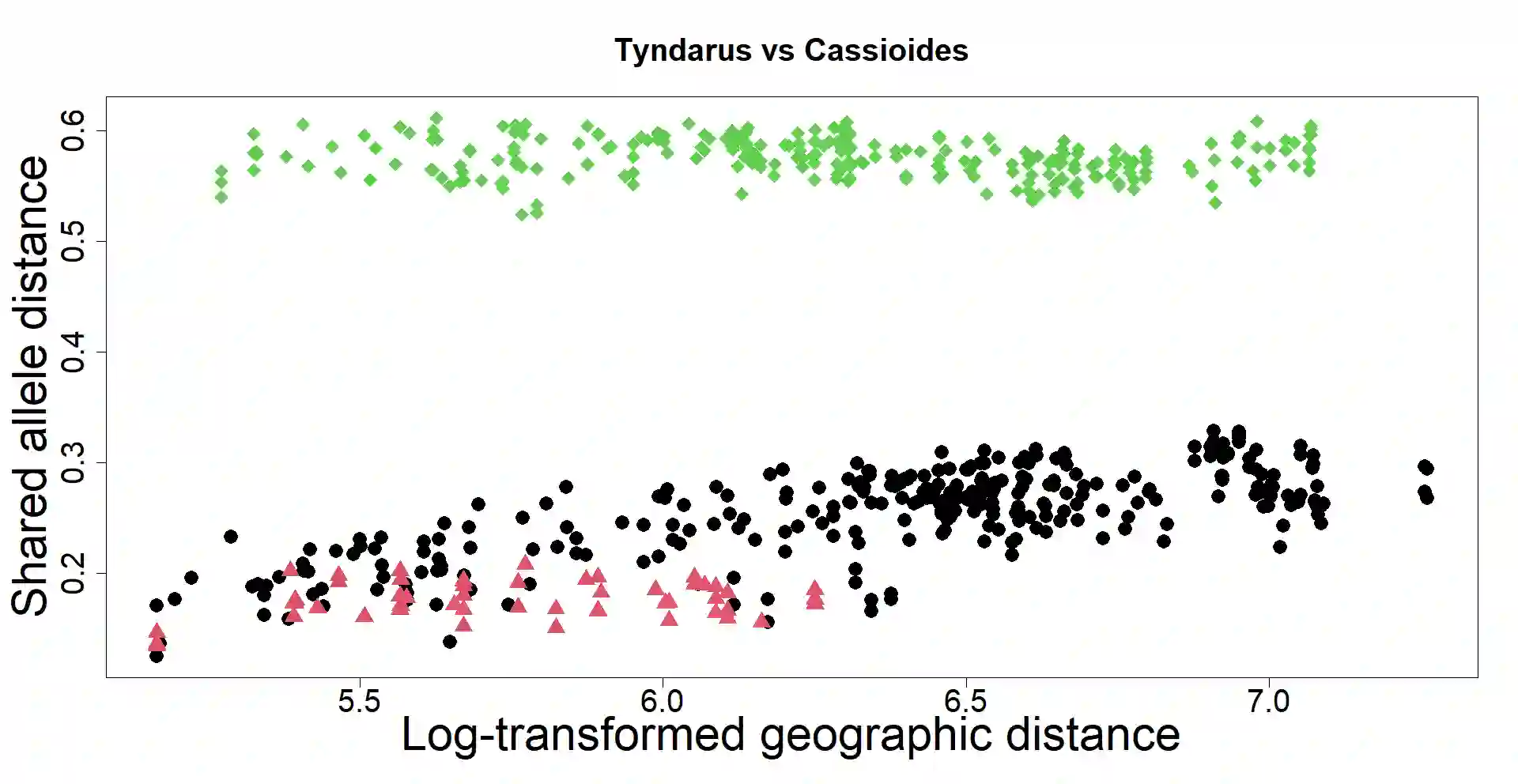
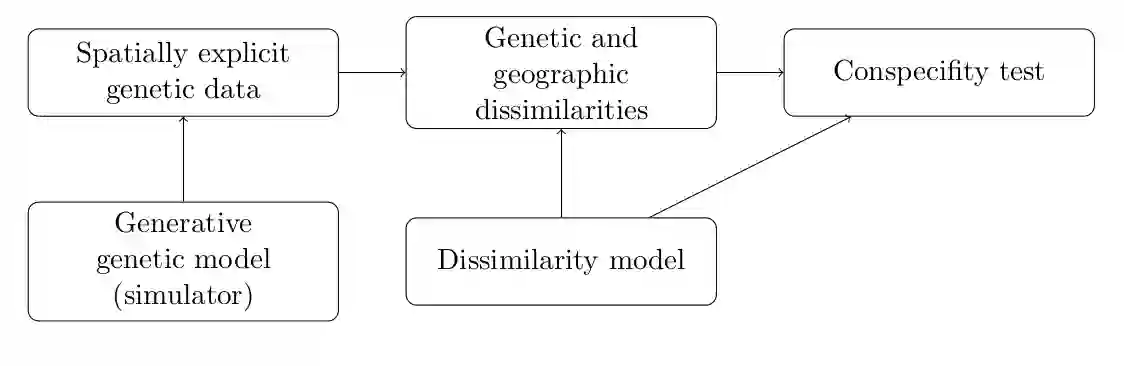
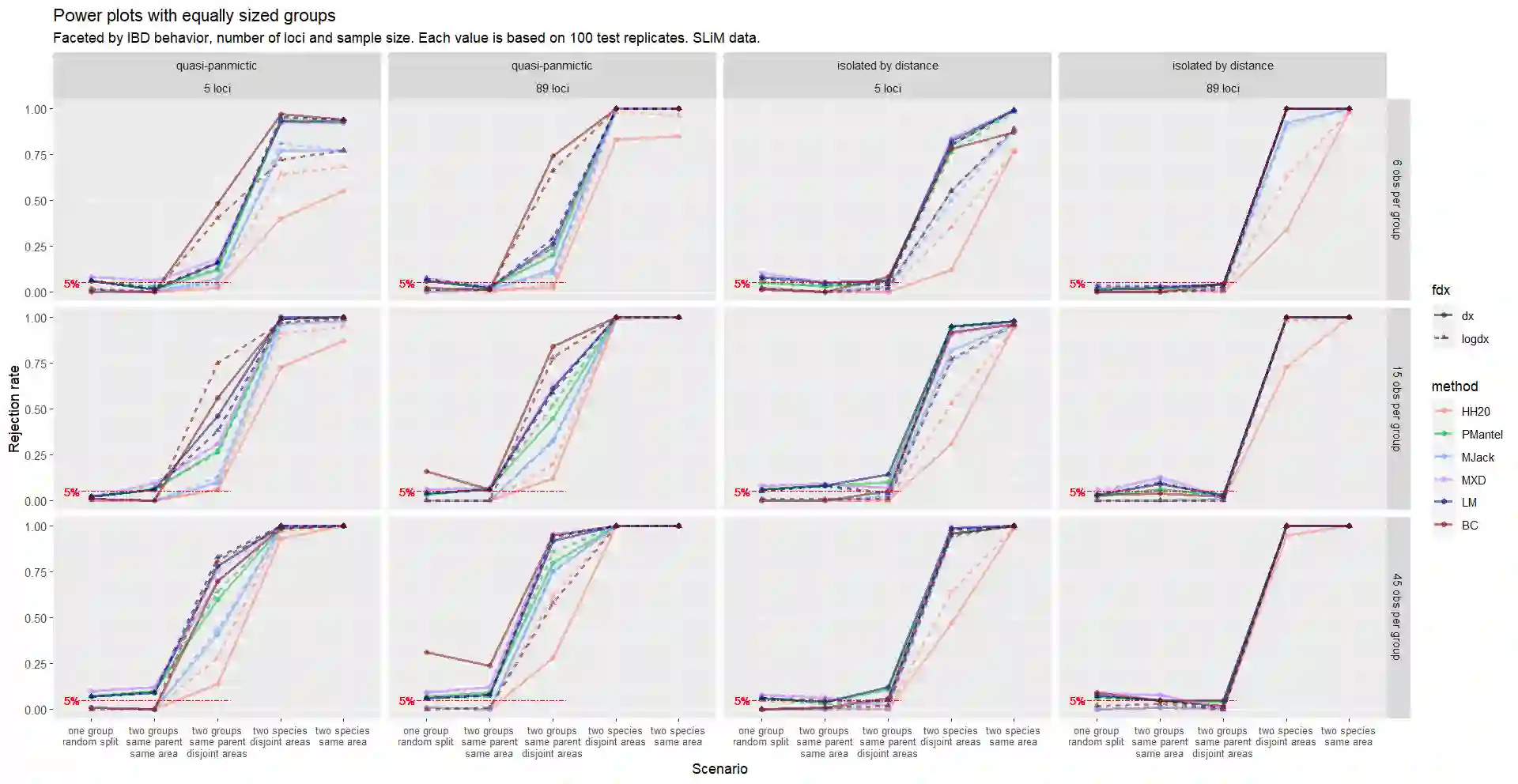
The delimitation of biological species, i.e., deciding which individuals belong to the same species and whether and how many different species are represented in a data set, is key to the conservation of biodiversity. Much existing work uses only genetic data for species delimitation, often employing some kind of cluster analysis. This can be misleading, because geographically distant groups of individuals can be genetically quite different even if they belong to the same species. We investigate the problem of testing whether two potentially separated groups of individuals can belong to a single species or not based on genetic and spatial data. Existing methods such as the partial Mantel test and jackknife-based distance-distance regression are considered as well as new approaches, i.e., an adaptation of a mixed effects model, a bootstrap approach, and a jackknife version of partial Mantel. All these methods address the issue that distance data violate the independence assumption for standard inference regarding correlation and regression; a standard linear regression is also considered. The approaches are compared on simulated meta-populations generated with SLiM and GSpace - two software packages that can simulate spatially-explicit genetic data at an individual level. Simulations showed that partial Mantel tests and mixed-effects models have larger power than jackknife-based methods, but tend to display type I error rates slightly above the significance level. An application on brassy ringlets concludes the paper.
翻译:生物物种的界定,即判断哪些个体属于同一物种,以及数据集中是否及存在多少个不同物种,是生物多样性保护的关键。现有研究多仅使用遗传数据进行物种界定,常采用某种聚类分析方法。这可能产生误导,因为即使属于同一物种,地理上隔离的个体群在遗传上也可能存在显著差异。我们研究了基于遗传和空间数据检验两个潜在分离的个体群是否可能属于同一物种的问题。考虑了偏Mantel检验、基于刀切法的距离-距离回归等现有方法,以及新提出的方法(混合效应模型的改编方案、自助法、偏Mantel的刀切版本)。所有这些方法都解决了距离数据违反标准相关性和回归推断中独立性假设的问题;同时考虑了标准线性回归方法。通过SLiM和GSpace(两款可模拟个体层面空间显式遗传数据的软件包)生成的模拟集合种群对这些方法进行了比较。模拟表明,偏Mantel检验和混合效应模型比基于刀切法的方法具有更高的检验功效,但往往第一类错误率略高于显著性水平。最后以铜色眼蝶的应用案例作为本文结论。




相关内容





 微信扫码咨询专知VIP会员