

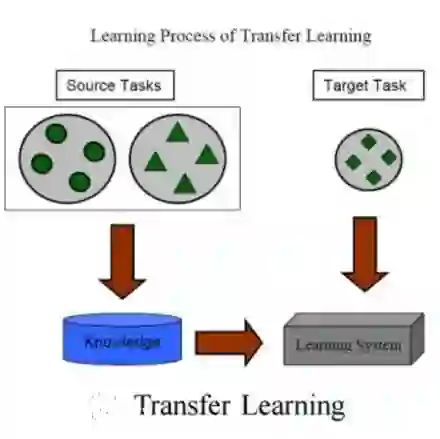
Human activity recognition (HAR) using machine learning has shown tremendous promise in detecting construction workers' activities. HAR has many applications in human-robot interaction research to enable robots' understanding of human counterparts' activities. However, many existing HAR approaches lack robustness, generalizability, and adaptability. This paper proposes a transfer learning methodology for activity recognition of construction workers that requires orders of magnitude less data and compute time for comparable or better classification accuracy. The developed algorithm transfers features from a model pre-trained by the original authors and fine-tunes them for the downstream task of activity recognition in construction. The model was pre-trained on Kinetics-400, a large-scale video-based human activity recognition dataset with 400 distinct classes. The model was fine-tuned and tested using videos captured from manual material handling (MMH) activities found on YouTube. Results indicate that the fine-tuned model can recognize distinct MMH tasks in a robust and adaptive manner which is crucial for the widespread deployment of collaborative robots in construction.
翻译:使用机器学习进行人类活动识别(HAR)在检测建筑工人活动方面展现出巨大潜力。HAR在人机交互研究中具有广泛应用,能使机器人理解人类同伴的活动。然而,现有许多HAR方法缺乏鲁棒性、通用性和自适应性。本文提出了一种适用于建筑工人活动识别的迁移学习方法,该方法所需数据和计算时间均减少若干数量级,却能实现相当或更优的分类精度。所开发的算法从原作者预训练的模型中提取特征,并针对建筑施工中的活动识别下游任务进行微调。模型基于Kinetics-400(一个包含400个不同类别的大规模视频人类活动识别数据集)进行预训练,并通过来自YouTube的手工材料搬运(MMH)活动视频进行微调和测试。结果表明,微调后的模型能够以鲁棒且自适应的方式识别不同的MMH任务,这对于协作机器人在建筑领域的广泛部署至关重要。




相关内容




 微信扫码咨询专知VIP会员