

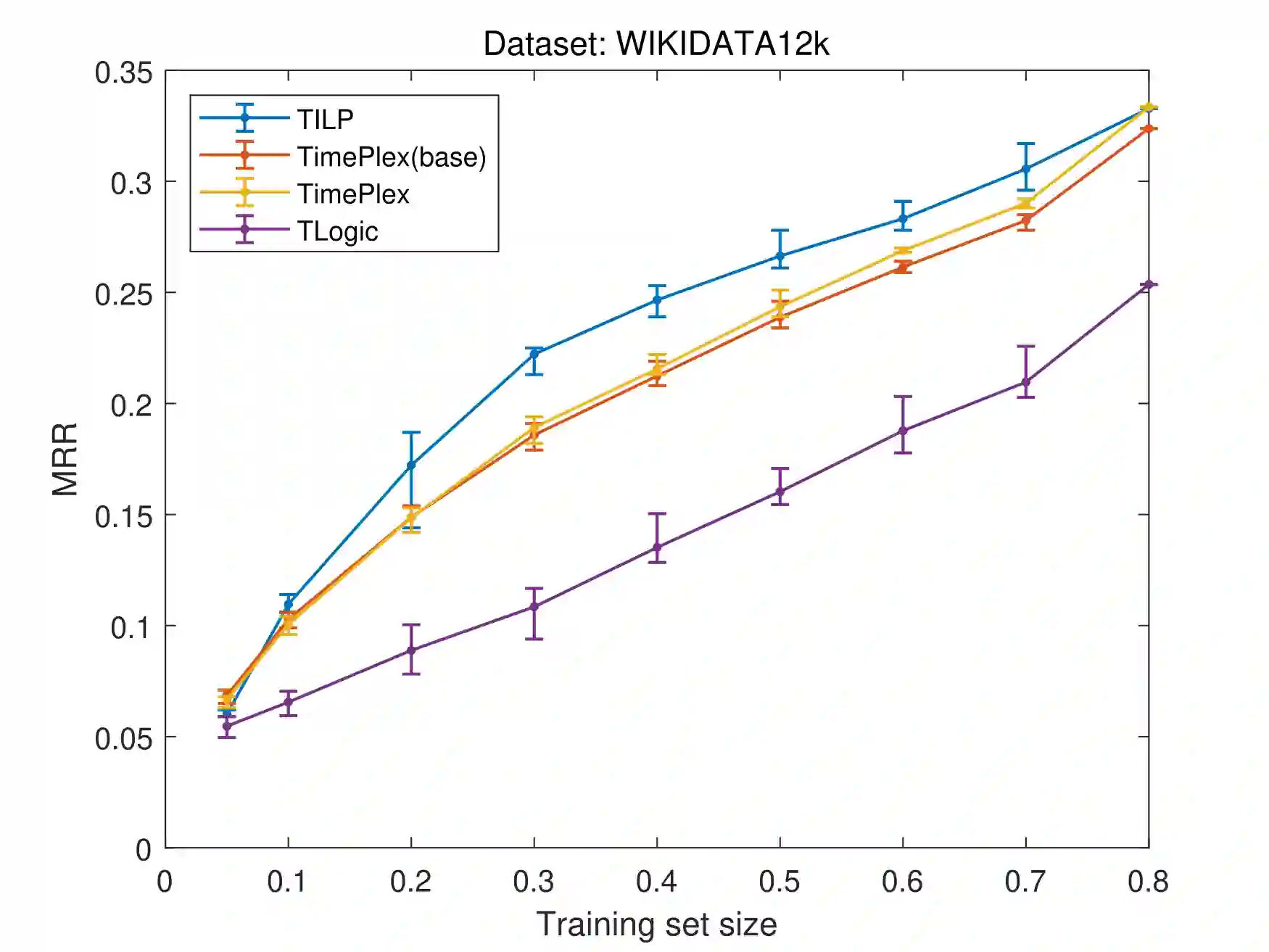
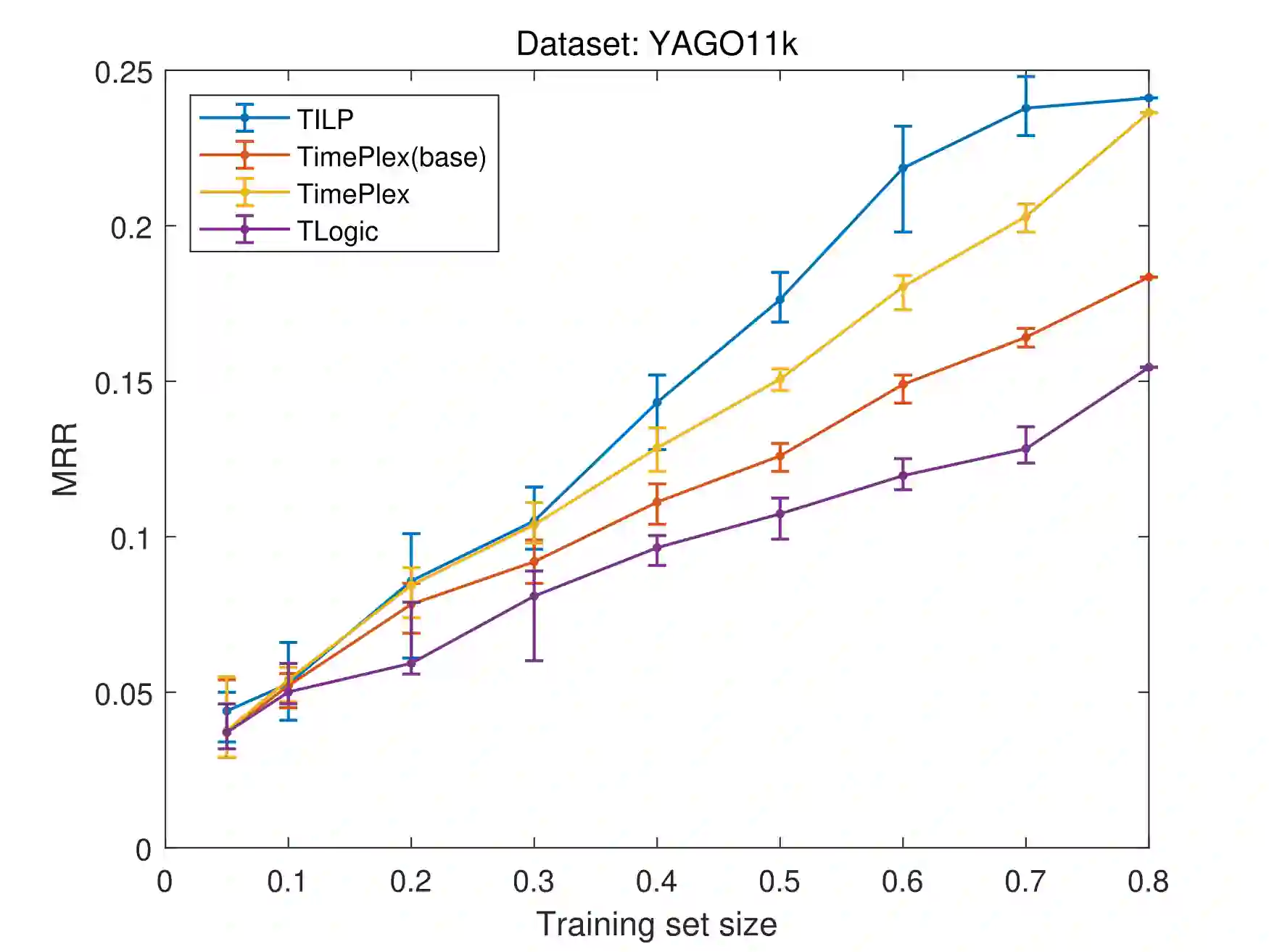
Compared with static knowledge graphs, temporal knowledge graphs (tKG), which can capture the evolution and change of information over time, are more realistic and general. However, due to the complexity that the notion of time introduces to the learning of the rules, an accurate graph reasoning, e.g., predicting new links between entities, is still a difficult problem. In this paper, we propose TILP, a differentiable framework for temporal logical rules learning. By designing a constrained random walk mechanism and the introduction of temporal operators, we ensure the efficiency of our model. We present temporal features modeling in tKG, e.g., recurrence, temporal order, interval between pair of relations, and duration, and incorporate it into our learning process. We compare TILP with state-of-the-art methods on two benchmark datasets. We show that our proposed framework can improve upon the performance of baseline methods while providing interpretable results. In particular, we consider various scenarios in which training samples are limited, data is biased, and the time range between training and inference are different. In all these cases, TILP works much better than the state-of-the-art methods.
翻译:与静态知识图谱相比,时态知识图谱(temporal knowledge graph, tKG)能够捕捉信息随时间的演变与变化,因而更具现实性与通用性。然而,由于时间概念为规则学习引入的复杂性,准确的图推理(例如预测实体间的新链接)仍是一个难题。本文提出TILP——一个用于时态逻辑规则学习的可微框架。通过设计约束随机游走机制并引入时态算子,我们确保了模型的高效性。我们展示了tKG中的时态特征建模(例如重复性、时序顺序、关系对之间的间隔以及持续时间),并将其融入学习过程。我们在两个基准数据集上将TILP与最先进的方法进行对比,结果表明我们的框架在提供可解释结果的同时,能够提升基线方法的性能。特别地,我们考虑了训练样本有限、数据存在偏差以及训练与推理时间范围不同的多种场景。在这些情况下,TILP的表现均显著优于最先进方法。
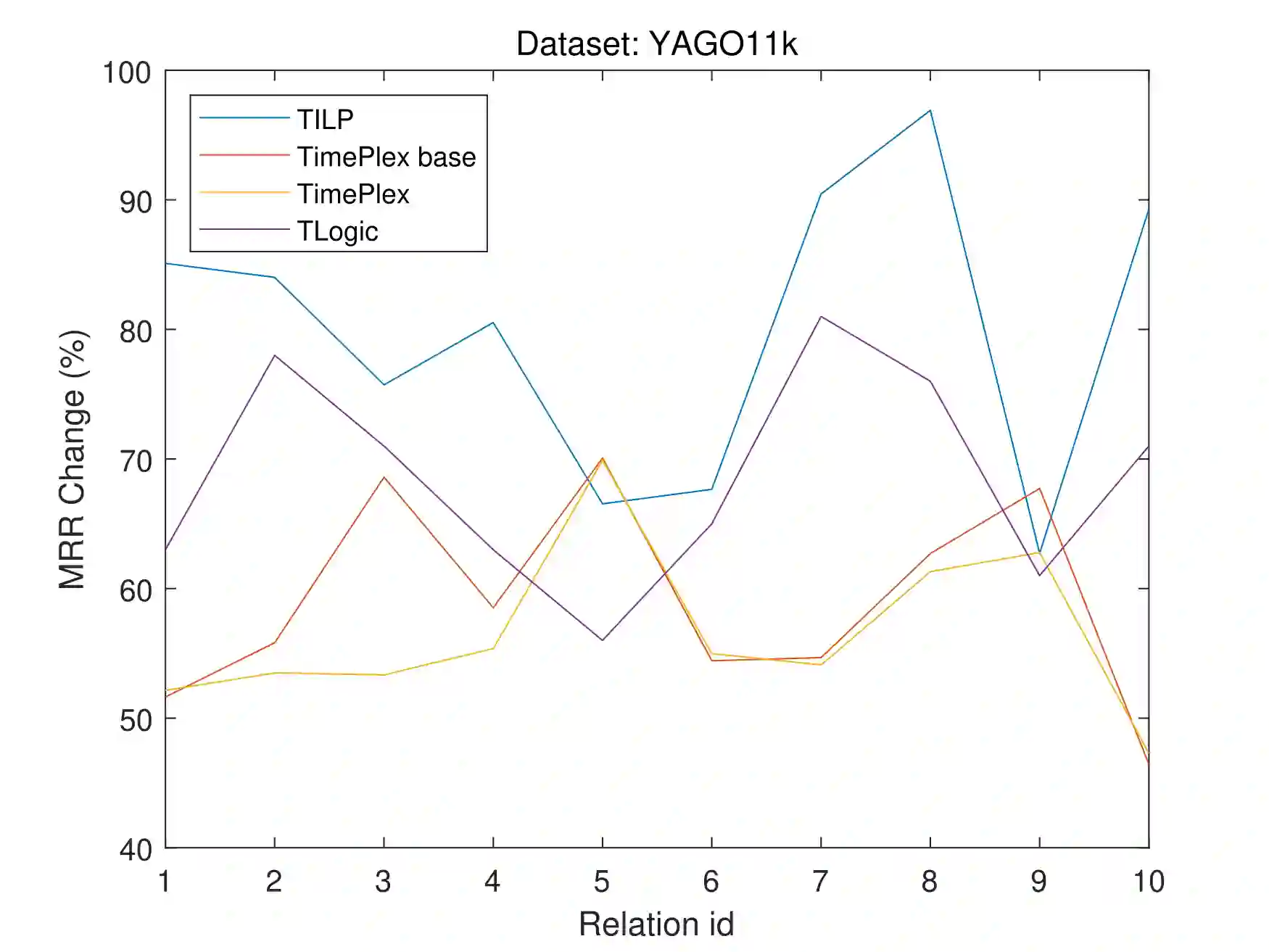




相关内容



 微信扫码咨询专知VIP会员