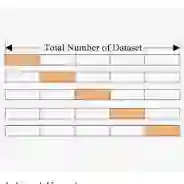
We introduce a new cross-validation method based on an equicorrelated Gaussian randomization scheme. Our method is well-suited for problems where sample splitting is infeasible, either because the data violate the assumption of independent and identically distributed samples, or because there are insufficient samples to form representative train-test data pairs. In such problems, our method provides a simple, principled, and computationally efficient approach to estimating prediction error, often outperforming standard cross-validation while requiring only a small number of repetitions. Drawing inspiration from recent splitting techniques like data fission and data thinning, our method constructs train-test data pairs using Gaussian randomization. Our main contribution is the introduction of an antithetic Gaussian randomization scheme, involving a carefully designed correlation structure among the randomization variables. We show theoretically that this antithetic construction can eliminate the bias of cross-validation for a broad class of smooth prediction functions, without inflating variance. Through simulations across a range of data types and loss functions, we demonstrate that our estimator outperforms existing methods for prediction error estimation.


翻译:本文提出一种基于等相关高斯随机化方案的新型交叉验证方法。该方法特别适用于样本划分不可行的问题场景,包括数据违反独立同分布假设的情况,以及样本数量不足以形成具有代表性的训练-测试数据对的情形。在此类问题中,本方法提供了一种简单、有理论依据且计算高效的预测误差估计方法,通常能在仅需少量重复实验的情况下超越标准交叉验证的性能。受数据裂变与数据稀疏化等最新划分技术的启发,本方法通过高斯随机化构建训练-测试数据对。我们的核心贡献在于引入了反相关高斯随机化方案,该方案在随机变量间建立了精心设计的相关结构。我们从理论上证明,对于一大类光滑预测函数,这种反相关构造能够消除交叉验证的偏差,同时不会增加方差。通过在不同数据类型和损失函数下的模拟实验,我们证明本估计器在预测误差估计方面优于现有方法。


0
下载
关闭预览

相关内容

交叉验证,有时也称为旋转估计或样本外测试,是用于评估统计结果如何的各种类似模型验证技术中的任何一种分析将概括为一个独立的数据集。它主要用于设置,其目的是预测,和一个想要估计如何准确地一个预测模型在实践中执行。在预测问题中,通常会给模型一个已知数据的数据集,在该数据集上进行训练(训练数据集)以及未知数据(或首次看到的数据)的数据集(根据该数据集测试模型)(称为验证数据集或测试集)。交叉验证的目标是测试模型预测未用于估计数据的新数据的能力,以发现诸如过度拟合或选择偏倚之类的问题,并提供有关如何进行建模的见解。该模型将推广到一个独立的数据集(例如,未知数据集,例如来自实际问题的数据集)。 一轮交叉验证涉及分割一个样品的数据到互补的子集,在一个子集执行所述分析(称为训练集),以及验证在另一子集中的分析(称为验证集合或测试集)。为了减少可变性,在大多数方法中,使用不同的分区执行多轮交叉验证,并将验证结果组合(例如取平均值)在各轮中,以估计模型的预测性能。 总而言之,交叉验证结合了预测中适用性的度量(平均),以得出模型预测性能的更准确估计。
【MIT】反偏差对比学习,Debiased Contrastive Learning
专知会员服务
91+阅读 · 2020年7月4日
【google】监督对比学习,Supervised Contrastive Learning
专知会员服务
32+阅读 · 2020年4月23日
因果关联学习,Causal Relational Learning
专知会员服务
185+阅读 · 2020年4月21日
智能合约的形式化验证方法研究综述
专知
16+阅读 · 2021年5月8日
【CVPR2021】跨模态检索的概率嵌入
专知
17+阅读 · 2021年3月2日
【干货书】贝叶斯推断随机过程,449页pdf
专知
30+阅读 · 2020年8月27日
基于逆强化学习的示教学习方法综述
计算机研究与发展
16+阅读 · 2019年2月25日
绝对干货 | 随机梯度下降算法综述
菜鸟的机器学习
15+阅读 · 2017年10月30日
精品公开课 | 随机梯度下降算法综述
七月在线实验室
13+阅读 · 2017年7月11日
国家自然科学基金
14+阅读 · 2015年12月31日
国家自然科学基金
6+阅读 · 2015年12月31日
国家自然科学基金
0+阅读 · 2015年12月31日
国家自然科学基金
0+阅读 · 2015年12月31日
国家自然科学基金
0+阅读 · 2015年12月31日
国家自然科学基金
0+阅读 · 2014年12月31日
国家自然科学基金
0+阅读 · 2014年12月31日
国家自然科学基金
0+阅读 · 2014年12月31日
国家自然科学基金
1+阅读 · 2014年12月31日
国家自然科学基金
0+阅读 · 2014年12月31日
Arxiv
0+阅读 · 2月3日
VIP会员
相关VIP内容
【MIT】反偏差对比学习,Debiased Contrastive Learning
专知会员服务
91+阅读 · 2020年7月4日
【google】监督对比学习,Supervised Contrastive Learning
专知会员服务
32+阅读 · 2020年4月23日
因果关联学习,Causal Relational Learning
专知会员服务
185+阅读 · 2020年4月21日
相关基金
国家自然科学基金
14+阅读 · 2015年12月31日
国家自然科学基金
6+阅读 · 2015年12月31日
国家自然科学基金
0+阅读 · 2015年12月31日
国家自然科学基金
0+阅读 · 2015年12月31日
国家自然科学基金
0+阅读 · 2015年12月31日
国家自然科学基金
0+阅读 · 2014年12月31日
国家自然科学基金
0+阅读 · 2014年12月31日
国家自然科学基金
0+阅读 · 2014年12月31日
国家自然科学基金
1+阅读 · 2014年12月31日
国家自然科学基金
0+阅读 · 2014年12月31日
Top
微信扫码咨询专知VIP会员