

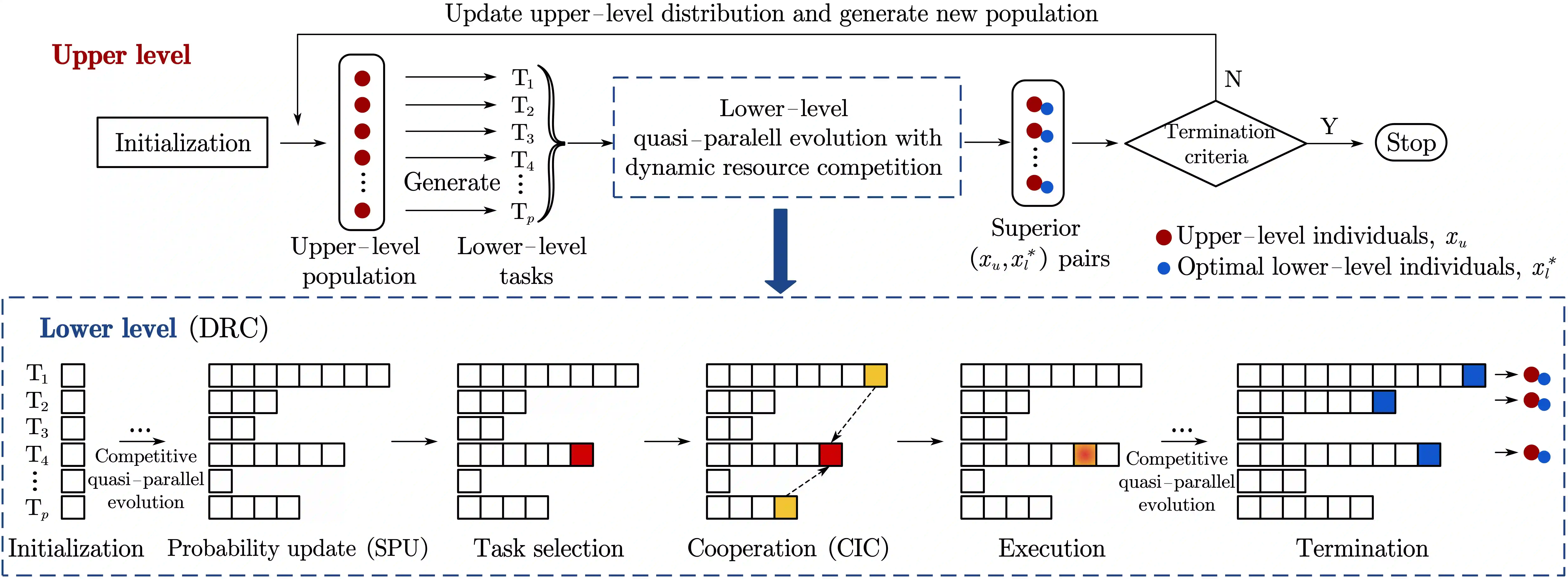
Bilevel optimization problems are characterized by an interactive hierarchical structure, where the upper level seeks to optimize its strategy while simultaneously considering the response of the lower level. Evolutionary algorithms are commonly used to solve complex bilevel problems in practical scenarios, but they face significant resource consumption challenges due to the nested structure imposed by the implicit lower-level optimality condition. This challenge becomes even more pronounced as problem dimensions increase. Although recent methods have enhanced bilevel convergence through task-level knowledge sharing, further efficiency improvements are still hindered by redundant lower-level iterations that consume excessive resources while generating unpromising solutions. To overcome this challenge, this paper proposes an efficient dynamic resource allocation framework for evolutionary bilevel optimization, named DRC-BLEA. Compared to existing approaches, DRC-BLEA introduces a novel competitive quasi-parallel paradigm, in which multiple lower-level optimization tasks, derived from different upper-level individuals, compete for resources. A continuously updated selection probability is used to prioritize execution opportunities to promising tasks. Additionally, a cooperation mechanism is integrated within the competitive framework to further enhance efficiency and prevent premature convergence. Experimental results compared with chosen state-of-the-art algorithms demonstrate the effectiveness of the proposed method. Specifically, DRC-BLEA achieves competitive accuracy across diverse problem sets and real-world scenarios, while significantly reducing the number of function evaluations and overall running time.
翻译:双层优化问题具有交互式层次结构的特点,上层在优化自身策略的同时需考虑下层的响应。进化算法常用于解决实际场景中的复杂双层问题,但由于隐含下层最优性条件所施加的嵌套结构,它们面临着显著的资源消耗挑战。随着问题维度的增加,这一挑战变得尤为突出。尽管现有方法通过任务级知识共享提升了双层收敛性,但冗余的下层迭代仍会消耗过多资源并产生无前景的解,从而阻碍了效率的进一步提升。为克服这一挑战,本文提出了一种高效的进化双层优化动态资源分配框架,命名为DRC-BLEA。与现有方法相比,DRC-BLEA引入了一种新颖的竞争性准并行范式,其中源自不同上层个体的多个下层优化任务相互竞争资源。通过持续更新的选择概率,为有前景的任务优先分配执行机会。此外,在竞争框架中集成了合作机制,以进一步提升效率并防止早熟收敛。与所选前沿算法的对比实验结果表明了所提方法的有效性。具体而言,DRC-BLEA在多样化问题集和实际场景中均取得了具有竞争力的精度,同时显著减少了函数评估次数和总体运行时间。




相关内容




 微信扫码咨询专知VIP会员