

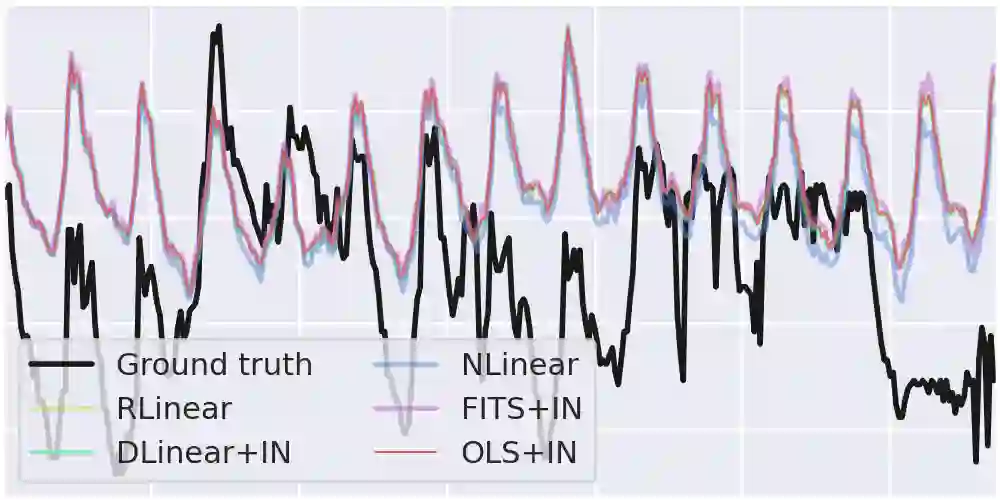
Despite their simplicity, linear models perform well at time series forecasting, even when pitted against deeper and more expensive models. A number of variations to the linear model have been proposed, often including some form of feature normalisation that improves model generalisation. In this paper we analyse the sets of functions expressible using these linear model architectures. In so doing we show that several popular variants of linear models for time series forecasting are equivalent and functionally indistinguishable from standard, unconstrained linear regression. We characterise the model classes for each linear variant. We demonstrate that each model can be reinterpreted as unconstrained linear regression over a suitably augmented feature set, and therefore admit closed-form solutions when using a mean-squared loss function. We provide experimental evidence that the models under inspection learn nearly identical solutions, and finally demonstrate that the simpler closed form solutions are superior forecasters across 72% of test settings.
翻译:尽管线性模型结构简单,但在时间序列预测任务中,即便与更深层、计算成本更高的模型相比,其表现依然出色。目前已提出多种线性模型变体,通常包含某些能提升模型泛化能力的特征归一化方法。本文分析了这些线性模型架构所能表达的函数集合,结果表明:几种流行的时间序列预测线性模型变体,在功能上与标准无约束线性回归等价且无法区分。我们刻画了每种线性变体的模型类别,证明每个模型都可被重新解释为对适当扩充特征集进行无约束线性回归,因此在使用均方损失函数时存在闭式解。实验证据表明,被检验模型学习到的解近乎相同,最终证实更简洁的闭式解在72%的测试设置中展现出更优的预测性能。








相关内容




 微信扫码咨询专知VIP会员