

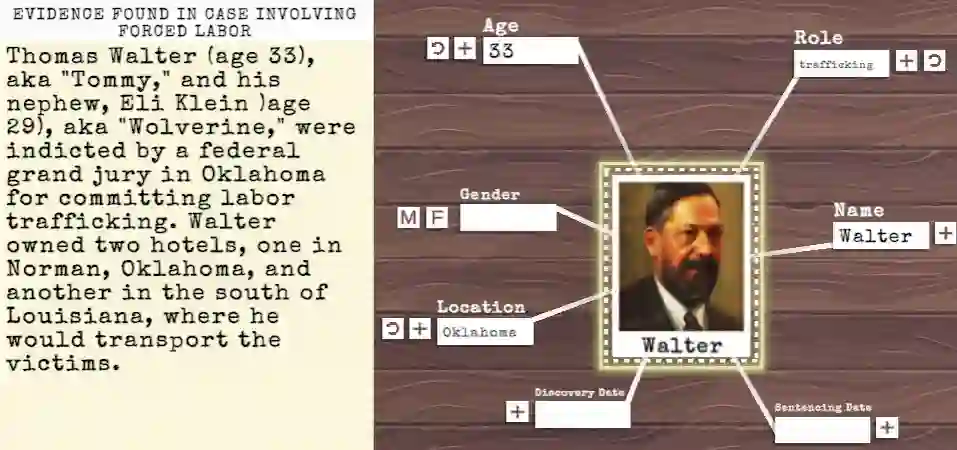
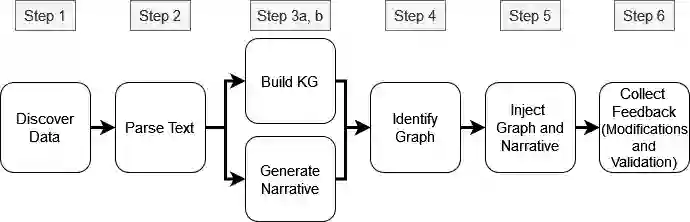
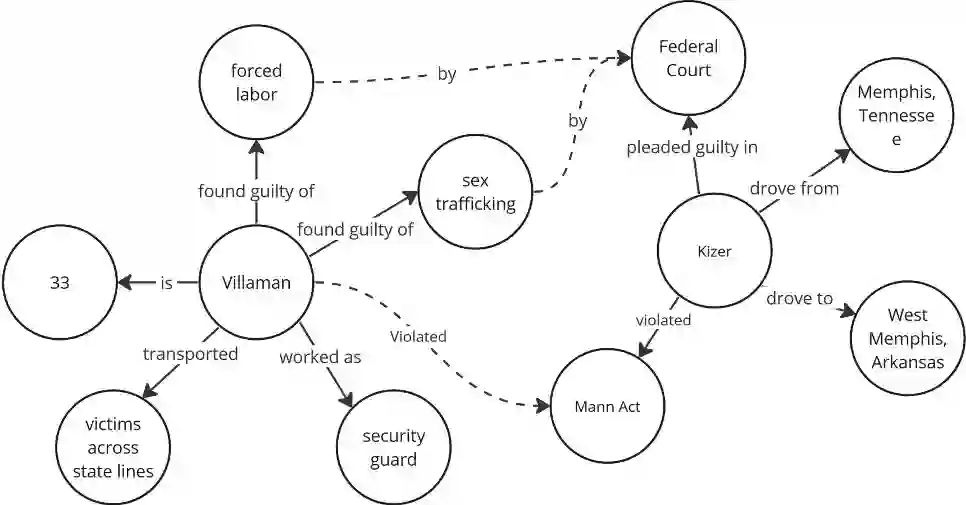
External knowledge graphs (KGs) can be used to augment large language models (LLMs), while simultaneously providing an explainable knowledge base of facts that can be inspected by a human. This approach may be particularly valuable in domains where explainability is critical, like human trafficking data analysis. However, creating KGs can pose challenges. KGs parsed from documents may comprise explicit connections (those directly stated by a document) but miss implicit connections (those obvious to a human although not directly stated). To address these challenges, this preliminary research introduces the GAME-KG framework, standing for "Gaming for Augmenting Metadata and Enhancing Knowledge Graphs." GAME-KG is a federated approach to modifying explicit as well as implicit connections in KGs by using crowdsourced feedback collected through video games. GAME-KG is shown through two demonstrations: a Unity test scenario from Dark Shadows, a video game that collects feedback on KGs parsed from US Department of Justice (DOJ) Press Releases on human trafficking, and a following experiment where OpenAI's GPT-4 is prompted to answer questions based on a modified and unmodified KG. Initial results suggest that GAME-KG can be an effective framework for enhancing KGs, while simultaneously providing an explainable set of structured facts verified by humans.
翻译:外部知识图谱可用于增强大语言模型,同时提供可由人类检查的可解释事实知识库。这种方法在可解释性至关重要的领域(如人口贩卖数据分析)中可能特别有价值。然而,创建知识图谱面临挑战。从文档中解析出的知识图谱可能包含显式连接(文档直接陈述的关系),但会遗漏隐式连接(对人类而言显而易见但未直接陈述的关系)。为解决这些问题,本研究初步提出了GAME-KG框架,全称为“通过游戏增强元数据与知识图谱”。GAME-KG是一种联邦式方法,通过视频游戏收集的众包反馈来修改知识图谱中的显式及隐式连接。通过两个演示展示GAME-KG:一是来自《黑暗阴影》视频游戏的Unity测试场景,该游戏收集对从美国司法部关于人口贩卖的新闻稿中解析的知识图谱的反馈;二是后续实验,提示OpenAI的GPT-4基于修改后和未修改的知识图谱回答问题。初步结果表明,GAME-KG可作为有效的知识图谱增强框架,同时提供经人类验证的可解释结构化事实集。




相关内容



 微信扫码咨询专知VIP会员