

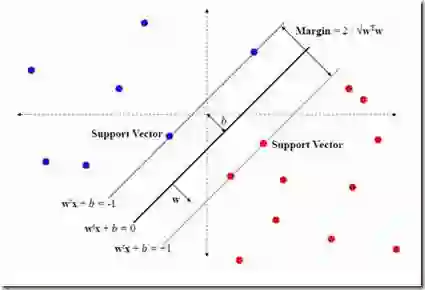
Modeling open hole failure of composites is a complex task, consisting in a highly nonlinear response with interacting failure modes. Numerical modeling of this phenomenon has traditionally been based on the finite element method, but requires to tradeoff between high fidelity and computational cost. To mitigate this shortcoming, recent work has leveraged machine learning to predict the strength of open hole composite specimens. Here, we also propose using data-based models but to tackle open hole composite failure from a classification point of view. More specifically, we show how to train surrogate models to learn the ultimate failure envelope of an open hole composite plate under in-plane loading. To achieve this, we solve the classification problem via support vector machine (SVM) and test different classifiers by changing the SVM kernel function. The flexibility of kernel-based SVM also allows us to integrate the recently developed quantum kernels in our algorithm and compare them with the standard radial basis function (RBF) kernel. Finally, thanks to kernel-target alignment optimization, we tune the free parameters of all kernels to best separate safe and failure-inducing loading states. The results show classification accuracies higher than 90% for RBF, especially after alignment, followed closely by the quantum kernel classifiers.
翻译:复合材料开孔失效建模是一项复杂任务,其响应具有高度非线性且失效模式相互耦合。该现象的数值建模传统上基于有限元方法,但需要在计算精度与成本之间进行权衡。为克服此缺陷,近期研究利用机器学习预测开孔复合材料试样的强度。本文同样采用数据驱动模型,但从分类视角处理复合材料开孔失效问题。具体而言,我们展示了如何训练代理模型以学习面内载荷作用下开孔复合材料层合板的最终失效包络线。为实现这一目标,我们通过支持向量机(SVM)解决分类问题,并通过改变SVM核函数测试不同分类器。基于核函数的SVM所具有的灵活性,使我们能够在算法中整合最新发展的量子核函数,并将其与标准径向基函数(RBF)核进行对比。最后,借助核目标对齐优化技术,我们调整所有核函数的自由参数,以最优区分安全载荷状态与诱发失效的载荷状态。结果显示,RBF核(尤其在参数对齐后)分类准确率超过90%,量子核分类器性能紧随其后。




相关内容



 微信扫码咨询专知VIP会员