

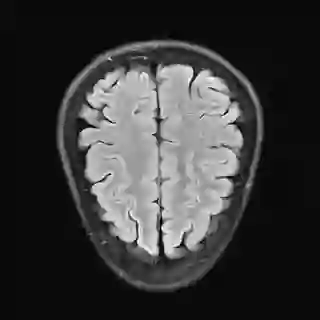
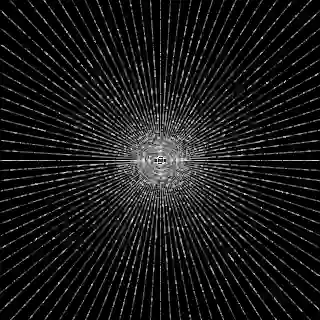
This article presents a novel undersampled magnetic resonance imaging (MRI) technique that leverages the concept of Neural Radiance Field (NeRF). With radial undersampling, the corresponding imaging problem can be reformulated into an image modeling task from sparse-view rendered data; therefore, a high dimensional MR image is obtainable from undersampled $k$-space data by taking advantage of implicit neural representation. A multi-layer perceptron, which is designed to output an image intensity from a spatial coordinate, learns the MR physics-driven rendering relation between given measurement data and desired image. Effective undersampling strategies for high-quality neural representation are investigated. The proposed method serves two benefits: (i) The learning is based fully on single undersampled $k$-space data, not a bunch of measured data and target image sets. It can be used potentially for diagnostic MR imaging, such as fetal MRI, where data acquisition is relatively rare or limited against diversity of clinical images while undersampled reconstruction is highly demanded. (ii) A reconstructed MR image is a scan-specific representation highly adaptive to the given $k$-space measurement. Numerous experiments validate the feasibility and capability of the proposed approach.
翻译:本文提出一种利用神经辐射场(NeRF)概念的新型欠采样磁共振成像(MRI)技术。通过径向欠采样,可将相应成像问题重构为从稀疏视角渲染数据进行的图像建模任务;因此,借助隐式神经表示,可从欠采样$k$-空间数据中获取高维MR图像。设计了一个从空间坐标输出图像强度的多层感知器,用于学习给定测量数据与目标图像之间由MR物理驱动的渲染关系。本文研究了实现高质量神经表示的有效欠采样策略。所提方法具有两大优势:(i)学习过程完全基于单组欠采样$k$-空间数据,而非依赖大量测量数据与目标图像集。该方法可潜在地应用于诊断性MR成像(如胎儿MRI),此类场景中数据采集相对稀缺或临床图像多样性有限,但对欠采样重建的需求极高。(ii)重建的MR图像是高度适应给定$k$-空间测量的扫描特定表示。大量实验验证了所提方法的可行性与能力。







相关内容


 微信扫码咨询专知VIP会员