

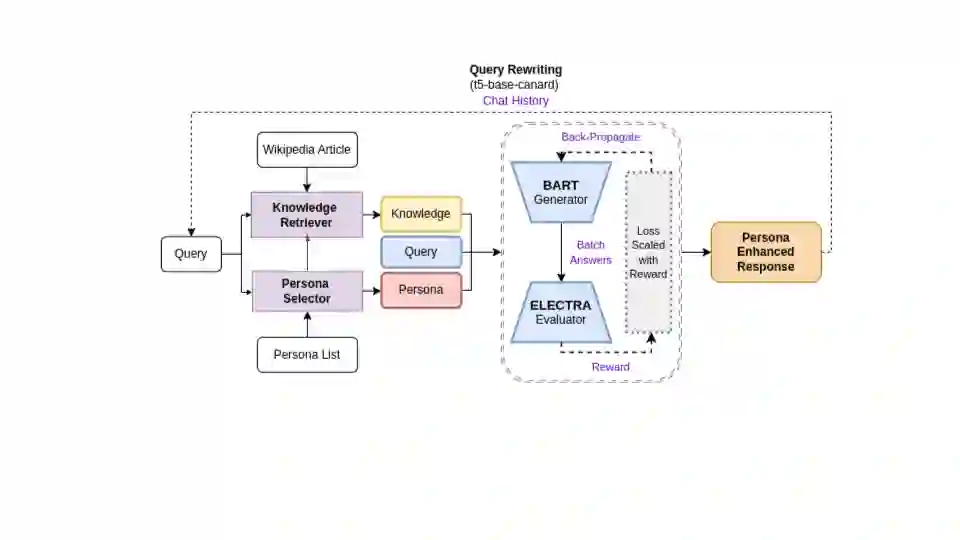
Personalizing conversational agents can enhance the quality of conversations and increase user engagement. However, they often lack external knowledge to appropriately tend to a user's persona. This is particularly crucial for practical applications like mental health support, nutrition planning, culturally sensitive conversations, or reducing toxic behavior in conversational agents. To enhance the relevance and comprehensiveness of personalized responses, we propose using a two-step approach that involves (1) selectively integrating user personas and (2) contextualizing the response with supplementing information from a background knowledge source. We develop K-PERM (Knowledge-guided PErsonalization with Reward Modulation), a dynamic conversational agent that combines these elements. K-PERM achieves state-of-the-art performance on the popular FoCus dataset, containing real-world personalized conversations concerning global landmarks. We show that using responses from K-PERM can improve performance in state-of-the-art LLMs (GPT 3.5) by 10.5%, highlighting the impact of K-PERM for personalizing chatbots.
翻译:暂无翻译




相关内容



 微信扫码咨询专知VIP会员