

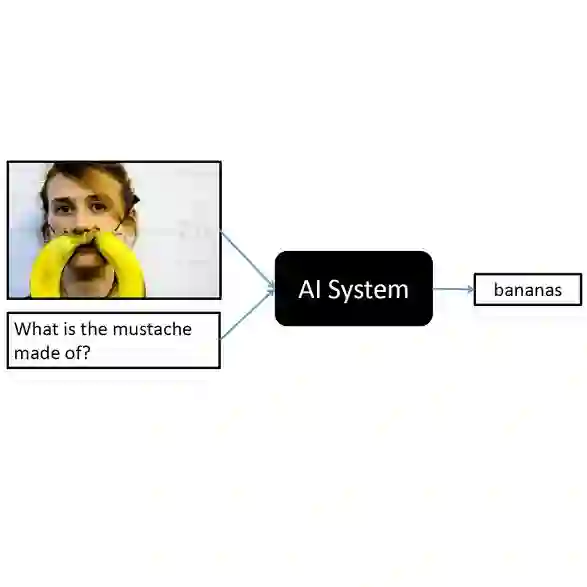
To increase the generalization capability of VQA systems, many recent studies have tried to de-bias spurious language or vision associations that shortcut the question or image to the answer. Despite these efforts, the literature fails to address the confounding effect of vision and language simultaneously. As a result, when they reduce bias learned from one modality, they usually increase bias from the other. In this paper, we first model a confounding effect that causes language and vision bias simultaneously, then propose a counterfactual inference to remove the influence of this effect. The model trained in this strategy can concurrently and efficiently reduce vision and language bias. To the best of our knowledge, this is the first work to reduce biases resulting from confounding effects of vision and language in VQA, leveraging causal explain-away relations. We accompany our method with an explain-away strategy, pushing the accuracy of the questions with numerical answers results compared to existing methods that have been an open problem. The proposed method outperforms the state-of-the-art methods in VQA-CP v2 datasets.
翻译:为提升视觉问答(VQA)系统的泛化能力,近期诸多研究尝试消除捷径关联问题或图像至答案的虚假语言或视觉偏差。然而,现有工作未能同时解决视觉与语言的混杂效应影响。当减少从一个模态习得的偏差时,往往增加了另一模态的偏差。本文首先建模了同时引发语言与视觉偏差的混杂效应,进而提出反事实推理以消除该效应的影响。基于此策略训练的模型能够同时高效地降低视觉与语言偏差。据我们所知,这是首项借助因果可解释消除关系来削弱VQA中视觉与语言混杂效应所导致的偏差的工作。我们配套提出一种可解释消除策略,推动含数值答案问题的准确率超越现有方法(该问题长期为开放难题)。所提方法在VQA-CP v2数据集上优于现有最优方法。




相关内容



 微信扫码咨询专知VIP会员