

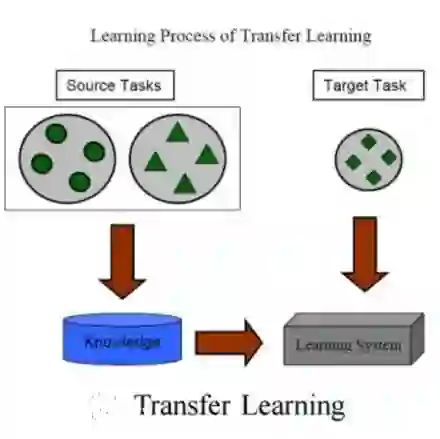
Node classification is a fundamental task, but obtaining node classification labels can be challenging and expensive in many real-world scenarios. Transfer learning has emerged as a promising solution to address this challenge by leveraging knowledge from source domains to enhance learning in a target domain. Existing transfer learning methods for node classification primarily focus on integrating Graph Convolutional Networks (GCNs) with various transfer learning techniques. While these approaches have shown promising results, they often suffer from a lack of theoretical guarantees, restrictive conditions, and high sensitivity to hyperparameter choices. To overcome these limitations, we propose a Graph Convolutional Multinomial Logistic Regression (GCR) model and a transfer learning method based on the GCR model, called Trans-GCR. We provide theoretical guarantees of the estimate obtained under GCR model in high-dimensional settings. Moreover, Trans-GCR demonstrates superior empirical performance, has a low computational cost, and requires fewer hyperparameters than existing methods.
翻译:节点分类是一项基础任务,但在许多现实场景中,获取节点分类标签可能具有挑战性且成本高昂。迁移学习通过利用源领域的知识来增强目标领域的学习,已成为应对这一挑战的有前景的解决方案。现有的节点分类迁移学习方法主要集中于将图卷积网络(GCNs)与各种迁移学习技术相结合。尽管这些方法已显示出良好的效果,但它们通常缺乏理论保证、条件限制严格,并且对超参数选择高度敏感。为了克服这些局限性,我们提出了一种图卷积多项逻辑回归(GCR)模型以及一种基于该模型的迁移学习方法,称为Trans-GCR。我们为高维设置下GCR模型所获估计提供了理论保证。此外,Trans-GCR展现出卓越的实证性能,计算成本低,并且比现有方法需要更少的超参数。




相关内容



 微信扫码咨询专知VIP会员