

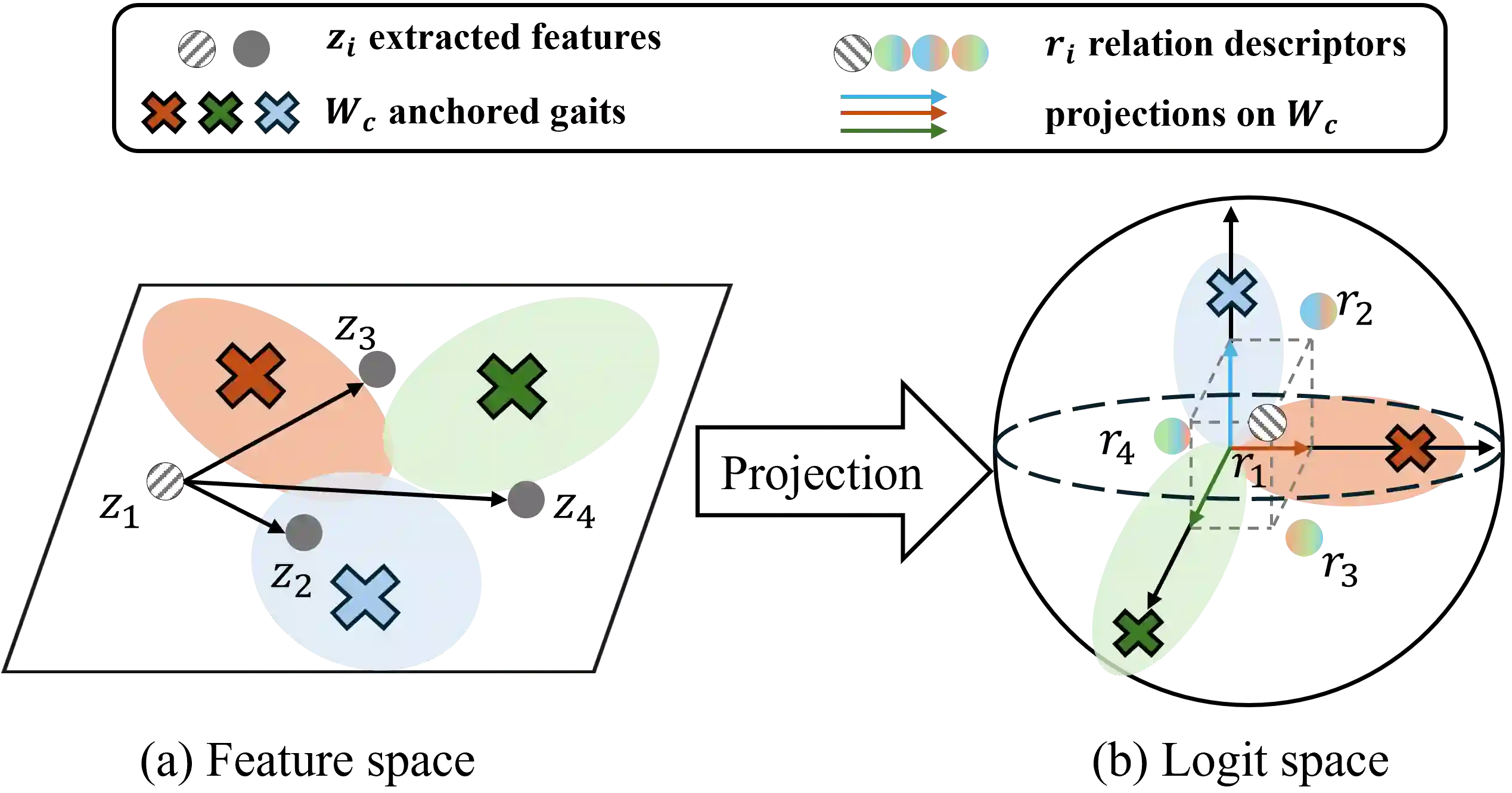
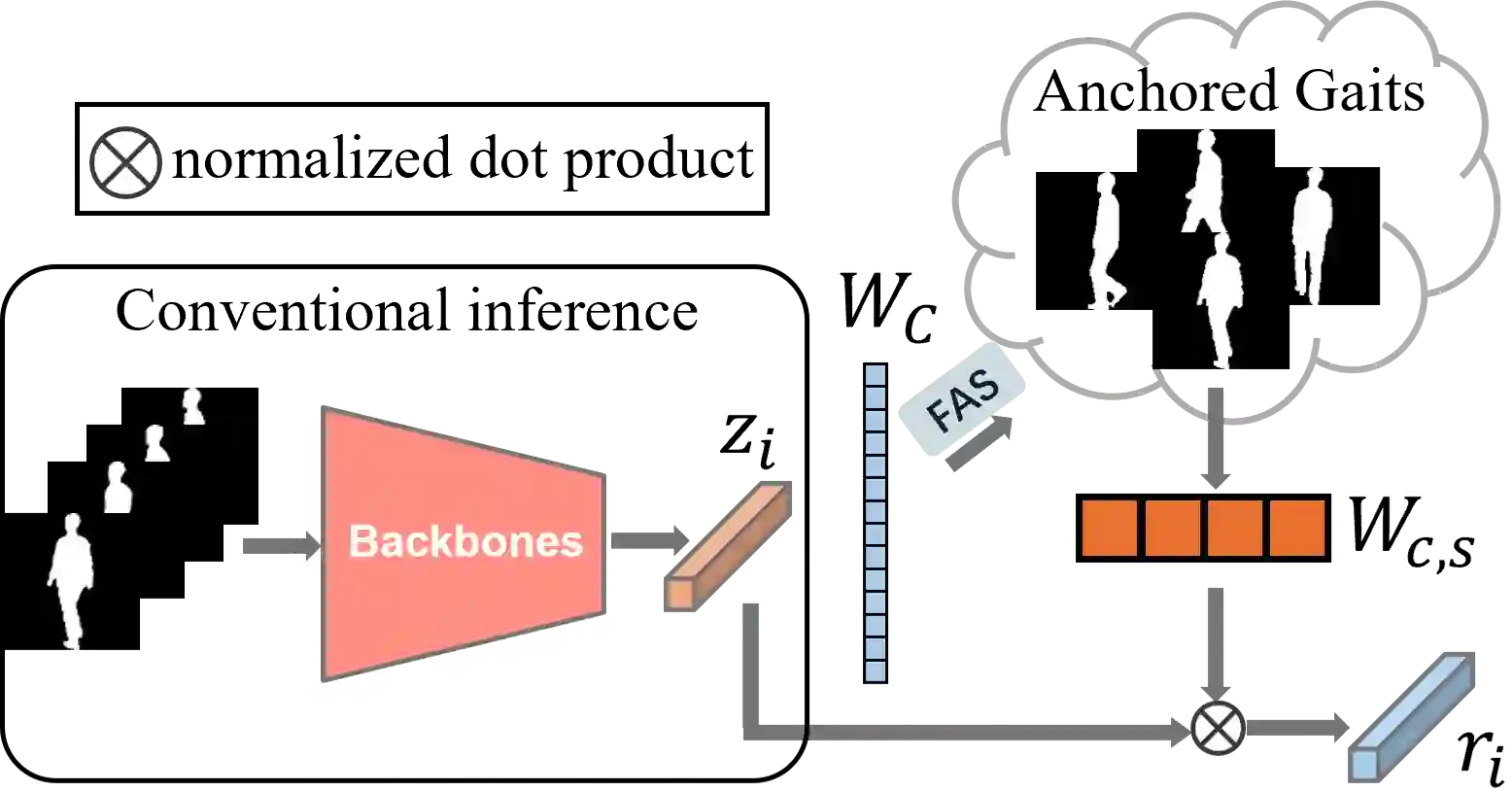
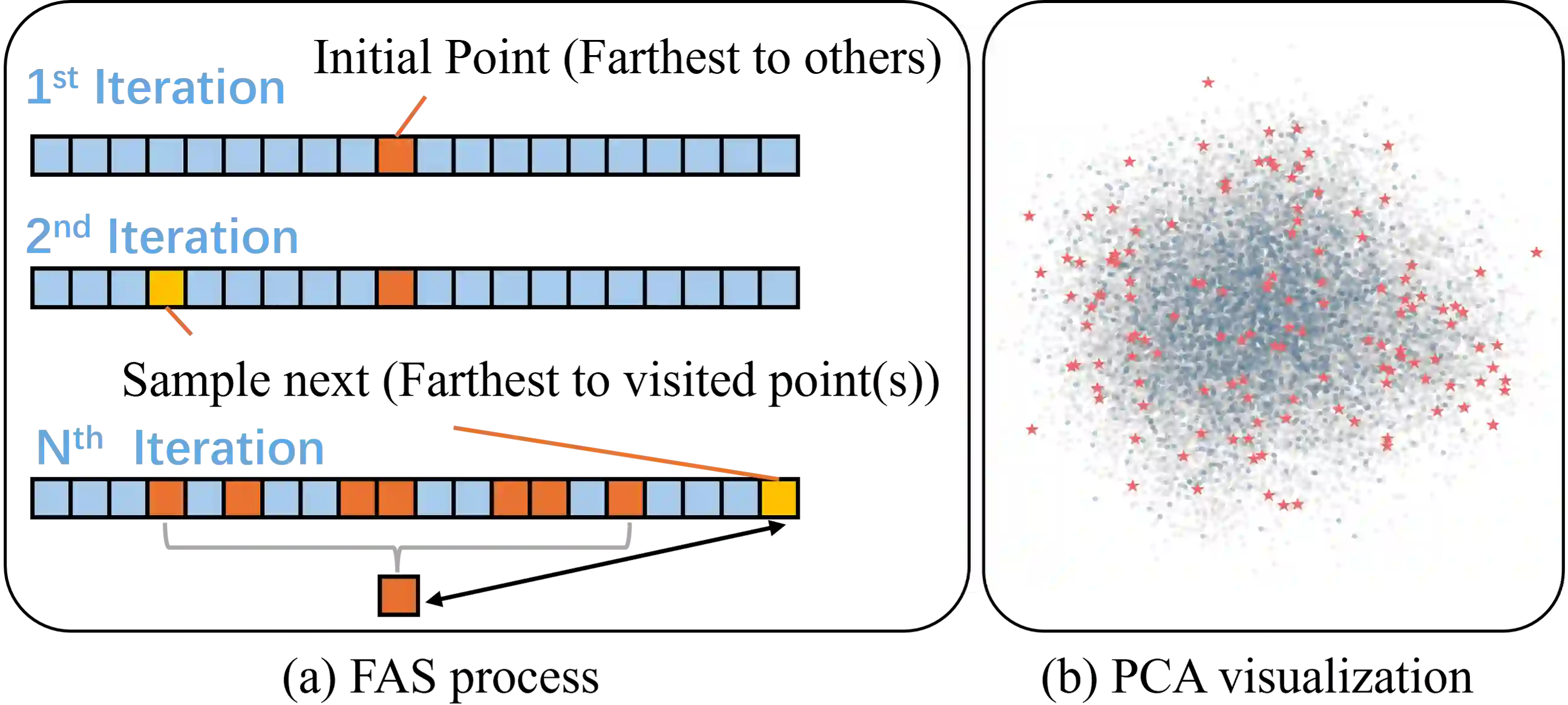
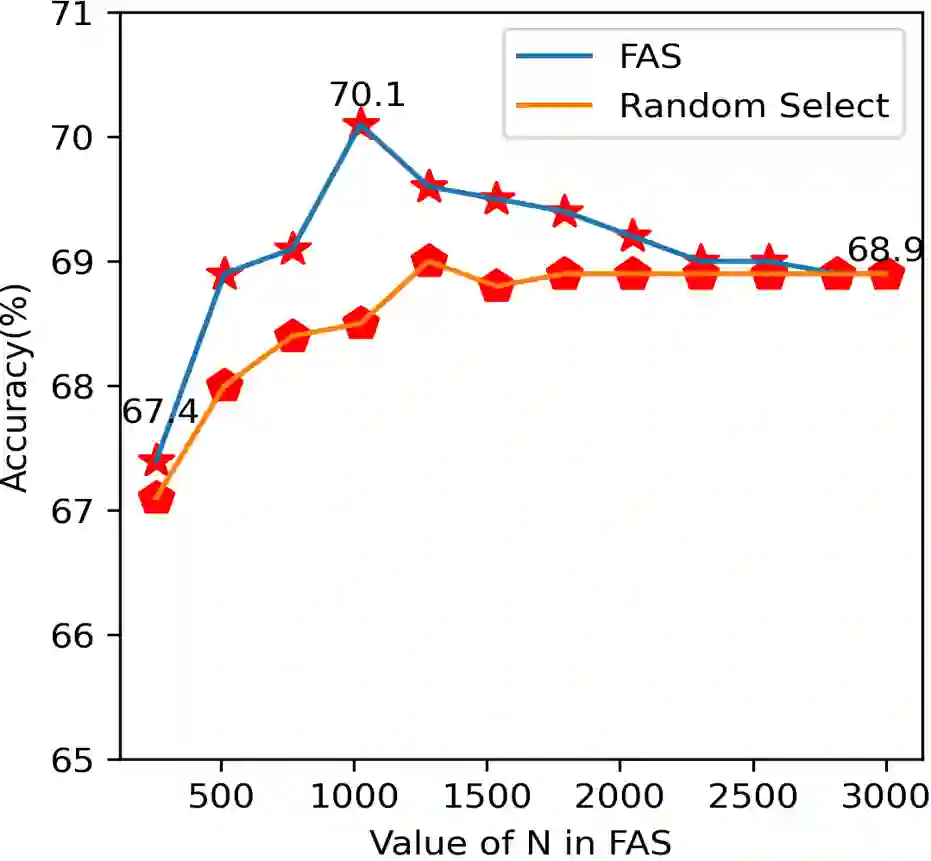
Gait recognition is to seek correct matches for query individuals by their unique walking patterns. However, current methods focus solely on extracting individual-specific features, overlooking inter-personal relationships. In this paper, we propose a novel $\textbf{Relation Descriptor}$ that captures not only individual features but also relations between test gaits and pre-selected anchored gaits. Specifically, we reinterpret classifier weights as anchored gaits and compute similarity scores between test features and these anchors, which re-expresses individual gait features into a similarity relation distribution. In essence, the relation descriptor offers a holistic perspective that leverages the collective knowledge stored within the classifier's weights, emphasizing meaningful patterns and enhancing robustness. Despite its potential, relation descriptor poses dimensionality challenges since its dimension depends on the training set's identity count. To address this, we propose the Farthest Anchored-gait Selection to identify the most discriminative anchored gaits and an Orthogonal Regularization to increase diversity within anchored gaits. Compared to individual-specific features extracted from the backbone, our relation descriptor can boost the performances nearly without any extra costs. We evaluate the effectiveness of our method on the popular GREW, Gait3D, CASIA-B, and OU-MVLP, showing that our method consistently outperforms the baselines and achieves state-of-the-art performances.
翻译:步态识别旨在通过个体独特的行走模式为查询行人寻找正确的匹配。然而,现有方法仅关注提取个体特异性特征,忽略了人际间关系。本文提出一种新颖的$\textbf{关系描述子}$,其不仅捕获个体特征,还捕获测试步态与预选锚定步态之间的关系。具体而言,我们将分类器权重重新解释为锚定步态,并计算测试特征与这些锚定步态之间的相似度得分,从而将个体步态特征重表达为相似度关系分布。本质上,关系描述子提供了一种全局视角,能够利用分类器权重中存储的集体知识,突出有意义模式并增强鲁棒性。尽管潜力巨大,但关系描述子存在维度挑战——其维度取决于训练集的身份数量。为解决此问题,我们提出最远锚定步态选择法以识别最具判别力的锚定步态,并采用正交正则化增加锚定步态间的多样性。与从主干网络提取的个体特异性特征相比,我们的关系描述子几乎无需额外成本即可提升性能。我们在流行的GREW、Gait3D、CASIA-B和OU-MVLP数据集上评估了方法的有效性,结果表明我们的方法始终优于基线方法,并达到了最先进的性能水平。




相关内容



 微信扫码咨询专知VIP会员