

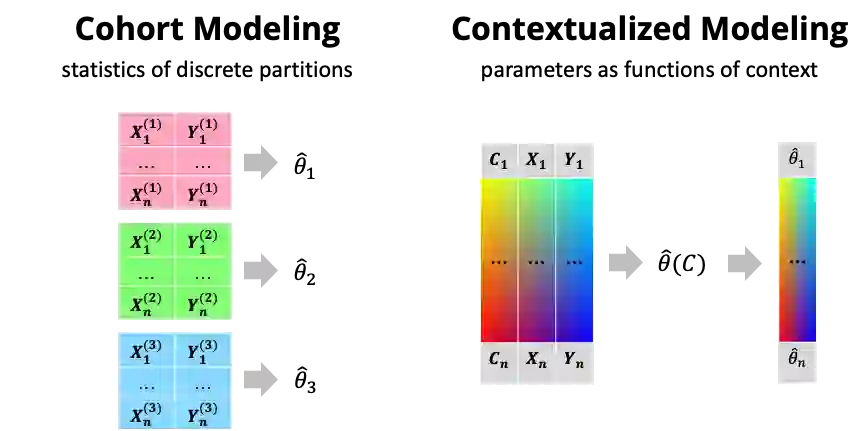
We examine Contextualized Machine Learning (ML), a paradigm for learning heterogeneous and context-dependent effects. Contextualized ML estimates heterogeneous functions by applying deep learning to the meta-relationship between contextual information and context-specific parametric models. This is a form of varying-coefficient modeling that unifies existing frameworks including cluster analysis and cohort modeling by introducing two reusable concepts: a context encoder which translates sample context into model parameters, and sample-specific model which operates on sample predictors. We review the process of developing contextualized models, nonparametric inference from contextualized models, and identifiability conditions of contextualized models. Finally, we present the open-source PyTorch package ContextualizedML.
翻译:我们探讨了情境化机器学习(Contextualized Machine Learning, CML)这一范式,其旨在学习异质性与情境依赖效应。情境化机器学习通过将深度学习应用于情境信息与情境特定参数模型之间的元关系,从而估计异质性函数。这是一种变系数建模形式,通过引入两个可复用概念(将样本情境转化为模型参数的情境编码器,以及作用于样本预测变量的样本特定模型)来统一现有框架,包括聚类分析和群组建模。我们回顾了情境化模型的开发过程、基于情境化模型的非参数推断,以及情境化模型的可辨识性条件。最后,我们介绍了开源的PyTorch工具包ContextualizedML。






相关内容





 微信扫码咨询专知VIP会员