

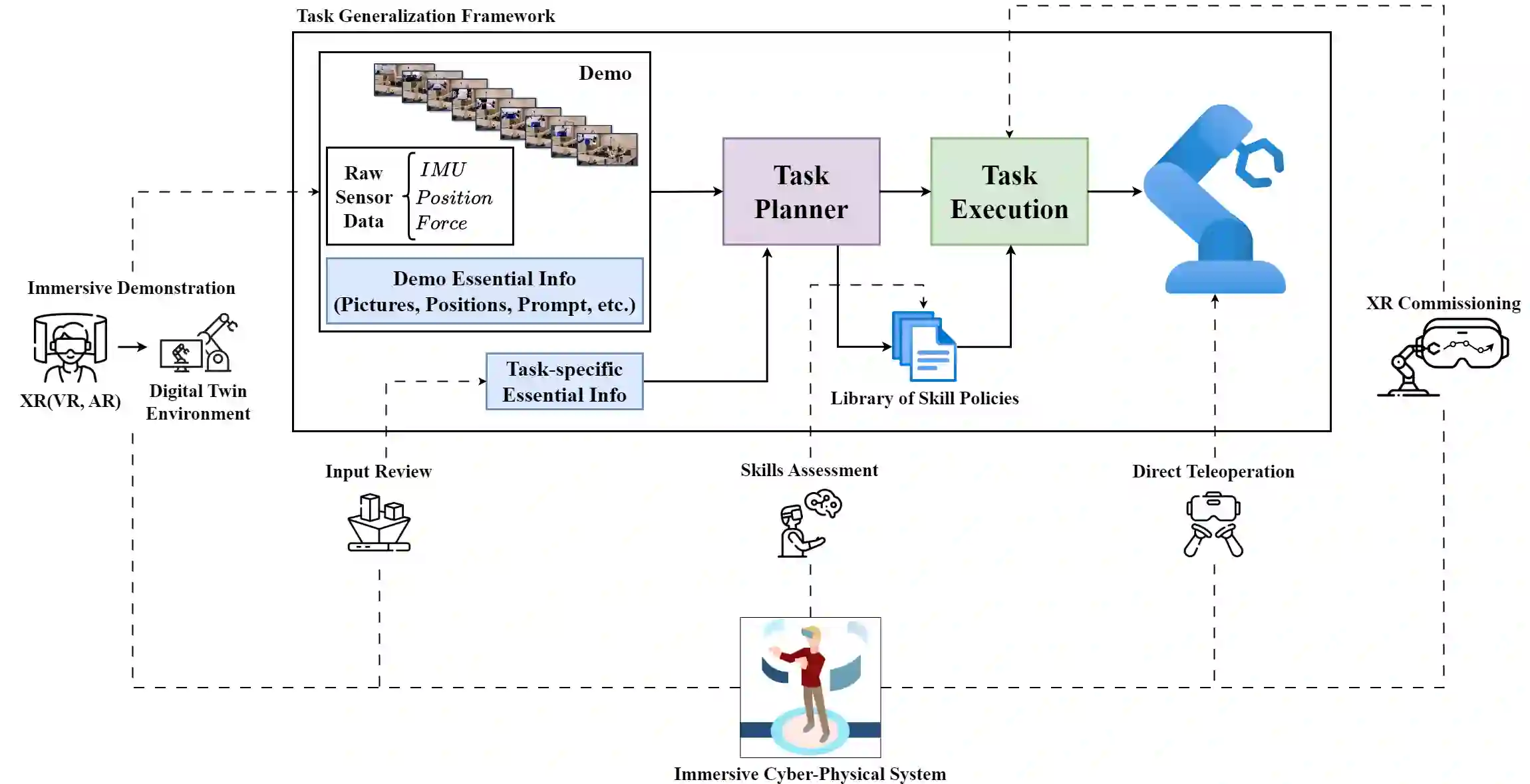
The rise of automation has provided an opportunity to achieve higher efficiency in manufacturing processes, yet it often compromises the flexibility required to promptly respond to evolving market needs and meet the demand for customization. Human-robot collaboration attempts to tackle these challenges by combining the strength and precision of machines with human ingenuity and perceptual understanding. In this paper, we conceptualize and propose an implementation framework for an autonomous, machine learning-based manipulator that incorporates human-in-the-loop principles and leverages Extended Reality (XR) to facilitate intuitive communication and programming between humans and robots. Furthermore, the conceptual framework foresees human involvement directly in the robot learning process, resulting in higher adaptability and task generalization. The paper highlights key technologies enabling the proposed framework, emphasizing the importance of developing the digital ecosystem as a whole. Additionally, we review the existent implementation approaches of XR in human-robot collaboration, showcasing diverse perspectives and methodologies. The challenges and future outlooks are discussed, delving into the major obstacles and potential research avenues of XR for more natural human-robot interaction and integration in the industrial landscape.
翻译:自动化的兴起为实现制造过程更高效率提供了契机,却往往削弱了灵活应对市场变化与满足定制化需求的敏捷性。人机协作试图通过融合机器的力量与精度、人类的智慧与感知理解来应对这些挑战。本文概念化并提出了一种基于机器学习、融合人在回路原则并利用扩展现实(XR)促进人机直观通信与编程的自主机械臂实现框架。此外,该概念框架预见了人类直接参与机器人学习过程,从而提升适应性与任务泛化能力。本文重点阐述了支撑所提框架的关键技术,强调了从整体层面发展数字生态系统的重要性。同时,我们回顾了扩展现实在人机协作中的现有实现方法,展示了多元化视角与实施路径。最后,探讨了当前面临的挑战与未来展望,深入分析了扩展现实在工业场景中实现更自然人机交互与集成的关键障碍及潜在研究方向。




相关内容





 微信扫码咨询专知VIP会员