

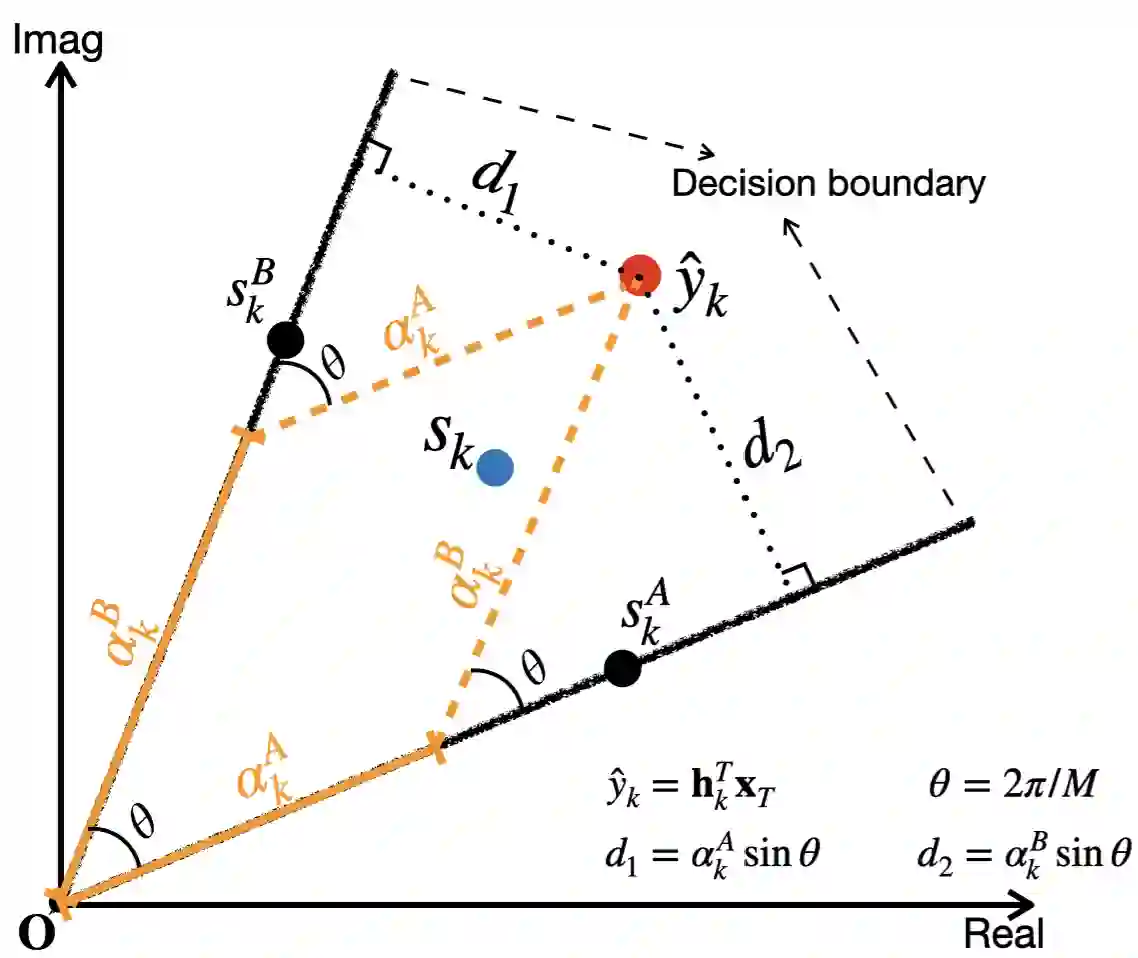
In this paper, we consider the one-bit precoding problem for the multiuser downlink massive multiple-input multiple-output (MIMO) system with phase shift keying (PSK) modulation. We focus on the celebrated constructive interference (CI)-based problem formulation. We first establish the NP-hardness of the problem (even in the single-user case), which reveals the intrinsic difficulty of globally solving the problem. Then, we propose a novel negative $\ell_1$ penalty model for the considered problem, which penalizes the one-bit constraint into the objective by a negative $\ell_1$-norm term, and show the equivalence between (global and local) solutions of the original problem and the penalty problem when the penalty parameter is sufficiently large. We further transform the penalty model into an equivalent min-max problem and propose an efficient alternating proximal/projection gradient descent ascent (APGDA) algorithm for solving it, which performs a proximal gradient decent over one block of variables and a projection gradient ascent over the other block of variables alternately. The APGDA algorithm enjoys a low per-iteration complexity and is guaranteed to converge to a stationary point of the min-max problem and a local minimizer of the penalty problem. To further reduce the computational cost, we also propose a low-complexity implementation of the APGDA algorithm, where the values of the variables will be fixed in later iterations once they satisfy the one-bit constraint. Numerical results show that, compared to the state-of-the-art CI-based algorithms, both of the proposed algorithms generally achieve better bit-error-rate (BER) performance with lower computational cost.
翻译:本文研究采用相移键控(PSK)调制的多用户下行大规模多输入多输出(MIMO)系统中的单比特预编码问题,重点关注基于经典构造性干扰(CI)的优化模型。我们首先证明该问题(甚至单用户情形)是NP难的,揭示了全局求解该问题的固有难度。随后提出一种新颖的负$\ell_1$惩罚模型,通过负$\ell_1$范数项将单比特约束惩罚至目标函数中,并证明当惩罚参数足够大时,原问题与惩罚问题的(全局与局部)解具有等价性。进一步将惩罚模型转化为等价的最小-最大问题,并设计高效的交替近端/投影梯度下降上升(APGDA)算法:该算法对变量块交替执行近端梯度下降与投影梯度上升操作,具有低单次迭代复杂度,且能收敛至最小-最大问题的稳定点及惩罚问题的局部极小点。为降低计算开销,我们进一步提出APGDA的低复杂度实现方案——后续迭代中一旦变量满足单比特约束即固定其取值。数值结果表明,与当前最先进的基于CI的算法相比,所提两种算法通常能以更低计算代价获得更优的误比特率(BER)性能。




相关内容



 微信扫码咨询专知VIP会员