

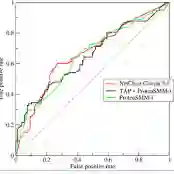
In this work we introduce the lag irreversibility function as a method to assess time-irreversibility in discrete time series. It quantifies the degree of time-asymmetry for the joint probability function of the state variable under study and the state variable lagged in time. We test its performance in a time-irreversible Markov chain model for which theoretical results are known. Moreover, we use our approach to analyze electrocardiographic recordings of four groups of subjects: healthy young individuals, healthy elderly individuals, and persons with two different disease conditions, namely, congestive heart failure and atrial fibrillation. We find that by studying jointly the variability of the amplitudes of the different waves in the electrocardiographic signals, one can obtain an efficient method to discriminate between the groups already mentioned. Finally, we test the accuracy of our method using the ROC analysis.
翻译:本文引入滞后不可逆性函数作为评估离散时间序列时间不可逆性的方法。该函数通过量化所研究状态变量及其时间滞后状态变量联合概率分布的时间不对称程度来表征不可逆性。我们在已知理论结果的时间不可逆马尔可夫链模型上测试了其性能。此外,我们应用该方法分析了四组受试者的心电图记录:健康年轻个体、健康老年个体以及两种不同疾病患者(即充血性心力衰竭和房颤患者)。研究发现,通过联合分析心电信号中不同波幅度的变异性,可以获得一种高效区分上述四组人群的方法。最后,我们采用ROC分析验证了该方法的准确性。




相关内容



 微信扫码咨询专知VIP会员