

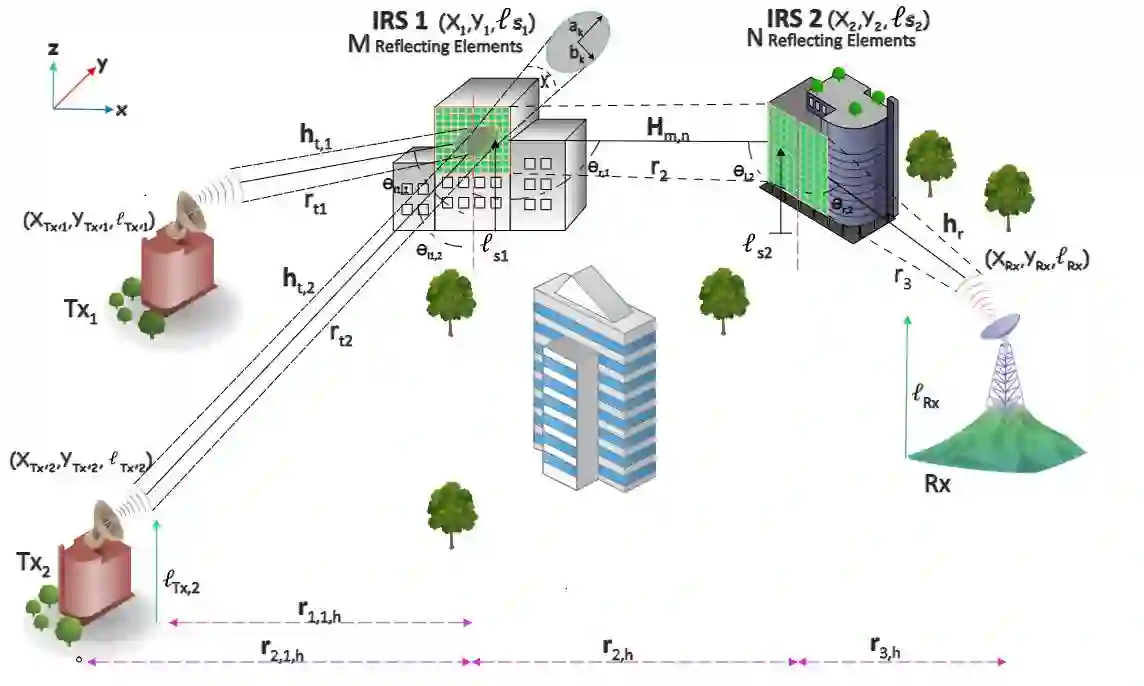
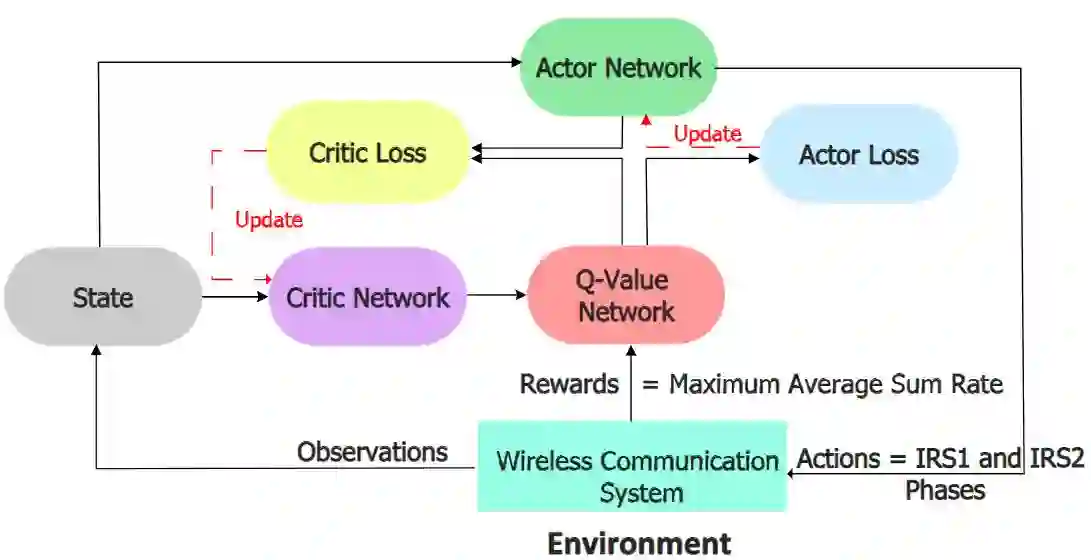
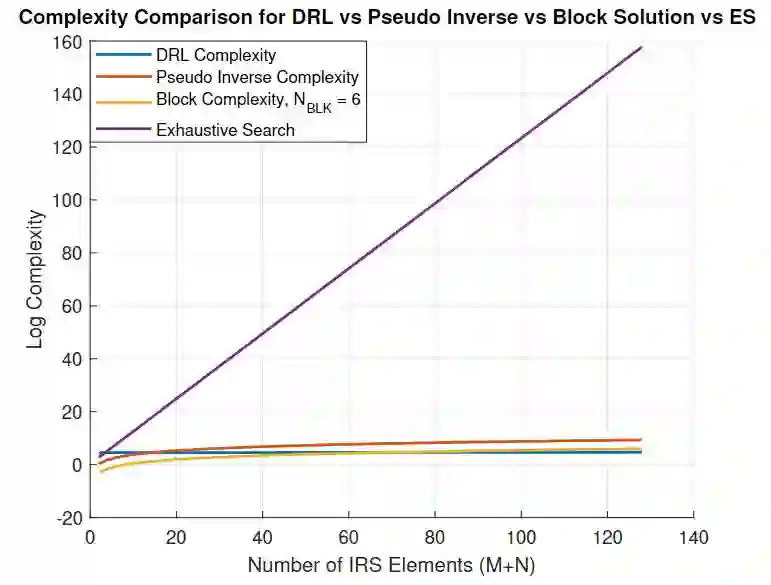
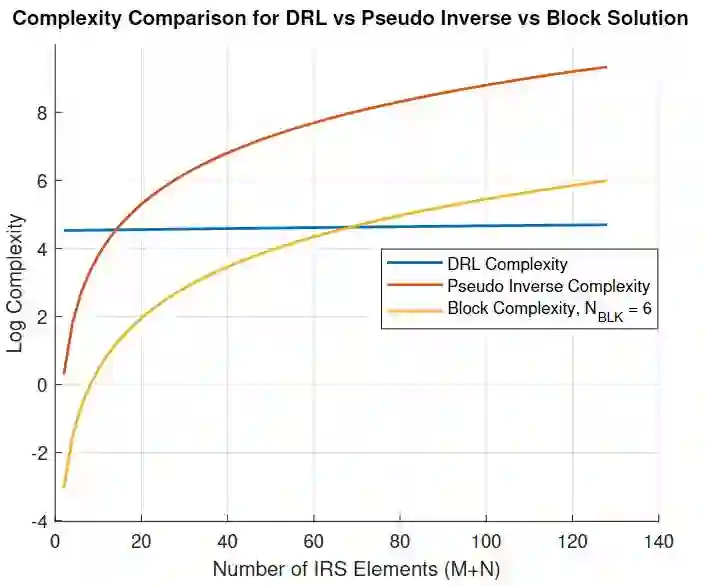
We investigate THz communication uplink multiple access using cascaded intelligent reflecting surfaces (IRSs) assuming correlated channels. Two independent objectives to be achieved via adjusting the phases of the cascaded IRSs: 1) maximizing the received rate of a desired user under interference from the second user and 2) maximizing the sum rate of both users. The resulting optimization problems are non-convex. For the first objective, we devise a sub-optimal analytical solution by maximizing the received power of the desired user, however, this results in an over determined system. Approximate solutions using pseudo-inverse and block-based approaches are attempted. For the second objective, a loose upperbound is derived and an exhaustive search solution is utilized. We then use deep reinforcement learning (DRL) to solve both objectives. Results reveal the suitability of DRL for such complex configurations. For the first objective, the DRL-based solution is superior to the sub-optimal mathematical methods, while for the second objective, it produces sum rates almost close to the exhaustive search. Further, the results reveal that as the correlation-coefficient increases, the sum rate of DRL increases, since it benefits from the presence of correlation in the channel to improve statistical learning.
翻译:我们研究了在相关信道假设下,利用级联智能反射面实现太赫兹通信上行链路多址接入。通过调整级联智能反射面的相位,需实现两个独立目标:1) 在存在第二用户干扰的情况下,最大化目标用户的接收速率;2) 最大化两用户的总和速率。由此产生的优化问题具有非凸性。针对第一个目标,我们通过最大化目标用户接收功率设计了一种次优解析解,但该方法会导致系统过定。我们尝试了基于伪逆和分块方法的近似解。针对第二个目标,推导出一个松散上界,并利用穷举搜索法求解。随后,我们采用深度强化学习同时解决这两个目标。结果表明,深度强化学习适用于此类复杂配置。对于第一个目标,基于深度强化学习的解优于次优数学方法;对于第二个目标,其产生的总和速率几乎接近穷举搜索解。此外,结果揭示:随着相关系数增大,深度强化学习的总和速率增加,因为它利用信道中的相关性来改进统计学习。




相关内容




 微信扫码咨询专知VIP会员